
Indonesia's economic fundamentals strong despite global dynamics: Airlangga
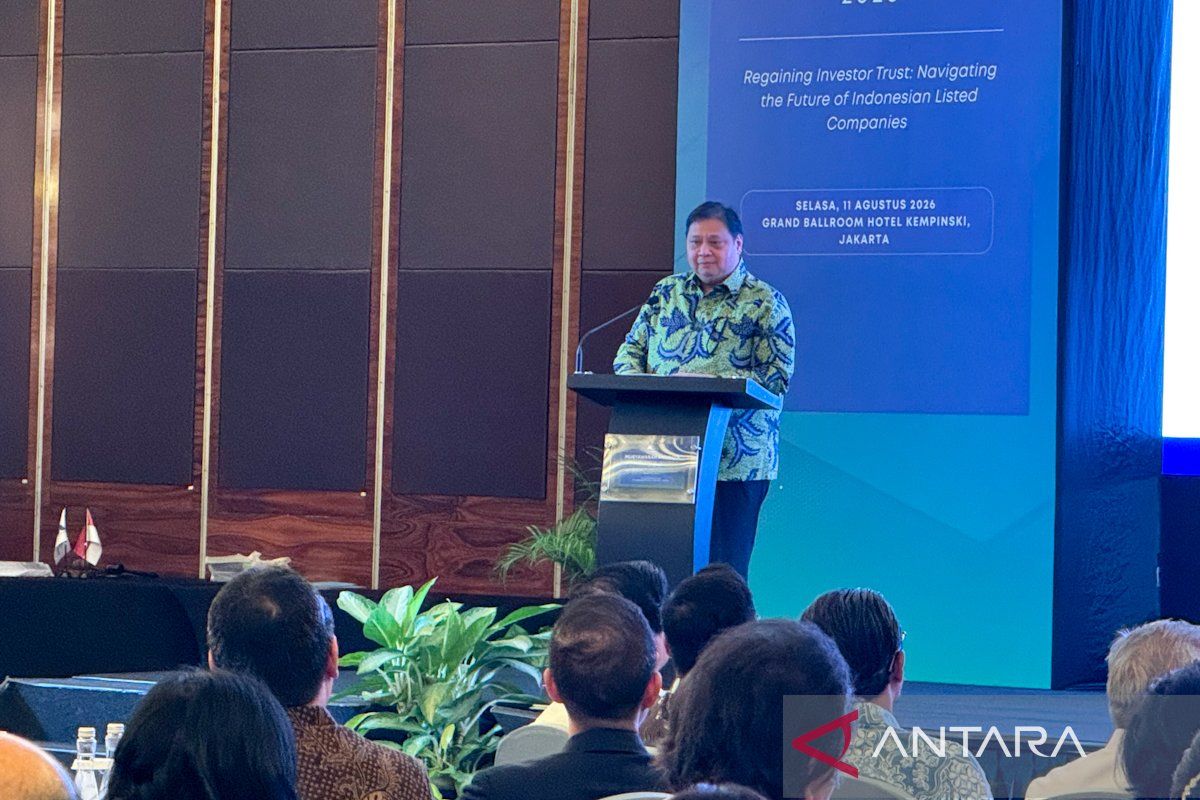
Coordinating Minister for Economic Affairs Airlangga Hartarto emphasised that Indonesia’s economic fundamentals remain strong, supported by fiscal discipline, investment-grade ratings, and investor confidence amid global uncertainty. Airlangga said Indonesia still maintains its investment-grade status from international rating agencies such as S&P, Fitch, and Moody’s, reflecting confidence in the stability of the national economy. “If we look at it, one thing that is always discussed is that Indonesia’s sovereign rating remains at investment grade,” Airlangga said at the 2026 Indonesian Issuers Association (AEI) Members’ Meeting themed “Regaining Investor Trust: Navigating the Future of Indonesian Listed Companies” in Jakarta on Tuesday. He added that Indonesia’s Panda Bond also received a Triple A rating, demonstrating that the credibility of government financial instruments remains recognised and attractive to international investors. “We see from S&P, then Fitch, Moody’s, and also the rating for Indonesia’s Panda Bond is Triple A,” he said. According to Airlangga, market players need not worry about one or two assessments, as the most important thing is that companies are able to maintain their business prospects, transparency, and good governance. He stressed that Indonesia is still viewed as a country with a stable economy, not a frontier market, so the government will continue to maintain various macroeconomic indicators to keep them on track. “So that is what we must maintain,” he said. Airlangga said one of Indonesia’s strengths is fiscal discipline through managing the budget deficit below 3 percent, a feat only a few countries in the world can maintain. He compared this condition with several developed countries that have much higher debt-to-gross domestic product (GDP) ratios, including Japan, the United States, and Singapore. “Countries like Japan have debt to GDP above 100 percent. The United States is the same, Singapore is the same. So what makes us worry? These are all figures we target ourselves and we are still relatively safe at these numbers. So let’s not worry excessively,” he stressed. In addition, Airlangga noted that Indonesia remains the country with the largest number of investors in ASEAN and has the second-largest number of listed companies, strengthening the competitiveness of the national capital market. According to him, the basic materials, transportation and logistics, and financial services sectors recorded high profit growth. “If we look at the profit growth of the sectors relied upon in Indonesia, basic materials had profit growth of 258.9 percent, transportation and logistics 103.4 percent, and financial 39.8 percent,” he said. Meanwhile, the listing of seven new issuers in July 2026 is expected to accelerate initial public offering (IPO) activity in the second half of the year. “Although we were a bit lagging in the first semester, hopefully the second semester can catch up with IPOs worth IDR 2.16 trillion,” he said. Airlangga stressed that the government will continue to encourage companies to maintain performance, strengthen governance, increase transparency, and utilise the capital market as a reflection of the strength of the national economy.