
Indonesia’s Digital Economy Grows 14 Per Cent as Communications Ministry Strengthens Innovation Ecosystem
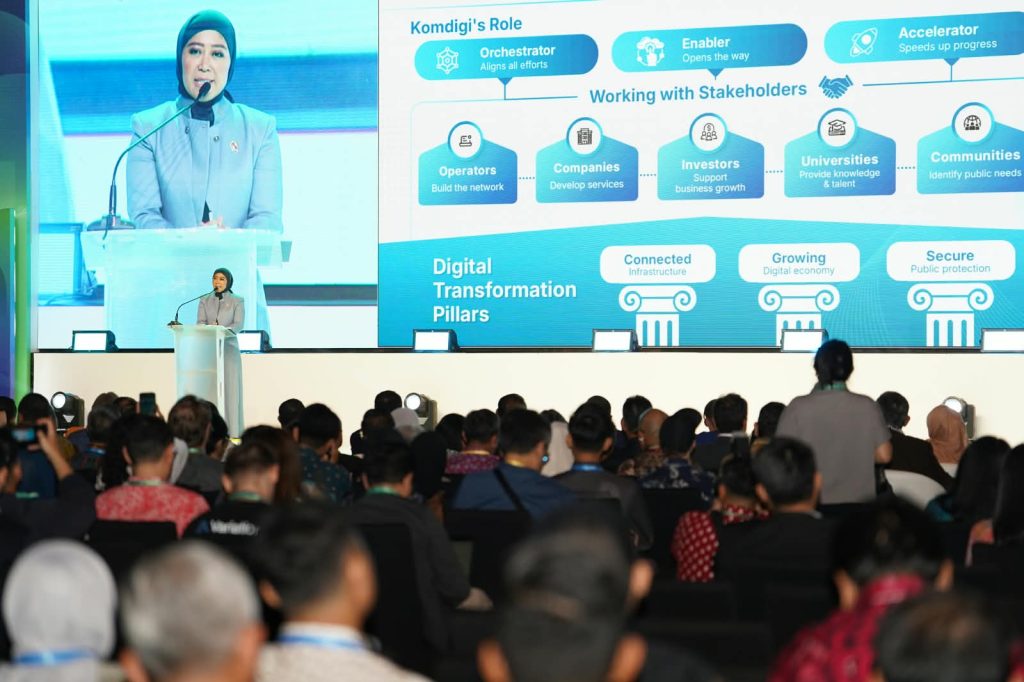
Sanur — Indonesia’s digital economy is forecast to reach US$99 billion in 2025, growing 14 per cent from the previous year. This makes Indonesia the largest digital-economy market in South-east Asia and creates opportunities to develop innovation, attract technology investment and raise national productivity.
Minister of Communication and Digital Affairs Meutya Viada Hafid said the growth reflected Indonesia’s considerable potential to develop a technology-based economy. However, rising digital transaction values must be accompanied by businesses’ ability to create added value, expand markets and improve efficiency.
“The e-Conomy SEA 2025 report estimates that Indonesia’s digital economy gross merchandise value (GMV) grew by 14 per cent from the previous year,” Meutya said when opening Bali Tech Week 2026 at the Bali Beach Convention Centre in Sanur, Denpasar, Bali, on Monday (19 October 2026).
She said digital-economy growth was increasingly evident in people’s everyday activities, including the use of the Quick Response Code Indonesian Standard (QRIS) for digital payments.
Nevertheless, wider adoption of technology must have a greater impact on business productivity, market development and the competitiveness of the national economy.
To strengthen the ecosystem, the Ministry of Communication and Digital Affairs (Kemkomdigi) is encouraging collaboration among digital talent, startups, industry players, investors and markets through various innovation-development programmes.
One initiative is the Garuda Spark ecosystem, which has run 178 programmes, reached more than 15,700 digital professionals, supported 80 startups and involved 80 partners from across the technology ecosystem.
The programme has also recorded more than Rp429.5 billion in direct investment, helping strengthen funding and the development of domestic technology companies.
Meutya said the innovation ecosystem needed continued support so that more Indonesian startups could develop products, secure funding and expand their market reach.
“These networks need to continue creating opportunities for Indonesian innovators to develop products and reach markets,” she said.
Indonesia’s games industry is one sector with growth potential. According to 2025 data from the Indonesian Game Association, 198 active game studios are part of the digital creative-industry ecosystem.
Meutya said developing the sector required talent, access to financing and industry partnerships so that more work by Indonesian developers could compete in wider markets.
Strengthening the games industry is also part of efforts to improve Indonesia’s ability to produce digital products and services, rather than merely serve as a market for technologies developed by other countries.
Digital social protection reaches 153 districts and cities
Alongside efforts to grow the technology industry, Kemkomdigi is expanding the use of digital infrastructure to improve the efficiency and quality of public services.
One such measure is the Digitalisation of Social Protection programme, whose trials have covered 153 districts and cities.
The programme is supported by the Government Service Connectivity System (SPLP), which facilitates data exchange between government systems to improve service integration and the accuracy of information management.
Meutya said that from 4 June to 11 September 2026, the SPLP processed about 17.7 million data-exchange transactions.
Data matching also recorded 4.12 million family cards successfully matched, as part of efforts to strengthen the integration of public-service data.
A 2025 study of the social-protection digitalisation trial in Banyuwangi district found that process costs could potentially be reduced by up to 90 per cent in the implementation examined.
The findings illustrate how technology can improve administrative efficiency in government when supported by data integration and adequate service governance.
For the government, developing the digital economy is not only about growth in transaction values and investment, but also about technology delivering tangible benefits to the public through more efficient and better-targeted services.
ASEAN cooperation offers opportunities for digital-economy growth
Meutya also stressed the importance of strengthening regional digital-economy cooperation to expand markets and improve Indonesia’s competitiveness.
She said the country’s digital-economy potential could be developed further through collaboration with ASEAN countries, including under the Digital Economy Framework Agreement (DEFA).
The agreement is seen as an opportunity to strengthen market integration, expand technology partnerships and deepen digital-economy ties among countries in the region.
Meutya said digital-economy growth required closer cooperation so that regional market potential could be matched by technological capability, innovation, investment and human resources.
Through Bali Tech Week 2026, Kemkomdigi is bringing together industry players, investors, innovators, academics and policymakers to help turn digital-economy opportunities into business partnerships and sustainable technology development.
The collaboration is expected to strengthen Indonesia’s position in the region’s digital economy while ensuring that technological growth contributes to business productivity and better-quality public services.
Source: jawawa.id (https://jawawa.id/newsitem/indonesias-digital-economy-grows-14-per-cent-as-communications-ministry-strengthens-innovation-ecosystem-1792407015)
Originally published by infopublik.id (https://infopublik.id/kategori/prioritas-nasional-2026/993645/ekonomi-digital-indonesia-tumbuh-14-persen-kemkomdigi-perkuat-ekosistem-inovasi), translated from Indonesian