
Indonesia's Defence Spending Plans Amid Economic Uncertainty
Geopolitical tensions in the Middle East continue to be fraught with uncertainty, where political and military developments can shift within 24 hours. Such conditions create high levels of uncertainty for industry players across various sectors, as well as for national fiscal policymakers.
Business leaders who set performance projections for their companies at the end of 2025 for 2026 have been forced to revise those estimates, much like the challenges faced by fiscal managers in recalculating government spending and revenue projections. At the grassroots level, communities have directly felt the impact of the war between Iran and the United States and Israel over the past few weeks.
Although no one can predict when the war between the two sides will end, one certainty is that the global economy will move towards a new state unlike the previous atmosphere.
Developments in Southwest Asia are also raising concerns in the Indo-Pacific region, particularly regarding the situation in the Taiwan Strait between Taiwan and China. The United States’ inability to provide a security umbrella to Gulf countries against Iranian attacks, combined with the commitment of some US military resources in Southwest Asia, raises questions about whether the US can offer a security umbrella to Taiwan and Japan if China invades Taiwan.
It also raises questions about whether the United States still has the capability to wage war simultaneously in two regions of the world. These questions arise because it is estimated that at least a third of the US’s surface-to-surface and surface-to-air missile reserves have been consumed in the war against Iran.
Meanwhile, the production capacity for missiles such as Tomahawk and Patriot does not match the rate of their consumption, notwithstanding that the US defence budget for 2026 reaches US$839.2 billion and may touch US$1.5 trillion next year.
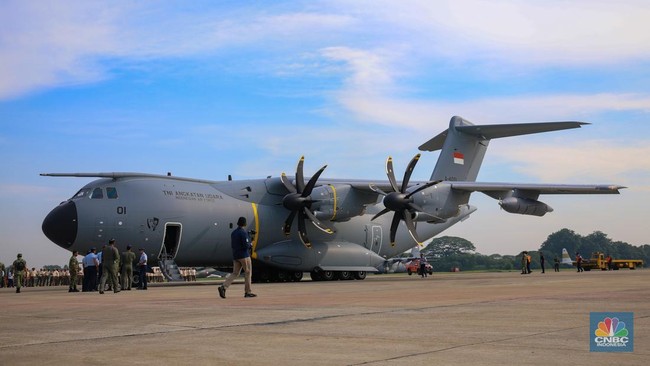
Global and regional security dynamics over the past few years have been one of the reasons why Indonesia is undertaking defence force modernisation with unprecedented intensity. At least until last year, Indonesia’s economy did not experience significant shocks to support defence modernisation, although there has been criticism regarding the effectiveness of using Foreign Loans (PLN) for such activities.
Additionally, there are critical views on the use of BA BUN for purchasing weapon systems such as fighter jets. However, entering 2026, Indonesia’s economy faces major challenges due to domestic and international developments, where the war between Iran and the United States and Israel has altered several fundamental government projections in fiscal and economic fields.
With the allocation of PLN for the Ministry of Defence set by the Ministry of National Development Planning/Bappenas at US$34.8 billion for the 2025-2029 period, the Ministry of Defence appears poised to begin significant war equipment spending this year.
Indeed, the amount of PLN to be spent this year does not reach US$34.8 billion, but the value to be spent seems larger than the PLN quota from 10 years ago. For illustration, during 2015-2019, the Ministry of Defence only received US$7.7 billion for weapon system acquisitions.
Regarding the Ministry of Defence’s plan to spend PLN significantly this year, there are several notes to consider.
First, fiscal capacity, where the government’s fiscal capacity in FY 2026 and FY 2027 needs to be taken into account because the geopolitical situation in Southwest Asia will have impacts until 2027.
The recovery of the global economic situation to return to pre-28 February 2026 conditions will take years, thus affecting Indonesia’s economic performance, including tax revenues and non-tax state revenues that will fund various APBN spending activities while controlling the deficit below three percent of GDP.
Will the fiscal capacity of the 2026 APBN and 2027 APBN be able to finance significant defence spending in 2026? It is important to remember that using the PLN scheme does not mean the government expends no pure Rupiah funds from the APBN.
Second, adherence to bureaucratic processes. Among the criticisms of the Ministry of Defence in the defence equipment spending programme is that contracts are sometimes awarded to suppliers when the budget to support those activities is not yet available. Regarding the plan for significant spending this year using the PLN scheme, has such a plan complied with government bureaucratic processes?
For instance, the signing of new contracts should occur after the Minister of Finance issues the Financing Source Determination expenditure, not merely based on the List of Priority Foreign Loan Plans and the Special Activity List issued by the Ministry of National Development Planning/Bappenas.
Third, scale of priorities. Is the plan for significant weapon system spending this year based on priority considerations or merely subjective decisions by decision-makers?
If based on priority considerations, it seems the Ministry of Defence does not need to carry out such significant spending. Assuming Indonesia intends to acquire Rafale, KF-21, frigates, and submarines as priority programmes, then the value