
Indonesia's Data Centre Business is Expanding, But Who Controls the Data?
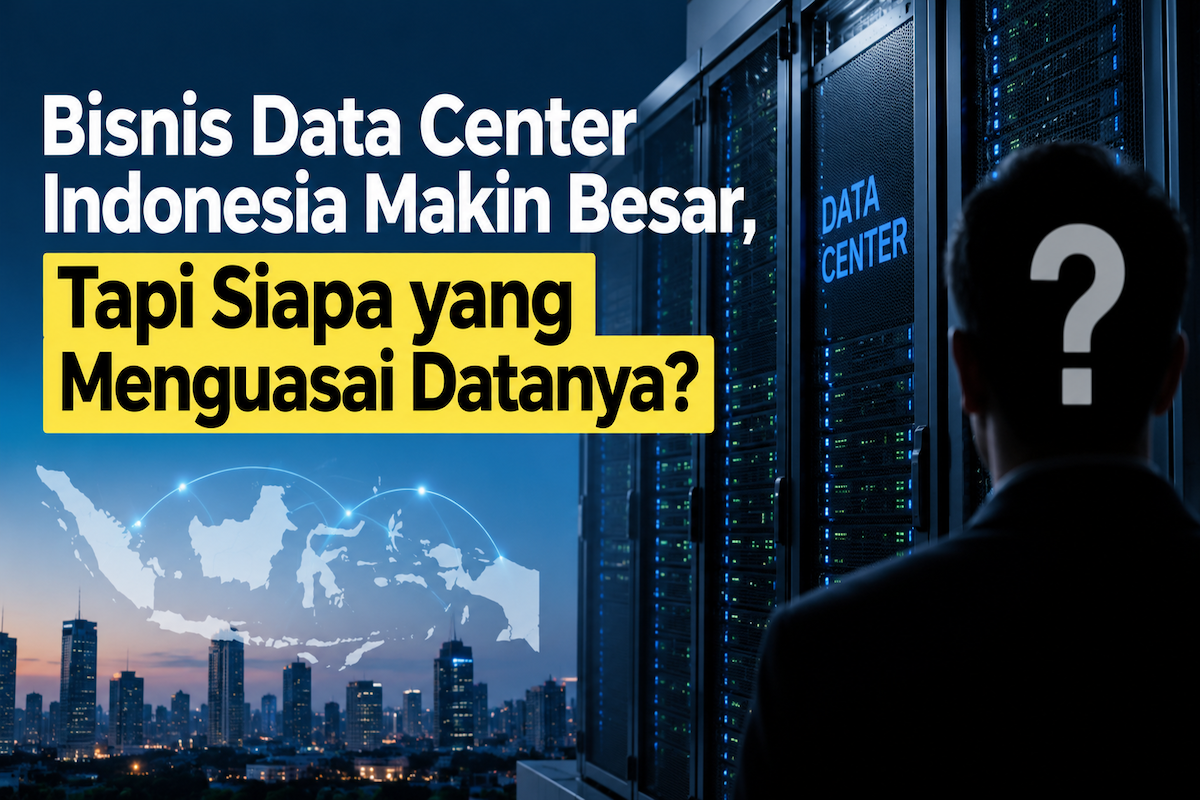
Indonesia is entering a new race: building data centre capacity on a gigawatt scale. Investment continues to flow, computing needs are surging, and AI requires massive amounts of GPUs and electricity, while the government aims for Indonesia to become a key digital hub in the region. However, behind the construction of these server-filled buildings, a much more strategic question arises: as more data is stored and processed in Indonesia, who actually controls that data?
This question is vital because data centres are more than just buildings filled with servers. They are hubs where various digital activities occur: public data is stored, applications are run, transactions are processed, AI is trained and operated, cloud services function, and various business and government information is transferred and analysed. Consequently, the larger Indonesia’s data centre capacity becomes, the more strategic Indonesia’s position in the digital economy becomes.
Growth is indeed very rapid. As of June 2025, the Ministry of Communication and Digital Affairs (Komdigi) noted that national data centre capacity had reached approximately 290 MW, up from 180 MW at the start of the current administration. The government estimates that Indonesia’s capacity requirements could reach 1.5–2 GW within the next two years. By September 2026, the electricity demand served by PLN for the data centre industry had reached approximately 1,989.5 MVA, or nearly 2 GW, while the pipeline of capacity under construction and planning also approaches 2 GW. These figures indicate that Indonesia’s data centre industry is moving from a standard infrastructure business to becoming a foundation of the digital and AI economy.
AI is accelerating this growth. While a conventional data centre requires significant electricity, AI computing centres require much higher power and cooling systems to operate large numbers of GPUs. The government has welcomed the development of an ‘AI Factory’ in Indonesia, projected to reach a capacity of up to 1 GW within three years, featuring infrastructure that includes data centres, GPUs, networks, storage, GPU-as-a-Service, and end-to-end AI workload management. In other words, the future of Indonesia’s data centres is no longer just about storing data, but about processing data into computation, intelligence, and economic value.
This is where the real issue begins. The buildings may be in Indonesia, the servers may be in Indonesia, and the electricity may come from Indonesia, but is the data and the value generated also truly under Indonesian control? The answer is not automatically yes.
Data centres can be owned by Indonesian or foreign companies. Servers may be located in Cikarang, Batam, Jakarta, or other regions, but the software managing them may originate from abroad. Cloud platforms can be controlled by global corporations. GPUs and computing technologies may depend on foreign supply chains. Even data physically located in Indonesia can be processed using technologies, AI models, and platforms developed overseas.
Therefore, data residency is not the same as data sovereignty. Data residency refers to where data is stored. Data sovereignty goes further: who has the authority, who controls the processing, which laws apply, who can access it, and how the state ensures that data is protected.
This distinction becomes increasingly important as Indonesia opens up to global data centre investment. The presence of international technology companies brings capital, technology, cloud capacity, and jobs. Indonesia also needs such investment to meet rapidly growing compute requirements. However, investment should not be measured solely by how many megawatts of capacity are built.
The more strategic question is: how much capability is also growing within Indonesia? Is Indonesia gaining technology transfers? Are local talents involved in the operation and development of these systems? Are local companies entering the supply chain? Is there development of national software and intellectual property? Does Indonesia have the ability to audit such technology? And if geopolitical or business relations change one day, can strategic services still function without full dependence on a single provider?
These questions align with the government’s policy direction, which is beginning to place digital infrastructure, data, and technology within a framework of sovereignty. In the 2026–2030 Digital Infrastructure Roadmap, the government emphasises that digital development is no longer just about pursuing access, but must also prioritise security and digital sovereignty. Infrastructure is viewed as an architecture encompassing connectivity, data centres, cloud, edge computing, and computing capacity.
Even in the context of AI, the government explicitly states that sovereignty does not mean Indonesia must close itself off from global technology. What is required is the strengthening of local talent, research, computing capacity, and the domestic technology ecosystem so that Indonesia can develop AI for national needs.
This means that data centres are actually part of a larger struggle over who controls digital infrastructure. So far, discussions on digital sovereignty have often been limited to personal data. However, the issue is much broader. Imagine if public health data, financial transactions, industrial activities, government data, educational data, and various other strategic data are increasingly processed using digital infrastructure. The value lies not just in the raw data, but in the ability to combine, analyse, and transform data into decisions and economically valuable products.
In the era of AI, the greatest value may not even lie in the data alone, but in the compute…