
Indonesia’s Data Centre Boom: What Should the Government Do?
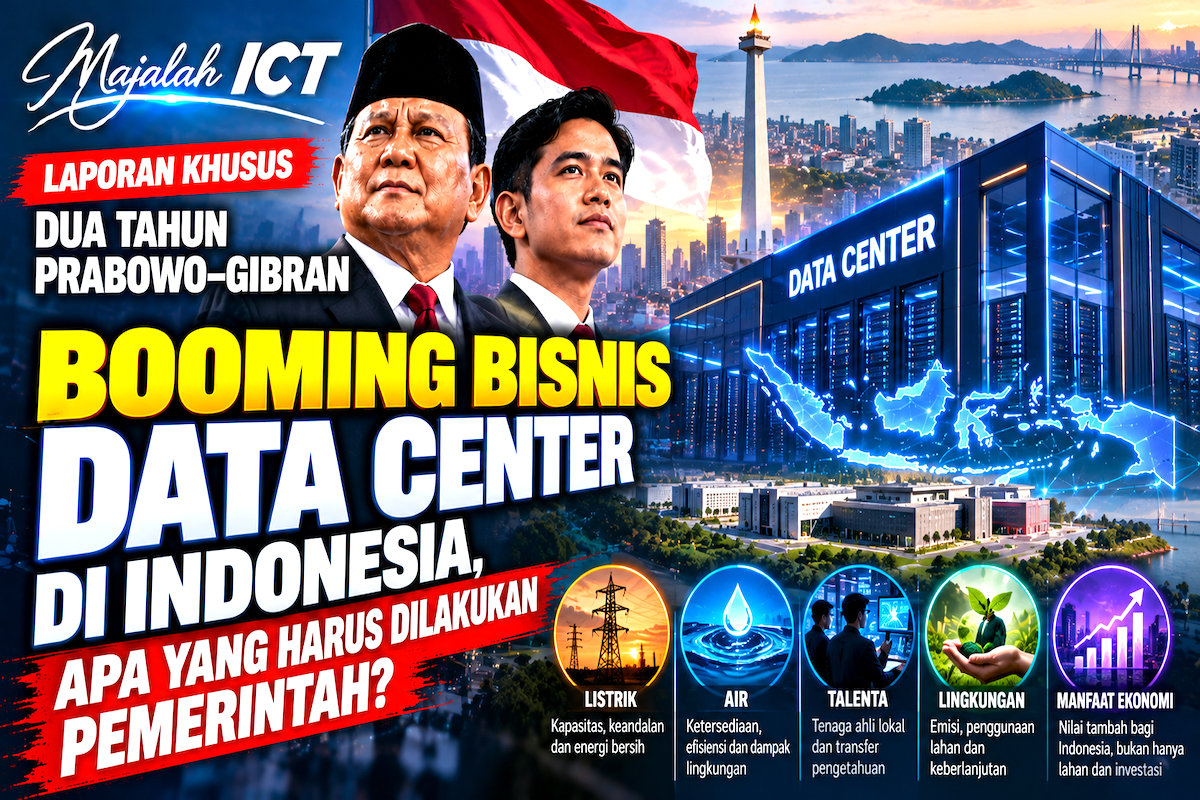
Indonesia is becoming increasingly aggressive in attracting data-centre investment to support its digital economy and artificial intelligence ambitions. But alongside the large investment figures and capacity announcements, an equally important question remains: how much benefit will this bring to the national economy, and who will bear the consequences of its use of electricity, water, land and environmental resources?
Data centres are becoming one of Indonesia’s new magnets for digital investment. Growth in cloud computing, digital transactions, electronic government services and artificial intelligence (AI) is driving demand for infrastructure capable of storing, processing and transmitting data on a large scale.
The government sees the sector as a strategic opportunity. Indonesia has a large digital market, an important geographical position in South-east Asia and growing infrastructure needs. Data-centre development could strengthen the national digital ecosystem while attracting high-value technology investment.
However, the issue requires closer scrutiny. In much of the coverage of investment, public attention focuses on project value, land area, investor names, capacity in megawatts and construction targets. These are all important, but they are not enough to establish whether the investment will genuinely benefit Indonesia in the long term.
A data centre is not simply a building filled with server racks. It requires large amounts of electricity, reliable cooling systems, water supplies or suitable cooling alternatives, telecommunications connectivity, skilled professionals, cyber security and environmental impact management.
Therefore, when evaluating the two years of the Prabowo–Gibran administration, the question is not just how much data-centre investment has been secured. It is whether Indonesia has prepared an ecosystem in which that investment can grow without compromising public needs or allowing most of its economic value to flow overseas.
Investment is growing and capacity is expanding
The scale of the opportunity is evident in the development of the data-centre industry. In August 2025, the Ministry of Communications and Digital Affairs’ Directorate General of Digital Infrastructure said Indonesia had around 185 data centres with a capacity of 274 MW, and set a target of more than 2,000 MW by 2029. These figures reflect an estimate and target announced in 2025, not a current measurement of the country’s operational capacity.
Batam is one of the locations attracting particular attention. Its proximity to Singapore, availability of industrial estates and place in the regional connectivity network make it attractive to data-centre developers.
In September 2026, BP Batam said the existing, committed and pipeline data-centre capacity in Batam totalled 1.47 GW of IT capacity. This figure needs to be interpreted carefully: existing capacity, projects backed by commitments and pipeline projects do not all mean that facilities have been completed or are operational.
One project illustrating the sector’s energy requirements is an agreement between PLN Batam and DayOne in April 2026 for an electricity supply of 511 MVA, or around 450 MW, for phased data-centre development.
These large figures reveal two sides of the opportunity. Investment could strengthen Indonesia’s position in the regional digital industry value chain. At the same time, energy needs and supporting infrastructure must be planned from the outset, rather than addressed only after facilities begin operating.
Large investment does not automatically translate into large economic benefits. Announced capacity must be distinguished from capacity actually in operation, while investment commitments must be distinguished from realised capital expenditure and domestic value added.
Electricity: data centres must not outgrow the energy system
Electricity is the most fundamental requirement for data centres. Servers must run continuously, while cooling systems, networks, security and supporting facilities also need a reliable power supply. Outages can affect digital services used by businesses, financial institutions and the public.
The issue is not only whether electricity is available now, but whether generation capacity, transmission and distribution networks, and system reserves will be sufficient to meet demand in the coming years.
In September 2026, BP Batam estimated that data-centre electricity demand would become a major challenge for Batam’s power system. Its projections indicated that the sector’s demand could exceed half of Batam’s peak electricity load by 2029. BP Batam also cited a forecast increase in overall peak demand from 841 MW in 2026 to 2,540 MW in 2035.
These projections show the need for integrated energy planning. The government and power providers must factor in digital industry demand alongside growth in households, public facilities, manufacturing, transport and other economic sectors.
There is also the question of the source of electricity. If data-centre growth is met mainly by fossil-fuel power stations, emissions could rise. This could conflict with the sustainability commitments of global companies and Indonesia’s energy transition targets.
Data-centre development should therefore be accompanied by a clear energy supply roadmap, including a more reliable grid, energy efficiency, verifiable use of renewable energy, and measures to ensure industrial demand does not undermine the reliability and affordability of electricity for the public.
The government must also distinguish between electricity capacity already available, capacity under contract and capacity that remains only a plan. These have different levels of certainty.
The principle is simple: do not merely count how many megawatts investors are requesting. Establish who will supply the electricity, when the network will be ready, how much it will cost and how it will affect the energy system as a whole.
Water: digital investment must not take precedence over residents’ needs
Water is often less prominent in the promotion of data-centre investment. Yet water may be required for direct cooling, supporting facilities and indirectly through the generation of electricity.
The amount consumed depends greatly on facility design, cooling technology, climate, server utilisation and energy sources. It is therefore wrong to assume that all data centres use the same amount of water. Nevertheless, water needs must be calculated at the planning stage.
Batam is an important example. In September 2026, BP Batam promoted the development of Sea Water Reverse Osmosis (SWRO), or seawater desalination, to supply data-centre industry needs without affecting reservoir water supplies for residents.
This approach deserves attention because it recognises that utility readiness cannot be judged solely by the availability of land and electricity. Raw water availability, treatment capacity, distribution networks and supply resilience during dry seasons are also crucial to a project’s viability.
However, SWRO is not a consequence-free solution. It requires energy and investment, and the management of concentrated brine from desalination must be addressed to prevent damage to the marine environment. Water quality, operating costs and distribution infrastructure must also be considered.
The government should therefore require large projects to have measurable water plans, including disclosure of projected consumption and supply sources, efficiency strategies, water reuse where possible, and plans for dealing with drought.
Most importantly, industrial needs must not be quietly passed on to the public through reduced clean-water supplies, higher service costs or increased pressure on local water resources.
The success of data-centre investment should be judged not only by its ability to meet investors’ needs, but also by whether it protects residents’ right to safe and affordable water.
Talent: will Indonesia provide only the buildings and hire expertise from abroad?
Data centres are physical infrastructure, but their economic value is increasingly determined by human expertise. Modern facilities need professionals in networking, computing systems, cyber security, facilities management, cooling, electrical systems, automation and cloud services.
This is where the benefits of investment need closer examination.
Data-centre construction can create jobs in building, installation and operations. But the number of construction workers is not the same as the number of professionals needed once a facility is running. Highly automated data centres can involve large investments while requiring relatively few direct employees compared with labour-intensive industries.
For example, BP Batam said an AI data-centre project backed by Range Intelligent Computing Technology Company Limited was expected to employ around 700–800 professionals in data centres and digital technology through recruitment collaboration and talent development with universities in Batam.
That figure is a projection announced for one specific project, not an estimate of total employment across Indonesia’s data-centre industry. Nevertheless, it illustrates the importance of linking investment to the development of local skills.
The government must ensure that investment does not stop at hiring workers for construction and support roles. There must be clear pathways for Indonesian professionals to take technical, managerial and strategic positions.
Companies could be encouraged to establish training, internship and certification programmes, partnerships with universities, and measurable knowledge-transfer initiatives. Success should be measured not just by the number of training participants, but by how many local workers secure good-quality jobs, improve their skills and progress to more senior positions.
Without such an agenda, Indonesia risks becoming the physical site of global digital infrastructure while continuing to depend on foreign expertise, equipment, software and higher-value services.
Environment: data centres need clear accountability
Environmental impacts go beyond electricity and water consumption. Data-centre construction also requires land and building materials, cooling systems, electronic equipment and backup batteries, and arrangements for waste disposal when equipment reaches the end of its life.
In some locations, the growth of industrial estates can put greater pressure on spatial planning and local infrastructure. Impact assessments should therefore reflect the conditions of each area, rather than relying solely on uniform general standards.
National and local governments must ensure that data-centre development complies with spatial plans, has adequate waste management and does not impose a disproportionate environmental burden on nearby communities.
Energy efficiency should also be a key indicator. Developers can disclose measures such as Power Usage Effectiveness (PUE), which compares a facility’s total energy consumption with the energy used by its IT equipment. However, PUE alone cannot capture the full environmental impact, as it does not directly measure water use, energy emissions or supply-chain impacts.
Sustainability reporting should therefore cover more than one indicator. The government can encourage disclosure of electricity and water consumption, emissions intensity, renewable energy use, electronic waste management and plans to improve efficiency.
Claims that a data centre is ‘green’ should be supported by transparent and verifiable measurement methods. Sustainability labels must not be merely marketing material.
The most important question: what remains in Indonesia?
This is the central issue that should be at the heart of the investment euphoria: how much value added from each data-centre project will Indonesia actually retain?
Investment can generate benefits through taxes, jobs, infrastructure development, use of local services, skills development, technology transfer and improved productivity in the digital economy. But these benefits do not arise automatically simply because a facility is built in Indonesia.
Much of the initial project expenditure may go towards hardware, cooling systems, electrical equipment and technology supplied from overseas. Some high-value technical services may also come from global companies. This does not mean the investment is without benefit, but it highlights the need for a strategy to widen the participation of Indonesian businesses and workers.
The government should measure project benefits using a broader set of indicators, including:
Realised investment: capital expenditure actually delivered, rather than announced commitments alone.
National and local revenue: taxes and other receipts in accordance with regulations, taking account of any incentives granted.
Job quality: the number of local workers, skill levels, wages and career progression.
Strengthening domestic industry: the share of goods and services procured from local suppliers that meet quality and security standards.
Technology transfer: training, certification, joint research and improvements in the capabilities of Indonesian companies.
Economic multiplier effects: contributions to local businesses, professional services and connectivity, as well as the use of digital services by productive sectors.
Resource efficiency: electricity and water use per unit of computing service, renewable energy use and waste management.
Community benefits: effects on public services, regional infrastructure and the affordability of essential needs.
These indicators would help the government distinguish projects that merely add physical capacity from those that also build national economic capabilities.
The links between data centres and other industries must also be considered. Computing infrastructure will have greater strategic value if it helps Indonesian companies develop AI, strengthen manufacturing, improve productivity among micro, small and medium-sized enterprises, build digital health services and improve public services.
If data-centre capacity grows but domestic companies lack competitive access to computing, talent and technology services, some of the opportunities for economic transformation may not be fully realised.
From investment incentives to ecosystem-readiness standards
The government need not reduce its ambition to attract data-centre investment. Instead, Indonesia should improve the quality of its approach to make it more competitive and sustainable.
One step to consider is a data-centre ecosystem-readiness framework for large-scale projects. This would not simply add bureaucracy, but help ensure that investment is suited to the capacity of each region.
Before projects receive relevant support and incentives, assessments should cover electricity and network readiness, sustainable water sources, connectivity, spatial planning, environmental impact, cyber security, talent availability and plans for local economic benefits.
Each project should also have a contingency plan. What happens if electricity demand rises faster than expected? What happens when water supplies decline? How will the facility maintain services during an outage?