
Indonesia's Cold Chain Industry Continues to Grow, Fuso Ready to Provide Maximum Support
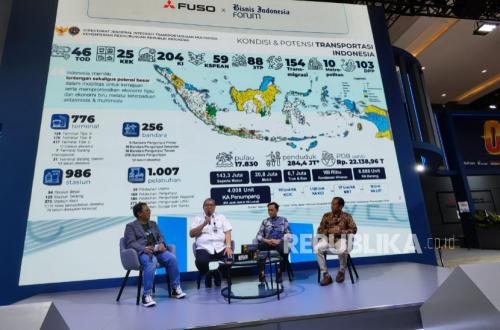
The cold chain industry in Indonesia is assessed to have tremendous prospects alongside changes in societal consumption patterns and the development of the modern logistics sector. This was highlighted in a talkshow featuring the Director General of Transport and Multimodal Integration of the Ministry of Transportation RI, M Risal Wasal, Chief Innovation Officer of PT Trimitra Trans Persada Tbk (Gerry Ardian), and Sales and Marketing Director of PT Krama Yudha Tiga Berlian Motors (Aji Jaya) as speakers at the Fuso booth at GIICOMVEC 2026, JIExpo Kemayoran, Jakarta, on Thursday (9/4/2026).
Risal emphasised that the need for cold chain is now increasingly broad and forms an important part of the national logistics system. “In the past, we were hesitant to send food products over long distances. Now, with technological developments and consumption patterns such as frozen food and cloud kitchens, the need for cold chain has become even more crucial,” he said.
According to him, the potential of cold chain is not only in the processed food sector but also encompasses fisheries products, agriculture, industrial zones, and tourism. Indonesia, with its many special economic zones, 3T areas (underdeveloped, frontier, outermost), and maritime centres, requires a refrigerated distribution system to maintain product quality.
The government has prepared various supports, from regulations and vehicle standardisation to the concept of multimodal transport based on a single document to improve logistics efficiency. “With this multimodal system, logistics cost efficiency can reach 35 per cent,” said Risal.
Nevertheless, challenges remain significant. One of them is the limitation of supporting infrastructure such as the availability of electricity for refrigerated containers on ships, synchronisation of schedules between transport modes, and limited carrying capacity. In addition, safety standards and road load-bearing capacity are also important concerns in the operation of cold chain vehicles.
From the business actors’ perspective, Gerry Ardian assessed that the cold chain business opportunities are very promising but require comprehensive readiness. “There are two main things we need, namely policy support and infrastructure. Regulations are already very supportive, but on-the-ground infrastructure remains a challenge,” he said.
He added that another challenge is maintaining product quality throughout the distribution process, especially in the transportation phase. “In the warehouse, we can control with systems and technology. But on the road, risks such as engine disruptions or temperature become major challenges,” he said.
As a third-party logistics (3PL)-based logistics company, B-Log continues to expand through three main pillars, namely the expansion of warehouse networks, strengthening of transport fleets, and development of digital systems to maintain distribution quality.
Source: jawawa.id (https://jawawa.id/newsitem/indonesias-cold-chain-industry-continues-to-grow-fuso-ready-to-provide-maximum-support-1775724717)
Originally published by Republika (https://ekonomi.republika.co.id/berita/td7w6k348/industri-cold-chain-indonesia-terus-tumbuh-fuso-siap-berikan-dukungan-maksimal), translated from Indonesian