
Indonesia's Coconut Productivity Lags as 377,000 Hectares of Plantations Age and Suffer Damage
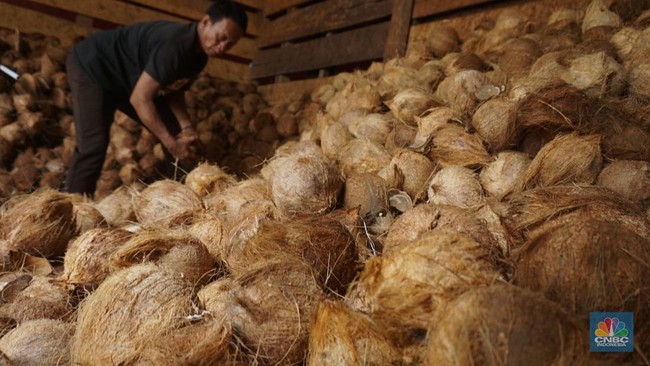
Jakarta, CNBC Indonesia — The Ministry of Agriculture (Kementan) has revealed that the national coconut plantation sector is facing serious challenges. Around 377,000 hectares of coconut plants in Indonesia have now entered the category of old and damaged, while productivity remains far below its ideal potential.
Agus Rosyid Wasingun, Quality Supervisor for Agricultural Products at the Directorate General of Plantations at the Ministry of Agriculture, said national coconut productivity currently stands at only around 1.1 tonnes per hectare, whereas good management could yield between 3.5 and 5 tonnes per hectare.
“Productivity is indeed not yet optimal, still at around 1.1 tonnes when it should reach 3.5 to 5 tonnes. This is hard work for all of us to raise that productivity. Then there is the high percentage of old and damaged plants, which currently reaches some 377,000 hectares out of 3.2 million — almost 30% to 40% of plants are old and damaged,” Rosyid said during the Coconut Downstream Webinar on Wednesday (22/7/2026).
According to Rosyid, this situation is one of the reasons why the competitiveness of Indonesia’s coconut commodity has not been optimal. Beyond low productivity, the domestic coconut processing industry is also considered not yet integrated, and thus unable to process every part of the coconut plant into value-added products.
On the other hand, he believes the prospects for the coconut commodity remain very promising. Global demand for coconut products continues to rise, and Malaysia even remains dependent on coconut supplies from Indonesia.
“The opportunity is actually considerable — global demand is quite large, and several countries have already started. Even Malaysia sources 89% of its coconut needs from Indonesia, so when it faced a shortage of raw materials two years ago, the Malaysian side came to the ministry to plead that there be no halt to coconut exports, just regulation and so on,” he said.
“That shows just how high their concern was, that 89% of Malaysia’s coconut needs are met from Indonesia. Export opportunities are also quite significant,” he continued.
To address the problem, the government is stepping up its coconut zone development programme through a downstream scheme. This year, the Ministry of Agriculture is targeting the development of 151,554 hectares of coconut plantations, nearly ten times the regular budget in previous years.
Rosyid said that in 2025, downstream programme realisation reached 1,975 hectares outside the regular programme, with a budget of Rp10.9 billion. This year, the government has prepared a budget of around Rp427 billion to support the development of coconut zones.
“We started in 2025 and, thank God, our realisation reached 92%, covering 1,975 hectares — this is outside the regular programme. In total, last year we developed 3,500 hectares. The budget from the downstream scheme was Rp10.9 billion, and this year it is quite extraordinary — ten times the regular budget of previous years. Our target this year is 151,554 hectares with a budget of roughly Rp427 billion,” he said.
“This excludes seedlings. Then in 2027, a further area is being prepared with an indicative ceiling already issued of 51,721 hectares, or a budget of Rp154 billion,” he added.
The programme will be implemented across 28 provinces as part of efforts to accelerate coconut downstreaming while boosting productivity, added value and farmers’ welfare. The government is also preparing the supply of superior seedlings, farmer assistance, and a rejuvenation programme to replace coconut plants that are old and no longer productive.
Source: jawawa.id (https://jawawa.id/newsitem/indonesias-coconut-productivity-lags-as-377-000-hectares-of-plantations-age-and-suffer-damage-1784703111)
Originally published by CNBC Indonesia (https://www.cnbcindonesia.com/news/20260722115647-4-752850/377-ribu-hektare-kebun-kelapa-ri-tua-dan-rusak-begini-efeknya), translated from Indonesian