
Indonesia's Coconut Industry Faces Crisis, Threatening Factory Closures and Layoffs
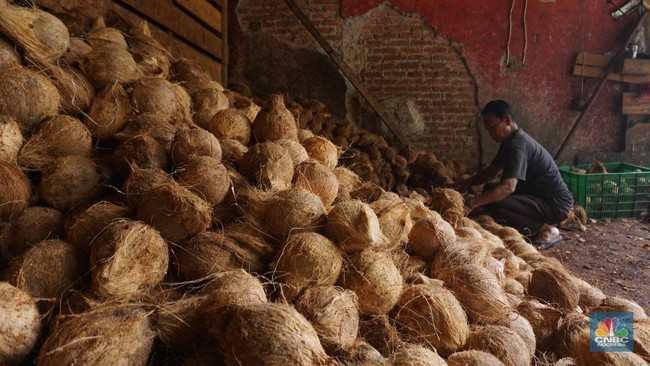
The Indonesian Coconut Processing Industry Association (HIPKI) is urging the government to immediately establish regulations for the export of whole coconuts. Industry players say the unregulated export of raw materials has caused domestic supplies for processing plants to dwindle. As a result, a number of factories have been forced to halt production, lay off workers, and even close permanently.
HIPKI’s Daily Chairman, Rudy Handiwidjaja, stated that the biggest challenge facing the coconut processing industry is not demand, but the lack of a policy regulating the export of whole coconuts as raw material. “The main challenge for the Indonesian coconut industry is industry protection through raw material export policy. The Indonesian government continues to permit it; until now, there has been no trade governance regulating the export of whole coconuts,” Rudy said during a webinar on Wednesday.
He noted that the impact of this lack of regulation has been felt by the industry in recent years. Raw material supplies have become increasingly difficult to obtain, disrupting company operations. “A few years ago, we experienced a very significant shortage of raw materials, so many of our coconut processing industry members could no longer produce, and they eventually laid off or terminated their employees, and some even closed permanently. This has happened in many regions,” he explained.
Rudy explained that Indonesia is the world’s second-largest coconut producer after the Philippines. National coconut production in 2025 is estimated to reach around 15 billion nuts, equivalent to 23% of global production. Of this amount, approximately 9 billion nuts, or 60% of national production, are used as raw material for the domestic processing industry into various products, ranging from copra, desiccated coconut, and coconut milk to coconut oil. The export value of the coconut industry reaches US$2.48 billion.
Despite this, Rudy said the opportunity to increase added value remains suboptimal because raw materials are instead widely exported abroad for processing into higher-value products. “Ironically, the raw materials come from Indonesia, but the domestic industry is still constrained by coconut regulations and raw material supply. Therefore, strategic incentives and policies are needed to attract these companies to move their factories to Indonesia and develop coconut downstream processing here,” Rudy said.
HIPKI believes that implementing governance on whole coconut exports will actually encourage new investment in the downstream sector. According to Rudy, foreign companies that have been importing raw materials from Indonesia have the potential to build production facilities domestically if such regulations are applied. “With the hope that trade governance will encourage more foreign industries to enter and build an ecosystem, thereby improving the welfare of coconut farmers in Indonesia,” he stated.
Therefore, HIPKI recommends that the government restrict the export of mature coconuts as raw material and only permit the export of young coconuts or green coconuts with their husks intact for the fresh coconut water segment. “Restrict raw material exports, only allow the export of young coconuts or green coconuts with their husks intact for the fresh coconut water segment, as is the practice in Thailand. They restrict the export of mature coconuts for processing. In Thailand, it is even prohibited, and the Philippines has also banned the export of whole coconuts,” he concluded.
Source: jawawa.id (https://jawawa.id/newsitem/indonesias-coconut-industry-faces-crisis-threatening-factory-closures-and-layoffs-1784785916)
Originally published by CNBC Indonesia (https://www.cnbcindonesia.com/news/20260723110540-4-753192/ancaman-ri-krisis-kelapa-di-depan-mata-awas-pabrik-tutup-dan-phk), translated from Indonesian