
Indonesia’s Coal Is Sold for Trillions, but the State’s Share Is ‘a Mere Grain of Sand’
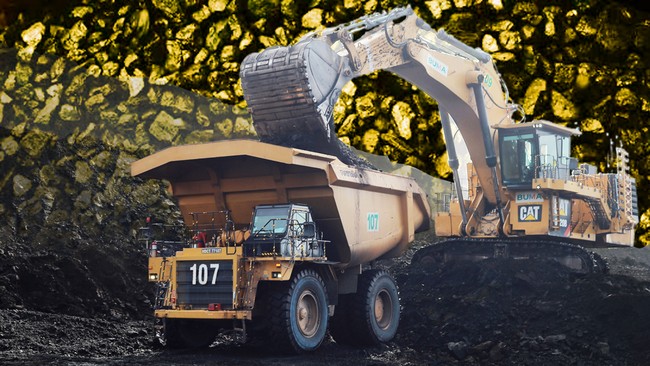
Jakarta, CNBC Indonesia – Indonesia’s coal business generates substantial trade through export and domestic markets. Assuming an exchange rate of Rp18,200 per US dollar and a domestic price of US$70 per tonne, estimated sales of Indonesian coal between 2016 and 2025 reached Rp7,406.92 trillion.
Over the same period, realised non-tax state revenue (PNBP) from the minerals and coal sector amounted to Rp896.29 trillion. This means PNBP from mineral and coal mining over the past decade was only around 12% of the estimated value of Indonesian coal sales. This comparison does not include sales of mineral commodities such as nickel, copper, gold and bauxite.
The scale of this economic activity reinforces the government’s interest in ensuring that transaction prices, sales volumes, royalties and tax obligations are reported accurately.
At company level, the five listed companies examined recorded a combined 31.40% increase in parent-attributable net profit in the first half of 2026. The growth points to improved company performance and makes their fiscal contributions an important area for scrutiny.
Domestic sales volumes increase
Annual domestic coal sales rose from 90.55 million tonnes in 2016 to 246.88 million tonnes in 2025. Coal and lignite exports, meanwhile, reached 524.01 million tonnes in 2025.
In 2025, power plants absorbed 141.40 million tonnes of domestic sales. The remaining 105.48 million tonnes went to other sectors.
Estimated sales value reaches Rp7,407 trillion
To illustrate the scale of the business, realised export values have been combined with a simulated value for domestic sales.
Export values were converted using an assumed exchange rate of Rp18,200 per US dollar. Domestic sales values were calculated by multiplying sales volumes by US$70 per tonne—the maximum coal price set under the Domestic Market Obligation (DMO)—and applying the same exchange rate.
In 2025, export value comprised Rp445.56 trillion for coal and Rp104.04 trillion for lignite. Adding estimated domestic sales of Rp314.53 trillion brings the estimated total to Rp864.13 trillion.
The US$70-per-tonne figure does not mean that every domestic consumer actually buys coal at that price. It reflects the rule setting a maximum price for coal supplied under the DMO, including coal for power plants. Actual prices depend on coal quality and calorific value, end use, applicable rules and sales contracts.
How does PNBP compare with sales value?
With the scale of sales established, state revenue can be set out separately for comparison. Realised minerals and coal PNBP reached Rp896.29 trillion over 2016–2025.
Source: Ministry of Energy and Mineral Resources.
The comparison is indicative because the figures cover different things. Minerals and coal PNBP includes both mineral and coal revenues and excludes taxes. The comparator, meanwhile, covers only coal and lignite sales, with the domestic component based on a simulation; sales of mineral commodities are not included.
If total sales of mineral commodities were included, PNBP’s share of total mineral and coal sales would probably be lower still.
The value of sales therefore highlights the importance of oversight to ensure companies meet their obligations in accordance with the rules and that the state’s share is optimised for the benefit of the public.
Export prices far below international series
Price differences are another issue requiring scrutiny. The implied export price is calculated by dividing the free-on-board (FOB) export value by export weight, while the NCFMc2 series is the average of daily price observations in the data file used.
In 2025, the combined implied export price was US$57.63 per tonne, while the NCFMc2 series averaged US$108.52 per tonne. The previously calculated figure of US$62.62 per tonne covered coal only and did not include lignite.
The difference needs to be tested against comparable quality, transaction periods and delivery terms. Differences in quality can produce a wide range of prices. For example, the second-period April 2025 Coal Reference Price (HBA) was US$120.20 per tonne for 6,322 GAR coal, compared with US$34.32 per tonne for the 3,400 GAR category.
The price gap is therefore a reason for further examination, but it is not, by itself, evidence of state losses or wrongdoing by any particular company.
Profits rise across five listed companies
AADI, BYAN, GEMS, BUMI and PTBA all recorded growth in parent-attributable net profit in the first half of 2026.
Their combined profit reached Rp23.81 trillion, up 31.40% from Rp18.12 trillion in the first half of 2025.
The increase points to a trend of improving profits among the five listed companies examined. However, the PNBP data in this article only run through 2025.
For 2026 PNBP, Energy and Mineral Resources Minister Bahlil Lahadalia said his ministry expected revenue from the minerals and coal sector to reach Rp160–165 trillion by the end of the year, up from about Rp130 trillion in 2025. He attributed the forecast to higher coal prices following the Indonesian Government’s cuts to coal production in the 2026 Work Plan and Budget (RKAB).
“Our PNBP in 2025 was around Rp130 trillion or so, approximately Rp130–135 trillion, and as of 1 October it had already passed Rp141 trillion. We are targeting Rp160–165 trillion by the end of 2026,” he said at the Minerba Convention & Exhibition (Convex) 2026 at JIExpo on Monday (2 November 2026).
Comparing net profit and royalties with revenue
To examine the relationship between revenue, profit and royalty payments, the following comparison uses 2025 full-year figures.
The comparison shows different circumstances among the companies. At BYAN, parent-attributable net profit was equivalent to 22.40% of revenue, while royalty payments amounted to 7.69%.
For AADI, GEMS, PTBA and BUMI, the available government-payment items show royalty/PNBP ratios higher than their parent-attributable net-profit ratios.
What are the payments after tax is included?
Royalties and PNBP are part of companies’ fiscal contributions. Tax payments should be shown separately to give a more complete picture.
AADI’s Rp14.53 trillion figure represents royalty and PNBP payments, while its income tax payments are reported separately at Rp3.72 trillion.
Gross payments should also be considered alongside tax refunds. In 2025, reports recorded tax refunds of about Rp3.41 trillion for AADI, Rp6.53 trillion for BYAN and Rp2.12 trillion for PTBA. The type and tax period must be matched before calculating net state revenue.
In BUMI’s case, KPC is recorded as a joint venture using the equity method. KPC’s tax and royalty payments are not included in BUMI’s consolidated cash flows. The table therefore does not show the full contribution of KPC and Arutmin’s operations.
Profit growth must be matched by certainty over the state’s entitlements
Rising profits among the five companies point to improved performance in the sample. For the government, this is relevant to monitoring companies’ ability to meet their obligations and ensuring that the bases for tax and royalty assessments are reported accurately.
The estimated sales value gives strong grounds for tighter reconciliation of production data, coal quality, shipments, selling prices and payments due. The difference between revenue and tax and PNBP payments also funds production, labour, transport, investment and other obligations.
Listed companies’ profits are rising and their businesses are substantial. The government has an interest in ensuring that all amounts due to the state are paid in full. Scrutiny of price fairness and payment compliance is essential to optimising revenue from Indonesia’s natural resources.
Coal prices weaken
Coal prices fell 0.72% to US$144.95 per tonne at the close of trading on Thursday (5 November 2026). The decline extended the sector’s losses, with prices down 4.92% over four days.
The previous day’s closing price was also the lowest since 1 September 2026.
Source: jawawa.id (https://jawawa.id/newsitem/indonesias-coal-is-sold-for-trillions-but-the-states-share-is-a-mere-grain-of-sand-1793933436)
Originally published by CNBC Indonesia (https://www.cnbcindonesia.com/research/20261102103127-128-781432/batu-bara-ri-dijual-ribuan-triliun-tapi-bagian-negara-butiran-debu), translated from Indonesian