
Indonesia’s Board of Peace Dilemma: Prabowo Caught Between Domestic Backlash and US Ties
analysis Asia
Indonesia’s Board of Peace dilemma: Prabowo caught between domestic backlash and US ties
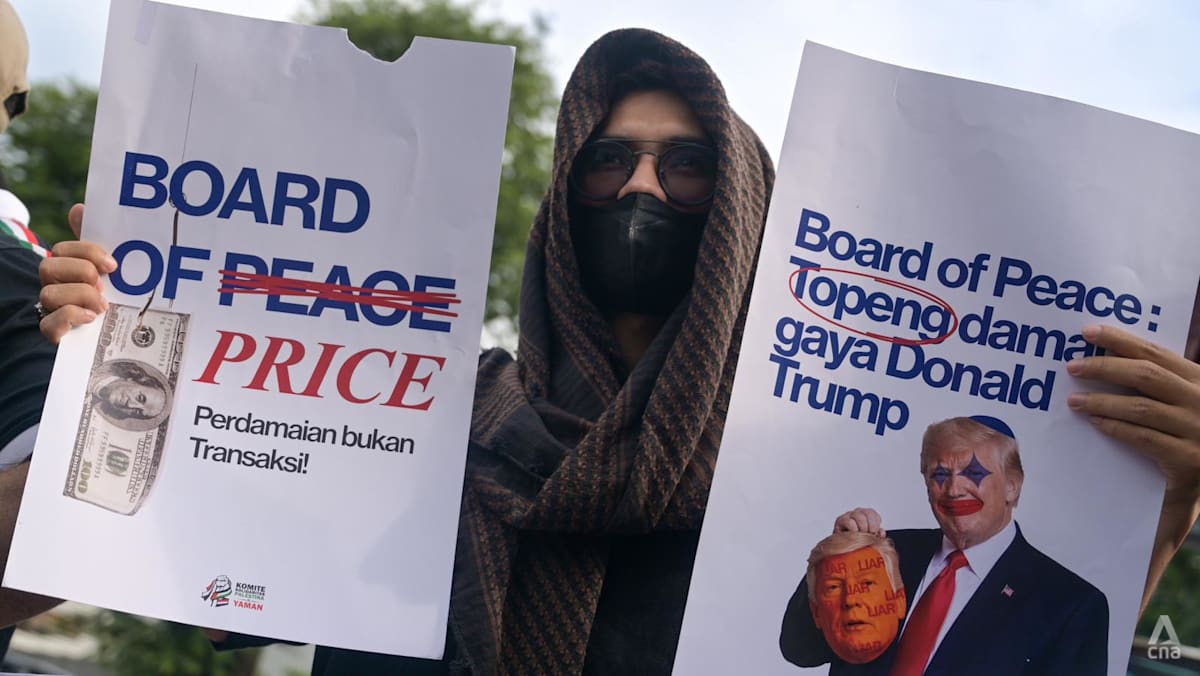
Indonesia is facing mounting pressure to reconsider its membership in the US-led Board of Peace (BoP), but leaving comes with risks, analysts say.
JAKARTA: When Indonesia President Prabowo Subianto accepted the United States’ invitation to join the Board of Peace (BoP) on Jan 22, he cast it as a strategic step to achieve lasting world peace and elevate Indonesia’s global standing as a middle power.
But public scepticism of Indonesia’s BoP participation has grown in the wake of the US-Israeli war on Iran and the death of three Indonesian peacekeepers in Lebanon last month.
The board was originally established to oversee post-conflict reconstruction in Gaza.
With politicians, including figures from Prabowo’s own coalition, now urging a reassessment of Indonesia’s membership, observers say the president risks being caught between domestic backlash and preserving ties with the US.
“The Board of Peace has become the Board of Problems,” declared Teuku Rezasyah, an international relations lecturer at Indonesia’s President University.
LATEST PUBLIC SENTIMENTS
Over half of respondents in a survey conducted last month disagree with Indonesia’s decision to join the BoP.
Conducted by three Indonesian research companies, the survey found that 50.9 per cent of more than 1,000 respondents disagreed with Indonesia’s decision to join the BoP, a body initiated by US president Donald Trump.
Only 33.8 per cent said they supported the decision while the rest were neutral, according to the findings released on Apr 2 by Indikator Politik Indonesia, Indonesian Survey Institute (LSI) and Saiful Mujani Research and Consulting (SMRC).
The result showed a marginal decline in support for BoP participation.
Before the US-Israeli war on Iran, another Indonesian research company, Media Survey Nasional (Median) conducted a similar study between Feb 10 and 14, showing that 50.4 per cent of the 1,200 respondents disagreed with Indonesia joining the BoP. In the February survey, 34.8 per cent said they supported the membership.
The latest survey was conducted between Mar 12 and 31, meaning some responses were given before the Indonesian peacekeepers were killed on Mar 29 and 30. Experts said support for the BoP would have been even lower if the study was conducted after the deaths.
A United Nations investigation found that a projectile fired from an Israeli tank resulted in the death of a peacekeeper on Mar 29.
Two peacekeepers were killed on Mar 30 by an improvised explosive device, most likely placed by Hezbollah, according to the UN.
Their deaths – the first among the UN peacekeeping force in the new war between Israel and Lebanese armed group Hezbollah, which erupted on Mar 2 – have also broadened criticism of Indonesia’s BoP participation, which was initially confined to Islamic groups with strong anti-Israel sentiments and analysts wary of US intentions.
“Indonesia’s benefits and diplomatic manoeuvring within the BoP are not clearly evident, thus it is understandable that there is much public resistance (to Indonesia’s membership),” Agung Nurwijoyo, an international relations expert from University of Indonesia told CNA.
GROWING POLITICAL BACKLASH
Several political parties, including those in Prabowo’s coalition, have urged a rethink of Indonesia’s BoP involvement.
“Israel’s attack on an Indonesian soldier is a clear disregard for the very notion of ‘peace’ that is supposed to be a core value of the BoP,” Ahmad Doli Kurnia, deputy chairman of Golkar Party said in a statement on Apr 1.
“We encourage the government to rethink Indonesia’s presence in the BoP.”
Golkar is the biggest party in Prabowo’s coalition.
The Islam-based Prosperous Justice Party (PKS), another member of Prabowo’s coalition, issued a similar call on Mar 30.
“The PKS believes there needs to be a serious evaluation of Indonesia’s position in various international peace forums, including the possibility of reviewing its involvement in the BoP if it is no longer effective in upholding global peace and justice,” the party said in a statement.
Politicians from the Indonesian Democratic Party of Struggle (PDI-P), not a member of the coalition, have taken a firmer stance and called for a full withdrawal.
“The government should immediately take steps to withdraw. This is important to maintain consistency with the ‘free and active’ (foreign policy) principle mandated by our Constitution,” PDI-P politician Tubagus Hasanuddin told media outlet Kompas on Mar 3.
Hasanuddin is a member of the Indonesian parliamentary commission overseeing defence and foreign affairs.
On Mar 3, Indonesian Foreign Minister Sugiono said “all BoP discussions are on hold as all attention has shifted to the situation in Iran”.
During a discussion with journalists and experts last month, Prabowo mooted the possibility of Indonesia leaving the BoP if it proves to be counterproductive to world peace and stability.
“If we conclude that there is no hope and that it is counterproductive, that it is draining our time and energy and does not serve Indonesia’s national interests, we will withdraw,” he said, as quoted by Kompas on Mar 19.
The Board of Peace and the Iran war
The BoP was originally established to ensure post-conflict reconstruction in Gaza proceeds effectively.
Trump began inviting countries to join the board in September and, on Jan 22, at the sidelines of the World Economic Forum in Davos, Switzerland, 21 countries including Indonesia signed the charter for the establishment of the BoP and became founding members.
Six more countries have since joined the BoP, including fellow Southeast Asian nations Cambodia and Vietnam.
Experts have voiced scepticism over the BoP’s effectiveness and warned that Indonesia risks being drawn into a pro-American orbit that prioritises the American president’s agenda.
Criticism grew after it was revealed that nations who accepted the invitation were
Source: jawawa.id (https://jawawa.id/newsitem/indonesias-board-of-peace-dilemma-prabowo-caught-between-domestic-backlash-and-us-ties-1776120642)
Originally published by CNA (https://www.channelnewsasia.com/asia/indonesia-board-peace-dilemma-gaza-iran-middle-east-conflict-6053136)