
Indonesia's Animation and Game Research and Development Centre Inaugurated in China
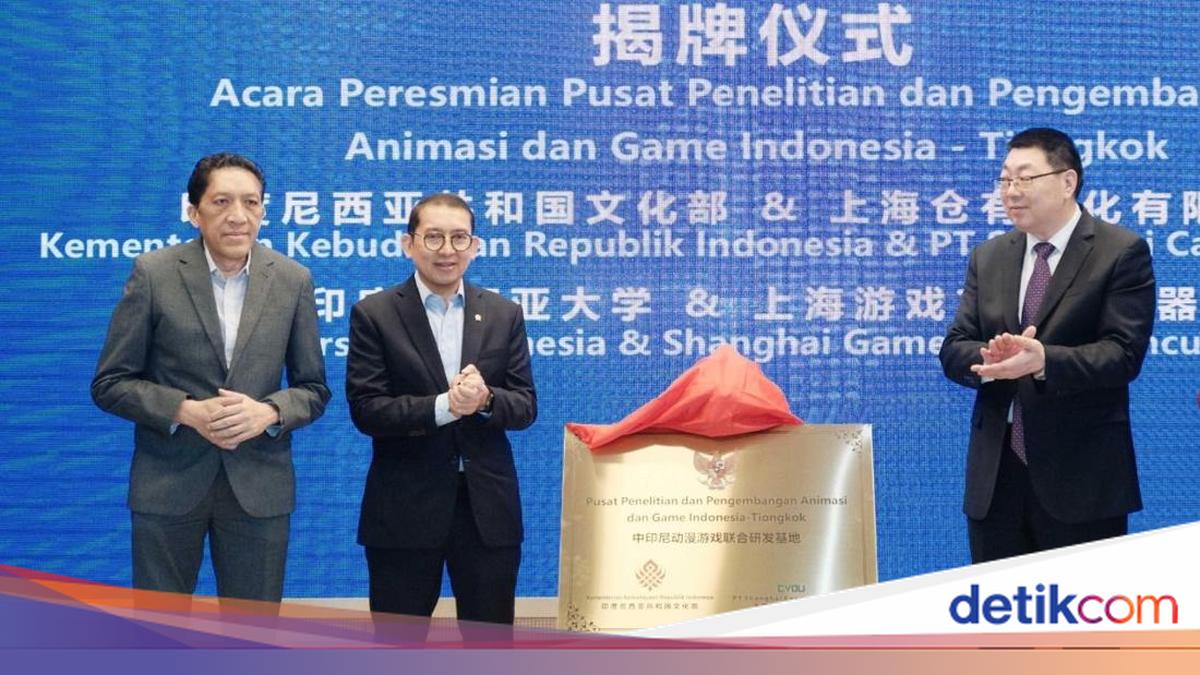
Culture Minister Fadli Zon inaugurated the Sino-Indonesian Joint Animation and Video Game Research and Development Centre in Shanghai, China. This inauguration signifies the strengthening of Indonesia-China cultural cooperation in the digital culture sector, particularly in animation, gaming, the development of culture-based intellectual property, talent enhancement, as well as research and industry collaboration.
In his speech, Fadli Zon stated that this facility marks a new chapter in Indonesia-China cultural cooperation that is increasingly oriented towards joint creation.
“Today, we are opening a new space for the encounter between culture, technology, talent, creativity, and the future. This centre signifies a shift from cultural exchange to cultural co-creation, from exchanging works to joint production that generates talent, IP, research, technology, and creative works that reach the world,” said Fadli Zon in his statement on Sunday (26/4/2026).
The inauguration of the Sino-Indonesian Joint Animation and Video Game Research and Development Centre in Shanghai, China, took place on Saturday (25/4).
According to him, over 76 years of diplomatic relations between Indonesia and China, cooperation between the two countries has been built on foundations of history, trade, diplomacy, and people-to-people relations.
“In the future, these relations will increasingly be driven by the new generation, including animators, game developers, storytellers, character designers, visual artists, programmers, producers, academics, and digital entrepreneurs,” added Fadli Zon.
Fadli Zon assessed that China is one of the world’s main centres for the digital cultural industry, with a strong technological ecosystem, production scale, industry networks, distribution, and commercialisation capabilities. On the other hand, Indonesia has one of the richest cultural reserves in the world or mega-diversity, which can serve as a source of narratives, characters, visuals, and world-building for digital works development.
“For creators, Indonesia is a universe of stories. The challenge is how to creatively, accurately, and competitively process this cultural richness; how culture does not stop as visual ornamentation, but becomes a source of knowledge, narrative, character, and strong world-building,” he emphasised.
Fadli Zon also stressed that animation and gaming are part of the strategic Cultural and Creative Industries (CCIs). The global gaming industry is projected to reach more than $275 billion by 2026, with growth driven by mobile gaming, e-sports, cloud gaming, and digital distribution.
“Indonesia is in the midst of this great dynamic. In the first quarter of 2026, Indonesia recorded around 870 million mobile game downloads, the highest in Southeast Asia. Indonesia also has about 192 million gamers, or around 43% of total Southeast Asian gamers. The value of Indonesia’s domestic gaming market is estimated to reach $2.5 billion,” he explained.
Nevertheless, he reminded that Indonesia’s gaming market is still heavily dominated by foreign games, while the share of local games remains relatively small. Therefore, Indonesia needs to move from being a consumer to a producer, creator, developer, and exporter of digital cultural IP.
“We must ensure that Indonesia does not stop as a consumer, but starts moving to become a producer, creator, developer, and exporter of digital cultural IP. For that, we need to strengthen the ecosystem through financing, research, technology, production management, talent quality, marketing, distribution, and IP protection,” said Fadli Zon.
Within the framework of national cultural policy, the Ministry of Culture (Kemenbud) is also strengthening the digital culture agenda through the development of the Cultural Data Hub, the preparation of cultural digitalisation standards, the strengthening of culture-based IP, and the development of digital innovation ecosystems such as AI, AR/VR, gaming, animation, digital installations, and video mapping.
Furthermore, Fadli Zon stated that through the Indonesian Cultural Gateway, Kemenbud has compiled thousands of cultural data in the form of photos, videos, 3D, VR, and digital maps.
“Digitalisation of cultural heritage has also produced more than 4,300 assets, including 3D modelling and scanning. In addition, the Budaya GO! programme has involved hundreds of teams and thousands of participants from dozens of provinces, while the culture-based IP-Nesia programme is starting to encourage the birth of games and animations sourced from Indonesia’s cultural richness,” he explained.
Eleven partner institutions also received awards for their support in developing this centre. These partners include the Shanghai Game Industry Incubator and Shanghai Shixiang Enterprise in the gaming sector; Shanghai Ranmai Network Technology, Shanghai Qianyi Information Technology, and Beijing Tunan Shengyi in the short video drama sector; the Henan Cultural Tourism Research Association and Shuhai Consulting in education and training; as well as Beijing Jiashiqiao International Technology Cultural Development in film and television.
On that occasion, Fadli Zon expressed six hopes for the establishment of this centre, namely the joint development of IP based on stories, characters, values, and cultural landscapes of Indonesia and China; strengthening of animation and gaming talent; strengthening of collaboration between government, universities, and industry; responsible development of cultural data and digital assets; expansion of access to works in the Indonesian, Chinese, Southeast Asian, and global markets; and strengthening of cultural diplomacy through digital works.
“We are in an era when the boundaries between culture, technology, and economy are increasingly merging. We must protect cultural heritage, revive traditions, and strengthen cultural communities. At the same time, Indonesian culture must be present in the digital space, enter the economic value chain, become a source of IP, and reach new generations around the world,” said Fadli Zon.
Fadli Zon hopes that the Sino-Indonesian Joint Animation and Video Game Research and Development Centre can become a bridge between technology