
Indonesia's Alumina Exports to China Surge Over 1,000%, Singapore Sees 14 Million Percent Jump
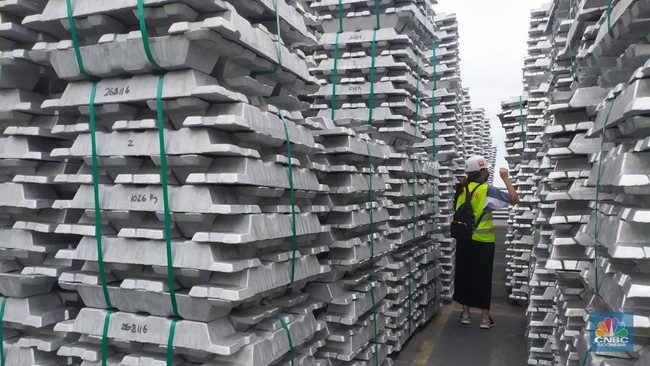
Jakarta, CNBC Indonesia – One Indonesian export commodity to China and Singapore has been soaring this year: aluminium oxide, or alumina (Al₂O₃), the key raw material for producing aluminium.
The Central Statistics Agency (BPS) recorded that Indonesia’s alumina exports to China between January and May 2026 reached US$127.1 million, or around Rp 2.28 trillion (US$1 = Rp 18,000). This figure surged 1,012.59% compared with the same period last year, which stood at just US$11.4 million.
The increase is also visible in monthly performance. In May 2026, Indonesia’s alumina exports to China reached US$65 million, up 507.72% compared with May 2025 and jumping 120.93% compared with April 2026.
The rise aligns with demand from the global aluminium industry, particularly from China, the world’s largest producer and consumer of aluminium.
Meanwhile, according to the Ministry of Trade’s One Data portal, Indonesia’s overall alumina exports (HS code 28182000) for January–May 2026 reached US$850.9 million, or roughly Rp 15,316.2 trillion.
Although still substantial, this represents a decline of 21.19% compared with the same period a year earlier. The drop indicates that global demand for alumina has not been evenly spread across all of Indonesia’s export destinations.
Despite the surge to China, Malaysia remains the largest market for Indonesian alumina, with exports worth US$167.4 million between January and May 2026.
However, shipments to the country plummeted 45.06% year-on-year. A similar situation occurred with India, which recorded exports of US$129.2 million but fell even more steeply, by 48.86%.
Amid the weakening of these two major markets, China has emerged as a bright spot.
Indonesia’s alumina exports to the Middle Kingdom reached US$127.1 million in January–May 2026, surging 1,012.6% compared with the same period last year.
With this achievement, China is now the third-largest market for Indonesian alumina and one of the main pillars supporting the commodity’s export performance.
Beyond China, several other countries have also recorded increased demand for Indonesian alumina. Singapore posted a remarkable figure: aluminium exports to the city-state soared by 14.9 million percent.
However, it should be noted that Singapore imported almost no aluminium in January–May 2025, so this year’s surge does not yet represent a large nominal value.
Exports to Qatar grew 33.47% to US$81.3 million, while exports to the Netherlands rose 37.98% to US$64.8 million.
The most spectacular jump actually occurred in Singapore, with exports reaching US$79 million, although the previous year’s export base was so small that it produced an extraordinarily high growth rate.
Chinese customs reported that the country’s imports of aluminium ores and concentrates reached US$6.48 billion between January and May 2026. This figure rose 31.9% compared with the same period last year. In terms of volume, imports reached 10,069 units with thin growth of 0.2%.
China’s sustained high demand stems from alumina’s critical role in the metal processing industry.
China is indeed reshaping the direction of its aluminium industry. According to research by the Asia Society Policy Institute, at the end of 2024 the Chinese government scrapped the % export tax rebate for aluminium products.
The policy briefly rattled global markets and drove aluminium prices on the London Metal Exchange (LME) higher, as market players anticipated that export supplies from China would shrink.
Beijing’s move does not mean that demand for aluminium and alumina in China is weakening. Rather, the policy direction has shifted. The Chinese government wants more aluminium supply absorbed in the domestic market to support strategic sectors, particularly electric vehicles and solar energy.
Demand from the electric vehicle industry is expected to be one of the main engines of aluminium consumption growth in China.
Electric vehicles require roughly 85% more aluminium than conventional petrol cars.
With electric vehicles’ share of car sales approaching half of China’s car market in 2024, aluminium demand from this sector is projected to surge from around 2 million tonnes in 2023 to nearly 10 million tonnes by 2030.
The solar energy industry also absorbs aluminium in large quantities. Aluminium is used for panel frames, mounting structures, and solar panel installation systems.
China added 277 gigawatts (GW) of solar power capacity throughout 2024, more than double the capacity added in the United States. Each kilowatt of solar capacity requires around 21 kilograms of aluminium, meaning clean energy expansion automatically drives demand for aluminium raw materials and alumina.
This strategic shift explains why China’s imports of aluminium ores and concentrates continue to grow strongly this year.
Indonesia’s position
Despite the sharp jump in Indonesia’s alumina exports, Indonesia’s share of China’s import market remains relatively small. Based on January–May 2026 data, Indonesia ranks ninth among suppliers of aluminium ores and concentrates to China, with imports worth US$207.23 million.
The Chinese market is still dominated by the European Union, with imports of US$3.24 billion between January and May 2026. The next positions are occupied by Thailand at US$624.66 million, Malaysia at US$575.83 million, Japan at US$543.49 million, and South Korea at US$440.99 million.
Indonesia’s entry into the top ten suppliers shows that the national alumina supply chain is beginning to gain a foothold in the global market.
Beijing is endeavouring to shift its aluminium industry away from the old model reliant on primary metal exports towards one producing higher value-added manufactured goods, such as electric vehicles, solar panels, electronics, and semiconductors.
In this new industrial landscape, demand for alumina as the primary raw material for aluminium will remain substantial and could open up broader market opportunities for supplier countries, including Indonesia.
Source: jawawa.id (https://jawawa.id/newsitem/indonesias-alumina-exports-to-china-surge-over-1-000-singapore-sees-14-million-percent-jump-1783673526)
Originally published by CNBC Indonesia (https://www.cnbcindonesia.com/research/20260709161840-128-749525/wow-ekspor-aluminium-ri-ke-china-melonjak-1000-singapura-14-juta), translated from Indonesian