
Indonesia's Absence from Global Energy Forum: A Danger Signal for Green Investment?
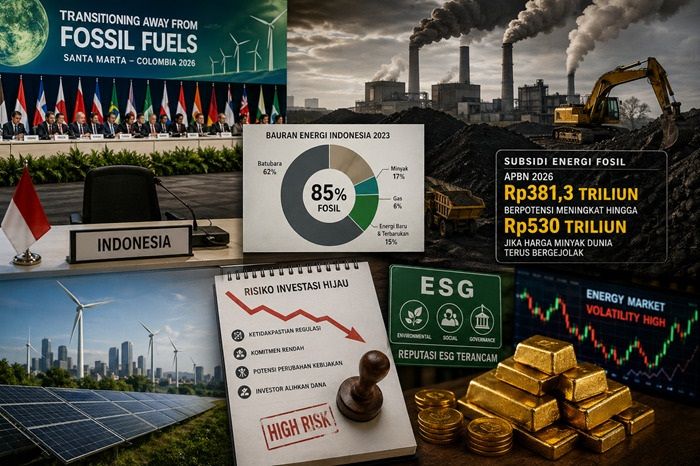
Indonesia’s absence from the global Transitioning Away from Fossil Fuels (TAFF) forum in Santa Marta, Colombia, from 24–29 April 2026, has attracted sharp scrutiny. While more than 50 countries gathered to discuss accelerating the energy transition, Indonesia’s non-attendance is seen as a signal of weak commitment to the global decarbonisation agenda.
This forum represents a crucial opportunity to align international efforts in reducing dependence on fossil fuels. However, Indonesia—as one of Southeast Asia’s largest economies—chose not to participate without a clear strategic explanation.
For market players, this signal goes beyond mere diplomatic issues. It concerns the direction of national energy policy, which directly impacts the flow of global investment.
Imbalance Between Commitment and Energy Reality
Structurally, Indonesia remains heavily reliant on fossil fuels. Data shows that around 85% of the national energy mix in 2023 came from coal, oil, and gas.
On the fiscal side, the government continues to allocate substantial subsidies. In the 2026 state budget, fossil fuel subsidies amount to Rp381.3 trillion and could rise to Rp530 trillion if global oil prices remain volatile.
Yet, global pressures are intensifying. The energy sector accounts for approximately 74.5% of worldwide greenhouse gas emissions, making it a primary focus for the transition agenda.
This imbalance reveals a chasm between the world’s increasingly aggressive push towards clean energy and Indonesia’s domestic conditions, which still rely on fossils.
Tug-of-War of Interests: Stability vs Transition
Indonesia’s main dilemma lies in domestic interests. Coal remains the backbone of national electricity generation and a source of export revenue. Meanwhile, energy subsidies help maintain public purchasing power.
However, global demands move in the opposite direction: phasing out fossil fuel subsidies and tripling renewable energy investments by 2030.
This situation places the government in a difficult position. The energy transition is not just an environmental issue but also involves social and economic risks, including potential spikes in electricity tariffs, energy inflation, and impacts on employment.
This signal of unclear policy direction could disrupt investor confidence. Between 2011 and 2023, Indonesia has secured around US$78 billion in climate financing. However, this portion remains small compared to the long-term needs of the energy transition.
Furthermore, bank financing for the green sector is still limited, at times only about 1.4% of total credit.
Indonesia’s absence from the global forum could reinforce perceptions of risk, from regulatory uncertainty to potential sudden policy changes. As a result, investors might redirect funds to other countries deemed more consistent in their energy transition agendas.
ESG Reputation at Risk
In the global investment landscape, ESG (Environmental, Social, Governance) indicators have become a primary factor in decision-making.
Countries perceived as unserious about the energy transition risk facing:
Declines in ESG ratings
Higher borrowing costs
Reduced access to global funds
With Indonesia’s absence from this important forum, the risk of a declining ESG reputation becomes all too real.
Long-Term Threat: Stranded Assets
Reliance on fossil fuels also opens the door to stranded assets—assets that lose value before the end of their economic life.
As the global transition accelerates, coal-based infrastructure could become obsolete faster than initially calculated. In the long term, this could lead to significant losses for both the state and investors.
Amid this dynamic, the market sees opportunities.
For long-term investors, the uncertainty of the energy transition and rising global risks make gold remain relevant as a hedge asset. Although short-term pressures from volatility and interest rate policies may weigh on it, gold still serves as the primary safe haven.
Meanwhile, for traders, this situation creates high-volatility momentum. Price movements in energy, fossil sector stocks, and ESG-based assets become more dynamic, opening opportunities for short-term strategies.
A Missed Opportunity?
Indonesia’s absence from the global energy forum should serve as a serious wake-up call. The world is moving swiftly towards a low-carbon economy, while Indonesia grapples with domestic dilemmas.
The choices ahead are increasingly clear: maintaining fossil fuel-based stability at the cost of long-term risks, or accelerating the transition with significant political and economic consequences.
This decision will not only shape national energy policy but also Indonesia’s position on the global investment map in the green economy era.
Source: jawawa.id (https://jawawa.id/newsitem/indonesias-absence-from-global-energy-forum-a-danger-signal-for-green-investment-1777585876)
Originally published by mistar.id (https://mistar.id/news/ekonomi/indonesia-absen-di-forum-global-energi-sinyal-bahaya-bagi-investasi-hijau), translated from Indonesian