
Indonesia's 112 Emergency Service Still Faces Integration and Response Challenges
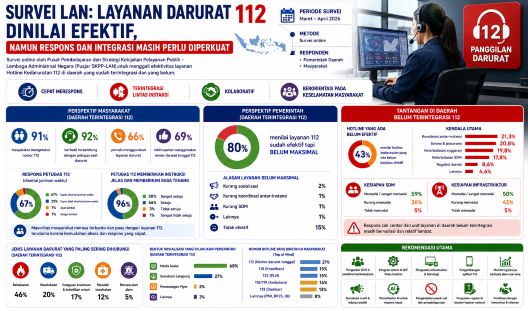
The National Administrative Agency (LAN), through its Public Service Policy Strategy Learning Centre (Pusjar SKPP-LAN), revealed that Indonesia’s 112 emergency hotline service continues to face various challenges, particularly in service integration, inter-agency coordination, and response quality across several regions.
The findings come from a national survey involving 573 respondents, including government officials and citizens across 49 regional governments in Indonesia.
Agus Sudrajat, Deputy for Quality Improvement of National Administrative Policy at LAN, stated that the study is crucial as the 112 service symbolises the state’s presence in providing protection and rapid response to citizens. ‘112 represents the state’s commitment to ensuring safety, protection, and swift response for the public,’ he said.
SINGLE EMERGENCY NUMBER
The government designated 112 as the national single emergency number in 2016 under Ministry of Communication and Digital Affairs Regulation No. 10 of 2016. However, by 2025, only 127 out of 514 districts/cities (24.7%) have implemented the service.
Survey results show regions with integrated 112 services have better service quality compared to those without integration.
91% of residents in integrated areas know the 112 number, with 66% using the emergency service. Call centre and field officer responses in these regions are also deemed faster.
Conversely, residents in non-integrated areas often resort to informal channels such as WhatsApp or personal contacts to report emergencies.
Pusjar SKPP-LAN noted key implementation barriers, including weak inter-agency coordination, inadequate infrastructure, insufficient operational budgets, and a shortage of trained operators.
The survey also found emergency operators often have dual roles within regional apparatus agencies (OPDs), a lack of binding national service standards, and insufficient outreach to vulnerable groups and remote areas.
PUBLIC NEEDS
Rahmat, Head of Pusjar SKPP-LAN, stressed the public needs a simple and accessible emergency system during crises. ‘In emergencies, people don’t have time to decide which number to call. The state must provide a fast, integrated, and easily accessible service,’ he said.
Based on the survey, Pusjar SKPP-LAN recommended seven key policy strategies: strengthening national emergency regulations, integrating services across 110-112-119, enhancing operator manpower, standardising response times, developing integrated command centres, strengthening regional funding, and integrating 112 with smart city ecosystems.
The survey also highlighted the importance of inclusive services under the ‘no one left behind’ principle to ensure emergency services reach vulnerable groups, rural communities, people with disabilities, the elderly, and those with limited digital literacy.
STRATEGIC INPUT
Agung Setio Utomo, Chair of the Facilitation Team for the Community Protection and Disaster Management Communication System at the Ministry of Communication and Digital Affairs, said the policy paper could provide strategic input for drafting the Presidential Regulation on Disaster and Emergency Communication System (PMPB).
He added that strengthening emergency services requires an integrated and responsive communication system to support cross-sector coordination during crises.
‘Ultimately, emergency services are not just about technology or apps. The most important thing is how the state can respond to citizens swiftly, co-ordinatedly, and reliably in the most critical moments,’ said the Head of Pusjar SKPP-LAN.