
Indonesia's 100 GW Solar Power Project Could Cut Emissions by 140 Million Tonnes of CO2
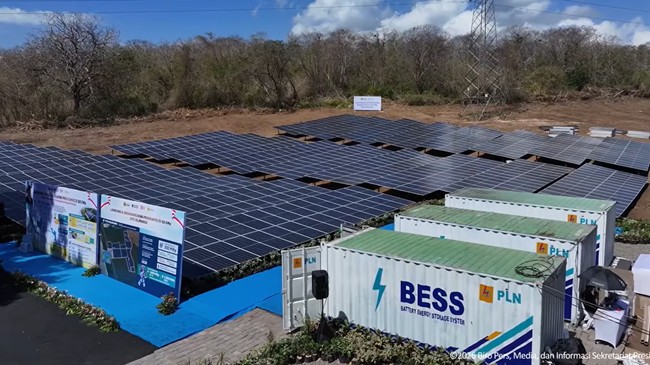
Jakarta, CNBC Indonesia - The Indonesian government has inaugurated a mega-project programme for the construction of Solar Power Plants (PLTS) with a total capacity of 100 Giga Watt peak (GWp). With this project, carbon emissions are estimated to fall by 140 million tonnes of CO2 per year.
Minister of Energy and Mineral Resources Bahlil Lahadalia projects that the reduction in carbon emissions from the jumbo project is equivalent to a carbon economic value of up to Rp 6.31 trillion.
“Apart from that, Mr President, if we are able to implement all of this, the emission reduction will be 140 million tonnes of CO2 per year with a carbon economic value of 6.31 trillion rupiah,” he explained in his report at the inauguration of the 100 GWp PLTS programme in Jembrana Regency, Bali, as quoted on Wednesday (26/8/2026).
The project requires a total investment of Rp 1,140 trillion and is projected to provide state energy subsidy efficiency of up to Rp 73.9 trillion annually. Bahlil said that the utilisation of solar energy will provide added value for the people because it uses domestic technology and labour.
“If the sun is Indonesia’s sun, the solar panels are made by the hard work of the Indonesian people, and the electric batteries are produced from the sweat of Indonesian workers, then this solar energy is Indonesia’s energy, the energy of Mother Earth,” he said.
As an initial stage, the government conducted a groundbreaking for a capacity of 5.3 GW, with the Bali region receiving a portion of 1,000 Megawatts (1 GW) equipped with a battery system. The development in Bali utilises state land to accelerate execution so that a shift away from the use of diesel power plants (PLTD) can occur immediately.
“And for the day that we are carrying out, we are groundbreaking 5.3 Gigawatts, and for Bali it is 1,000 Megawatts plus batteries,” he added.
The electricity generated from the PLTS will be in the range of 5 to 6 US dollar cents per kWh, excluding battery costs.
“Specifically for Bali, by using 1,000 Mega Watts (MW), it is able to achieve efficiency of 0.6 million kilolitres of diesel fuel carried out by PLN. All this time, Bali has still been using PLTD,” he explained.
Based on records from the Ministry of Energy and Mineral Resources, the mega-project requires a total investment of US$ 73 billion, equivalent to more than Rp 1,140 trillion.
The government projects that the operation of the 100 GW PLTS will be able to provide energy subsidy budget efficiency of up to Rp 73.9 trillion per year and absorb around 5.52 million workers.
The government will prioritise a cooperation scheme with the private sector or Independent Power Producers (IPP) through a tender process.
Furthermore, the government is ready to take over the project work through the Daya Anagata Nusantara Investment Management Agency (BPI Danantara) if the price offered by developers is not competitive for the interests of the state.
Source: jawawa.id (https://jawawa.id/newsitem/indonesias-100-gw-solar-power-project-could-cut-emissions-by-140-million-tonnes-of-co2-1787719866)
Originally published by CNBC Indonesia (https://www.cnbcindonesia.com/news/20260826095157-4-762265/plts-100-gw-ri-ini-bisa-tekan-emisi-140-juta-ton-karbon-dioksida), translated from Indonesian