
Indonesians Queue in Droves for Subsidised Homes, So Why Are Sales Sluggish?
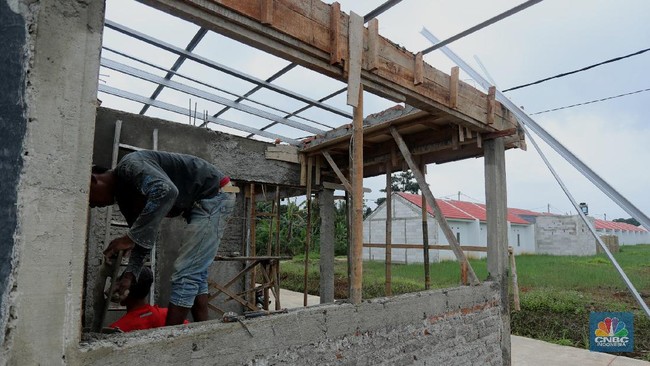
Jakarta, CNBC Indonesia — The distribution of subsidised homes through the Housing Financing Liquidity Facility (FLPP) is under pressure. However, the problem is thought to stem not only from weaker purchasing power, but also from disrupted housing supply caused by permit obstacles and policies in several regions.
One of the biggest problems is a moratorium on housing construction permits in West Java, which has long been one of the country’s main suppliers of subsidised homes. The moratorium, or temporary suspension of housing development permits, was formally introduced through West Java Governor’s Circular Letter No. 180/HUB.03.08.02/DISPERKIM, dated 13 December 2025.
“West Java has been dominant for 30 years. Around 40% of supply comes from there. The past two years have been disrupted by the licensing moratorium,” property analyst Panangian Simanungkalit told CNBC Indonesia on Tuesday (5 November 2026).
The disruption to construction in West Java has affected the availability of homes that people can buy through the FLPP scheme. With new projects on hold, the number of homes meeting the programme’s criteria has also fallen, meaning people applying for subsidised mortgages cannot always find a suitable property.
Uncertainty over land status is another obstacle for developers. Panangian highlighted cases in which land held by developers for years was later classified as Protected Rice Field (LSD).
“Developers have held land for five years, acquiring it little by little. Suddenly, a determination comes out saying the land is protected rice field and cannot be built on,” he said.
This uncertainty makes it difficult for developers to plan construction. In some cases, the land-status issue only comes to light after a project is under way and some houses have already been built.
Bureaucratic problems and policy uncertainty are also hampering supply.
“There are many problems in Indonesia’s bureaucracy. Ministries and agencies are creating uncertainty,” Panangian said.
The decline in FLPP disbursements cannot be attributed directly to weakening demand. According to Panangian, the number of people who do not own a home remains very high, while the annual quotas and capacity of government programmes are limited.
“Demand has barely changed over the years. People are still queuing to claim their entitlement. There are still many people without homes,” he said.
Panangian said supply problems were a more significant factor than changes in demand. This was evident from the disruption to housing production in areas that have historically made a major contribution to FLPP distribution.
“The FLPP is not under much pressure from the demand side. Supply, because of the moratorium, has had a greater impact,” he stressed.
According to figures on the official website of the Ministry of Housing and Settlement Areas (PKP), as of 19 October 2026, the Housing Financing Savings Management Agency (BP Tapera) recorded 184,342 subsidised FLPP mortgages, or 52.67% of the 350,000-unit target for 2026. These comprised 184,318 landed-house mortgages and 24 apartment mortgages.
BP Tapera also recorded potential demand for 39,830 units still in the process of construction through to mortgage signing, as well as 28,208 subsidised homes available. If all this potential demand is realised, cumulative disbursements are projected to reach 224,172 units, or about 64% of the annual target.
Earlier, subsidised home sales in the first half of 2026 were reported to have fallen sharply compared with the same period last year. Developers said the slowdown was driven by a combination of supply-side problems and reduced public ability to afford homes.
Newly appointed chair of the Indonesian Association of Housing and Settlement Developers (APERSI), Deddy Indrasetiawan, said 91,531 subsidised homes were sold in the first half of 2026. This was down from 120,976 in the first half of 2025, a year-on-year fall of 24.3%.
“Based on the comparison of actual sales in the first half of 2025 and the first half of 2026, they fell from 120,976 to 91,531, a 24.3% year-on-year decline,” Deddy told CNBC Indonesia on Tuesday (21 July 2026).
Source: jawawa.id (https://jawawa.id/newsitem/indonesians-queue-in-droves-for-subsidised-homes-so-why-are-sales-sluggish-1793688712)
Originally published by CNBC Indonesia (https://www.cnbcindonesia.com/news/20261103113023-4-781833/warga-ri-antre-beli-rumah-subsidi-mengular-kenapa-penjualan-seret), translated from Indonesian