
Indonesians Must Prepare as Megathrust Earthquakes Continue to Threaten
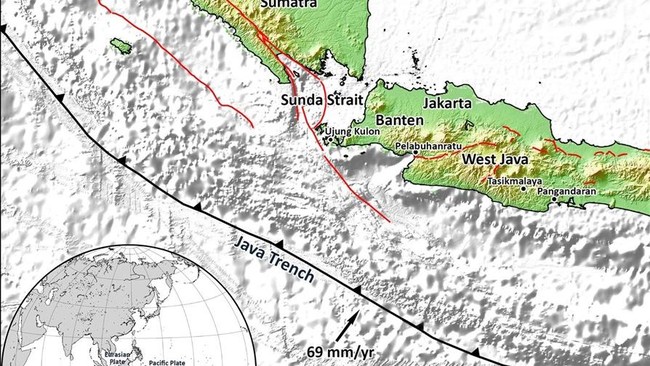
Indonesian citizens need to increase their vigilance in facing the threat of large earthquakes, including megathrust earthquakes in the Sumatra region. The public is also encouraged to change their mindset from waiting for when an earthquake will occur to ensuring readiness when a disaster strikes.
Daryono, a member of the Indonesian Disaster Expert Association (IABI), stated that earthquakes cannot be prevented or predicted with precise timing. However, the risk of casualties can be reduced if the community understands the threats and prepares mitigation steps early.
“We must change the paradigm from ‘when will the earthquake occur’ to ‘are we ready when the earthquake occurs?’ Earthquakes cannot be prevented and their timing cannot yet be predicted. However, casualties can be reduced,” said Duta, as quoted on Sunday (4/10/2026).
According to him, residents need to know whether their homes are located in earthquake or tsunami-prone areas, recognise safe buildings, identify evacuation routes and assembly points, and prepare family communication plans.
Energy Accumulation in the Sumatra Zone
One area of concern is the Mentawai-Siberut and Mentawai-Pagai megathrust zones in West Sumatra. Based on studies cited by Daryono, both segments theoretically have the potential for earthquakes with a magnitude of approximately Mw8.9.
This region is located west of Sumatra, where the Indo-Australian Plate continues to move and subduct beneath the Sunda Plate.
“This movement occurs very slowly—only a few centimetres per year, so we do not feel it in our daily lives. However, over decades to hundreds of years, this movement can cause rocks to experience pressure and store a very large amount of energy,” he said.
Daryono explained that research by Ongky Anggara et al. (2026) used GNSS data from 35 stations during the 2018-2021 period to measure crustal deformation in Sumatra, including 11 stations in the Mentawai Islands and 14 stations around the Sumatra Fault Zone. The results showed crustal shortening or compression in central Sumatra due to plate interaction.
Plates Continue to Move
The research also found high maximum shear strain in northern Siberut and the Padang area. According as Daryono, these findings indicate that tectonic processes are still ongoing and stress continues to develop.
“The earth’s crust in that area is not ‘dormant’; geodetic measurements show that tectonic processes are still working and stress is continuously developing,” he said.
Particular attention is also directed to the plate boundary area around Mentawai, which is still experiencing coupling or a relatively locked condition. Strong coupling zones were primarily found in western Siberut, while other areas show more complex patterns due to energy release from previous earthquakes.
In a 200-year return period scenario, the research estimates that Segment A in northern Siberut theoretically has a potential of up to Mw8.98, while Segment B in southern Siberut is around Mw8.79. However, Daryono emphasised that these figures are not a prediction that such a large earthquake will occur immediately.
“Mw8.98 and Mw8.79 are not predictions that such a large earthquake will occur soon. These figures are estimates of potential based on slip accumulation models, coupling, and the return period assumptions used in the research,” he clarified.
Two Threats Looming Over West Sumatra
The earthquake threat in West Sumatra does not only originate from the megathroll zone at sea. History records that the region has experienced large earthquakes, including Bengkulu in 2007 and Mentawai in 2010, while a large earthquake in 1833 is estimated to have reached approximately Mw8.8 and triggered a tsunami on the coast.
“Large earthquakes in this area are not merely a possibility based on computer models, but are part of the geological history of the west coast of Sumatra,” said Daryono.
On land, there is also the Sumatra Fault Zone, including the Sianok Segment. Research estimates the slip rate of the Sianok Segment at approximately 16.5 ± 4 millimetres per year with a locking depth of about 15 ± 3 kilometres.
“The resulting earthquakes are generally not as large as megathrust earthquakes, but because the source is shallow and can be near populated areas, the tremors can still be very destructive,” he said. Thus, West Sumatra faces two simultaneous hazards: large earthquakes from the subduction zone in the west and shallow earthquakes from active faults on land.
Do Not Fear, Obey Natural Warnings
Daryono emphasised that the findings regarding tectonic energy accumulation in Mentawai and West Sumatra are not a reason to panic, but rather a warning to strengthen preparedness.
“Science is not yet able to determine the exact date, hour, and location of a large earthquake,” he said. Therefore, residents in Mentawai and the West Sumatra coast need to know evacuation routes and locations, especially since offshore megathrust earthquakes have the potential to trigger tsunamis.
“In a local tsunami scenario, time is a precious safety factor. Therefore, if you feel very strong or prolonged earthquake tremors in coastal areas, the community needs to understand that the shaking itself is a natural warning to immediately carry out evacuations according to local procedures,” he stressed.
Daryono also encouraged the reinforcement of houses, schools, hospitals, hotels, government offices, and critical infrastructure to meet earthquake resistance standards.
“The most important message of this research is not ‘a large Mentawai earthquake will occur soon’. The message is that the tectonic processes under Mentawai and West Sumatra are still active, some zones are still storing deformation, and scientifically, there is the potential for large earthquakes in the future,” he concluded.
Source: jawawa.id (https://jawawa.id/newsitem/indonesians-must-prepare-as-megathrust-earthquakes-continue-to-threaten-1791107566)
Originally published by CNBC Indonesia (https://www.cnbcindonesia.com/news/20261004095846-4-773126/warga-ri-harus-bersiap-gempa-besar-megathrust-terus-mengancam), translated from Indonesian