
Indonesians Compare Village Co-ops to Alfamart-Indomaret, Zulhas Responds
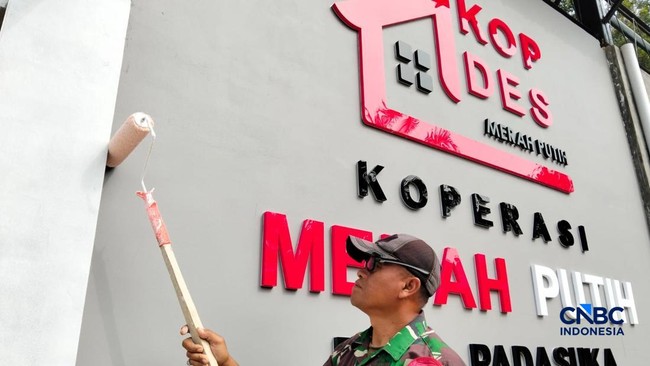
Coordinating Minister for Food Zulkifli Hasan (Zulhas) believes many people still misunderstand the function of the Koperasi Desa/Kelurahan Merah Putih (Red and White Village/Sub-district Co-operatives). According to him, the co-operatives are not simply village shops or supermarkets, but are designed to become government economic infrastructure as well as a backbone of the national food supply chain.
Zulhas explained that the Koperasi Desa/Kelurahan Merah Putih programme is currently still in the development stage, so its performance cannot yet be fully assessed. The government is targeting the establishment of 80,000 co-operatives, but for the initial phase the focus is on 40,000 co-operatives that already have land ready.
“Yes, this co-operative is not yet active, it hasn’t started. So 80,000 co-operatives will be built. But 80,000 is a lot, isn’t it, not a small number. So, this year we are focusing on 40,000 first,” Zulhas said during CNBC Indonesia’s Economic Update 2026 on Tuesday (23/6/2026).
He acknowledged that the process of establishing the legal entities for 80,000 co-operative units within six months is a major undertaking. However, the next challenge is constructing the physical co-operative buildings, which requires a longer period.
“Now, building 80,000 of them certainly needs a long time. Therefore, we are focusing first on the 40,000 that already have land, with an average area of 1,000 square metres. A 600-square-metre building will be constructed on that. Later, the function of this co-operative… the general view is that a co-operative is like a supermarket. It is not,” he stated.
Responding to perceptions developing in the community, including much criticism, Zulhas said this perception arises because the co-operatives are not yet fully operational. The government is currently still completing physical construction and preparing the human resources who will manage the co-operatives.
“Yes, it’s not accurate because it’s not finished yet, indeed. So people are still guessing. First, the legal body was established, now the physical structure is being built. Hopefully, around 30,000 of these physical structures will be completed by August-September,” he said.
According to Zulhas, once physical construction is completed by August-September 2026, the government will begin optimising the co-operatives’ functions and preparing their management.
“So indeed, it hasn’t started running yet. But people are already assessing all sorts of things, even though it hasn’t started. Perhaps we have also been lacking in explanation, or there may be implementing behaviours that are less than appropriate, for example, because this is a new product,” he said.
Furthermore, Zulhas outlined two main functions of the Koperasi Desa/Kelurahan Merah Putih. First, as a means to shorten the supply chain for various community needs and to serve as government infrastructure at the village level.
“So, what is clear is this… the co-operative was established with two functions: one, to cut long supply chains; two, to act as an offtaker,” Zulhas said.
He gave the example that the distribution of rice social assistance to the community will in future be carried out through the Koperasi Desa/Kelurahan Merah Putih to ensure it is better targeted.
“The government, under the direction of the President (Prabowo Subianto), has decided to provide assistance to 30 million Indonesians in the form of 10 kilograms of rice for 3 months. 10 kilograms of rice for 3 months. Later, that assistance will be delivered through the co-operatives,” he explained.
Besides social assistance, the co-operatives will also become distribution channels for various other necessities such as subsidised fertiliser, 3-kilogram LPG cylinders, and even financial services via BRILink.
“For example, fertiliser, which has been somewhat scarce, will later be distributed through the co-operatives. So the various supply chains are being cut. The 3-kg subsidised cooking gas will also later go through the co-operatives,” he said.
On the other hand, the co-operatives will also function as offtakers or buyers of the community’s produce. With this scheme, fishers and farmers are expected to have market certainty when commodity prices fall.
“If the fish doesn’t sell, if the unhusked rice is bought cheaply, then the co-operative will buy it. The co-operative will buy the fish, and the co-operative will later supply it to the SPPG. If the unhusked rice is cheap, the co-operative will buy it and later supply it to Bulog,” Zulhas said.
According to him, the existence of the Koperasi Desa/Kelurahan Merah Putih is part of the government’s strategy to strengthen food self-sufficiency while promoting economic equity down to the villages.
“After food self-sufficiency, we must think about the people’s economy. The President says the economy must not be controlled by just 50 people,” he stated.
Zulhas stressed that the development of village co-operatives is a long-term project intended as a new centre of economic growth in the regions. For this reason, the government is not targeting all co-operative functions to run perfectly in a short time.
“Therefore, a centre of economic growth is being built in every village through co-operatives. Later, it will host MSME exhibitions so that eventually all 80,000 villages will be connected to one another. This is a massive undertaking; it cannot be completed in one year,” he concluded.