
Indonesians celebrate Eid al-Adha in Beijing without animal sacrifice
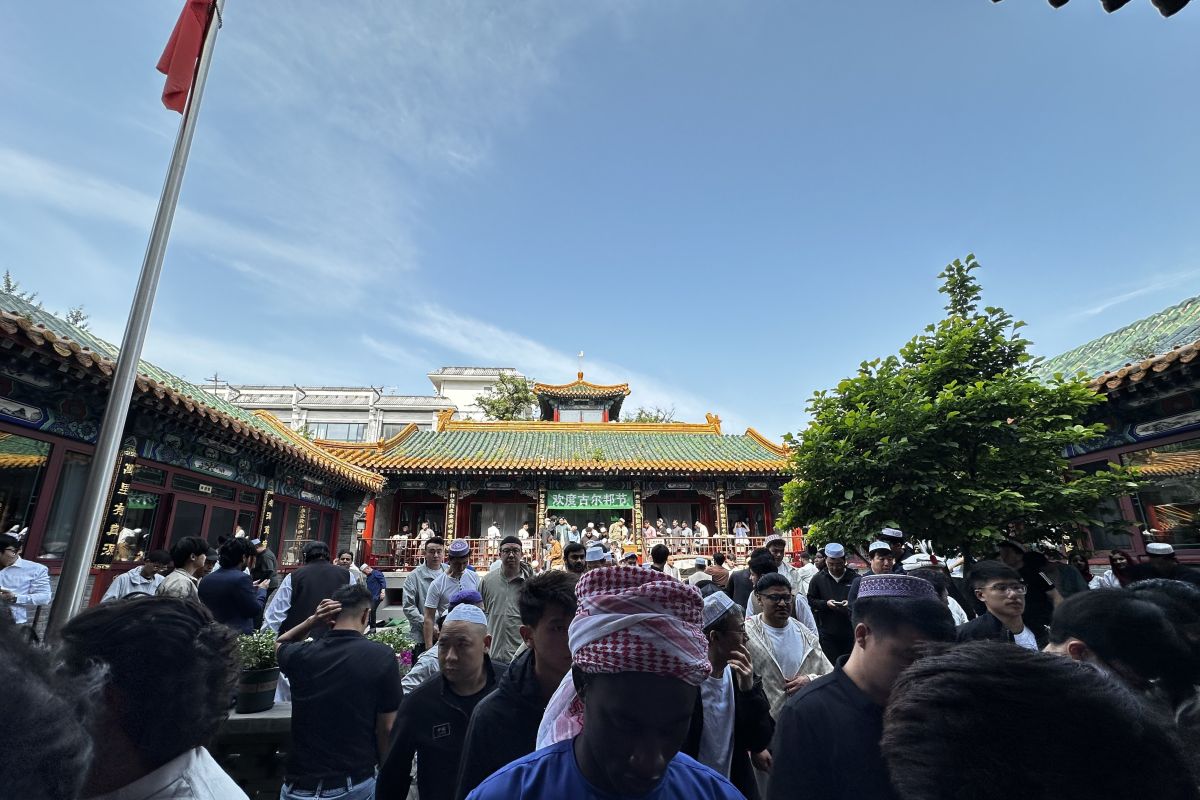
A number of Indonesian citizens (WNI) performed Eid al-Adha prayers (Id) 1447 Hijriah at Haidian Mosque in Beijing on Wednesday (27 May) without the customary animal sacrifice as practiced in Indonesia.
“I pray at Haidian Mosque because it is close to my campus and has more flexible prayer times. Prayers at other embassies start an hour earlier and are farther away,” said Fatikha Laras Sinindyas, a postgraduate student at Renmin University, who was interviewed at Haidian Mosque in Beijing.
The Eid al-Adha prayer sequence began at 8:00 local time, starting with takbir recitations by two imams followed by the reading of short Quranic verses. Around 200 worshippers from various countries attended the prayer at the mosque.
According to Laras, the later timing of the Eid prayers at Haidian Mosque allowed her time to prepare for worship. She compared it to her hometown in Bogor Regency, West Java, where Eid prayers typically start around 6:30 or 7:00 AM.
Meanwhile, Donny Bagas Kuncoro, a postgraduate student at Beijing University of Science and Technology, described differences in the Eid prayer sequence between Beijing and Indonesia.
“In Indonesia, the prayer sequence starts with the prayer and ends with the sermon. Here, there is a lecture before the prayer. The procedure is slightly different: in the first raka’ah, there are four takbirs, whereas in Indonesia there are seven,” said Donny, who has attended Eid prayers at Haidian Mosque twice.
At Haidian Mosque, two sermons are delivered in two languages. The first sermon is in Mandarin before the Eid prayer begins, and the second in Arabic after the prayer concludes.
Another difference is the number of takbirs during Eid al-Adha prayers: seven times, compared to the usual 12 times in Indonesia. In the first raka’ah, four takbirs are performed, followed by three in the second raka’ah before the ruku’ (bowing) position.
“In the second raka’ah, after the imam recites Surah Al-Fatihah and a short surah, three takbirs follow. In Indonesia, it is usually takbirs first, then Al-Fatihah and a short surah,” Laras added.
Additionally, there was no animal sacrifice ritual as in Indonesia; instead, a special table was set up for donations via QR code or cash.
Despite the differences, Laras expressed comfort with praying at Haidian Mosque due to strict security measures and responsive committee members.
“At first I was nervous, but the committee was friendly and security was high. I didn’t expect baggage checks with X-ray machines and metal detectors before entering the mosque,” she said.
“The mosque accommodates both male and female worshippers. The committee directs other worshippers to tighten the rows so everyone has space to pray,” she added.
After the prayer, the committee distributed snacks such as chocolates and dates to female worshippers.
Despite being far from home and facing ritual differences, Donny said he still felt devout during prayers and noted that the Eid celebration at Haidian Mosque has become more vibrant each year.
“Praying at Haidian Mosque allows me to meet other Muslims, and the prayer remains devout. From 2025 to 2026, I feel the mosque has become busier,” he added.
When asked about their hopes, Donny and Laras expressed a desire to celebrate Eid al-Adha with their families in Indonesia.
“I hope to celebrate the next Eid al-Adha with my family and surrounded by good people,” Laras said.
“Insha Allah, I want to pray Eid al-Adha in Indonesia after three years in China. I miss celebrating with my parents and the vibrant takbirs in Indonesian mosques,” Donny concluded.