
Indonesians Begin Producing Premium Diesel from Plastic Waste
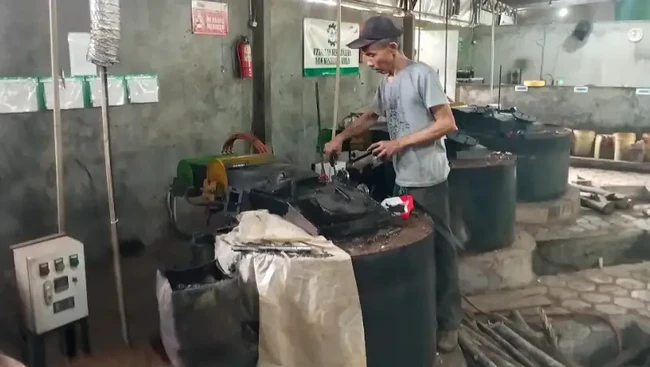
The National Research and Innovation Agency (BRIN) has introduced a technology capable of processing residual plastic waste into a liquid fuel called Petasol using Fastpol pyrolysis. The innovation was launched in Kalurahan Wukirsari, Kapanewon Imogiri, Bantul Regency, Yogyakarta Special Region, as a solution for managing low-value plastic waste that is difficult to recycle, while simultaneously creating new economic value for the community.
The Fastpol pyrolysis technology was developed by BRIN together with several partners to process various types of residual plastic waste, ranging from multilayer packaging and mixed plastics to plastic waste with no market value. Through this process, plastic waste is converted into liquid fuel that can be used for diesel engines.
Heru Susanto, a researcher at BRIN’s Centre for Sustainable Industry and Manufacturing Systems Research, explained that the technology works through pyrolysis, or the thermochemical decomposition of plastic material at temperatures of 250-350 degrees Celsius with little or no oxygen. He noted that the process essentially returns plastic, which originates from petroleum, back into fuel.
‘With this technology, plastic waste that previously had no economic value can be processed into useful products. One kilogram of residual plastic waste can produce approximately 0.8 to 0.9 litres of PETASOL,’ Heru stated. He explained that the processing of waste into fuel takes about seven to eight hours, after which the fuel must still undergo purification and filtration stages before it is ready for use.
Beyond helping to reduce waste accumulation, the technology is considered to have economic potential because its production costs are relatively low compared to the value of its utilisation. ‘The focus of this activity is the handling and reduction of low-value plastic waste that has been a residue in integrated waste treatment facilities and waste banks. The PETASOL fuel is a bonus that makes recycling actors and environmental activists interested in participating because of the economic opportunities, so it can be sustainable,’ he explained.
Heru noted, however, that the success of waste processing technology does not depend solely on machinery. Waste sorting from the household level remains a critical factor, as high sorting costs are still a major challenge. He said that collaboration between technology and a good waste management system is the key to the programme’s success.
‘Validated Fastpol Petasol technology meets dedicated environmental activists like KSM Pilah Berkah, which provides comprehensive services where all sorted waste is collected. This is supported by a real-time database, which is a strength for responsible and sustainable waste management,’ Heru said.
In terms of quality, BRIN claims that Petasol has combustion performance that even exceeds standard diesel. BRIN’s Director of Technology Transfer and Audit, Edi Hilmawan, explained that test results show Petasol has a cetane number of 51, higher than the standard diesel rating of around 48. ‘The cetane number is an indicator of combustion quality in diesel fuel. Petasol has a cetane number of 51, so its combustion quality is very good,’ Edi clarified. BRIN is continuing to refine the product so that all fuel parameters can meet applicable standards, including aspects related to specific gravity and regulation. ‘In principle, it is safe for use in vehicles,’ he added.
Going forward, BRIN is open to broader cooperation with local governments, communities, and the industrial sector to expand the utilisation of this technology. Meanwhile, Bantul Regent Abdul Halim Muslih assessed that the innovation could address two issues at once: waste management and the provision of alternative energy. ‘The fuel produced is equivalent to diesel with good quality. This will answer the waste problems we have been facing,’ Halim said. He revealed that Bantul Regency produces around 600 tonnes of waste daily, with approximately 30 per cent being plastic waste. With this volume, the potential for converting waste into fuel is considered very significant. Through collaboration between BRIN, local government, businesses, and the community, Petasol is expected to become a model for integrated waste management that can be replicated in other regions.