
Indonesian village heads study coffee processing in Yunnan
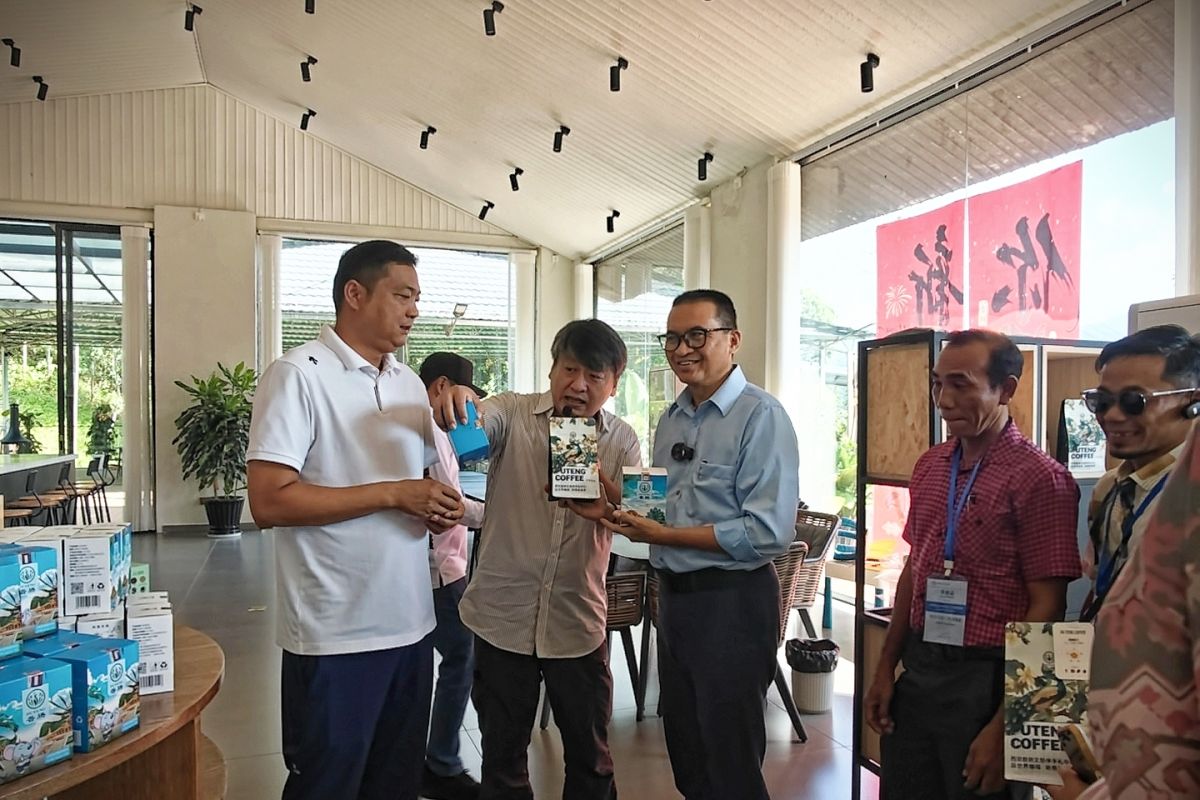
Kunming (ANTARA) - Coffee packets adorned with images of Asian elephants lined up on one side, whilst rows of coffee trees bearing still-green cherries stood on the other.
On Saturday (12/9), more than 20 village officials from Indonesia walked among the coffee trees at the Puteng Coffee Plantation in Chengganhe Village, Puwen, Jinghong City, in southwest China’s Yunnan Province. They observed coffee processing, discussed cultivation techniques, sampled coffee, and explored potential cooperation between rural industries in both countries.
Adamal Tampubolon, the village head of Hutagodang in North Sumatra Province, stood in front of a packet of specialty coffee.
He picked up the packet, carefully examining the Asian elephant design on the packaging, then walked towards the coffee trees and bent down to inspect the coffee cherries peeking out from the dense foliage. From time to time, Adamal exchanged glances with local staff about cultivation methods.
“Our village was severely affected by the floods in Sumatra last year, and our houses suffered heavy damage. At the moment, we are rebuilding,” said Adamal Tampubolon.
Although the floods disrupted the lives of local residents, the coffee trees on the hills survived. He came to China hoping to see how coffee-growing communities in Yunnan transform coffee beans into higher-value products, and to bring that experience back to his village to help farmers increase the added value of their coffee and regain confidence in developing the industry.
At the Puteng Coffee Plantation, the journey from coffee bean to cup can be seen at every stage. Fresh coffee cherries are processed and roasted before being made into espresso, flavoured instant coffee, and coffee-flavoured alcoholic beverages. At the processing facility, standardised production procedures and a closed-loop water recycling system operate smoothly, with wastewater treated and recycled.
“We are also very interested in washed coffee processing, wastewater treatment, and sustainable development. This is an experience worth bringing home,” said Mulyadin Malik, head of the Development and Information Agency (BPI) for Villages and Disadvantaged Regions at the Ministry of Villages and Development of Disadvantaged Regions (Kemendes PDT).
The company currently imports a quantity of coffee beans from abroad and also purchases beans cultivated by farmers in surrounding villages for processing. Going forward, the company hopes to bring more high-quality Indonesian coffee beans to the Chinese market.
As he tasted the espresso, Malik nodded repeatedly, showing his interest in Yunnan’s coffee industry chain, which links cultivation with processing.
“Indonesia has many different types of coffee, each with its own characteristics. Luwak coffee, for instance, is a distinctive product, and coffee produced in villages can be of very good quality. However, the packaging is not attractive enough, making it difficult to sell at a good price,” said Malik.
He hoped the visit would help them learn how Yunnan develops coffee packaging, branding, and marketing, so that high-quality coffee can be sold at better prices.
Daodelong, general manager of Puteng Trading Co., Ltd., had previously visited Indonesia to study the Indonesian coffee industry and was deeply impressed by the quality of Indonesian coffee beans and the diligence of the farmers who cultivated them.
On the day of the visit to the Puteng Coffee Plantation, Daodelong and Tampubolon reached a preliminary cooperation agreement to bring Indonesian coffee beans to the Chinese market for further processing in Yunnan.
“In the future, there will be coffee products that blend the flavours of Indonesia and China,” said Daodelong.
“If farmers produce separately, it will be difficult to maintain price stability or build a strong brand,” said Tampubolon.
After returning home, he hopes to encourage more coffee farmers to cooperate through village-level organisations, strengthen their bargaining power, and develop their own coffee brands.
Yunnan is China’s largest coffee-producing province. After years of development, the province has built a complete coffee industry chain covering nurseries, cultivation, processing, and sales, whilst continuously increasing the proportion of specialty coffee and processed coffee products.
Puwen is located in the northern part of Jinghong City. With its cool winters, mild summers, and relatively large temperature differences between day and night, Puwen provides favourable conditions for arabica coffee cultivation. In recent years, Puwen has promoted integrated development encompassing plantations, processing, marketing, tourism, and coffee culture.
According to local data, Puwen has coffee plantations covering 34,790 mu (approximately 2,319 hectares), producing around 26,500 tonnes of fresh coffee cherries each year, with a total output value of about 480 million yuan (1 yuan = IDR 2,624).
As they prepared to leave the plantation, the Indonesian village officials were still reluctant to depart. Some bent down to observe the coffee cherries on the trees, some studied the coffee packaging, whilst others discussed processing techniques.
Coffee grown in different countries and regions carries flavours shaped by different landscapes and growing conditions. Yet here in the mountains of Yunnan, a single coffee bean has become a new vehicle for exchange. From sharing cultivation experiences to exchanging processing technology and exploring market cooperation, coffee industries separated by thousands of kilometres are gradually drawing closer through a tangible and increasingly connected industry chain.