
Indonesian Tycoon Who Made His Mark in Singapore, with Streets Named After Him
Jakarta, CNBC Indonesia – Many Indonesian businesspeople hold assets in Singapore. But few people know that one Indonesian businessman once owned land there equivalent to a quarter of its territory. Imagine: of Singapore’s 728.6 square kilometres, 182 square kilometres belonged to him.
Such was his influence and contribution that his name was commemorated in Singapore street names and buildings. Who was he?
The World’s Sugar King
The businessman was Oei Tiong Ham, a Semarang-born magnate who owned one of the world’s largest sugar companies, Oei Tiong Ham Concern (OTHC). OTHC was a business conglomerate founded by Oei Tiong Ham in 1893.
OTHC began with a company called Kian Gwan, established by Oei’s father in 1863. Kian Gwan initially dealt in property, but gradually moved into the sugar business after Oei took over its management.
Through its substantial sugar monopoly, OTHC exported 200,000 tonnes of sugar, surpassing many Western companies in 1911–1912, Onghokham wrote in Konglomerat Oei Tiong Ham (1992).
At the same time, OTHC succeeded in controlling 60 per cent of the sugar market in the Dutch East Indies. Its business interests extended beyond the archipelago to India, Singapore and London. Its operations also went beyond sugar, encompassing warehousing, shipping and banking.
Given the scale of his business, it is hardly surprising that Oei was said to have amassed a fortune of 200 million guilders. By way of comparison, one guilder in 1925 could buy 20 kilogrammes of rice. At a price of Rp10,850 per kilogramme, his fortune would be worth an estimated Rp43.4 trillion.
Moving to Singapore
Over time, the enormous profits Oei made became a misfortune. His wealth drew the attention of tax officials in the Dutch East Indies colonial government. According to Liem Tjwan Ling in Oei Tiong Ham: Raja Gula dari Semarang (1979), the colonial government demanded 35 million guilders from Oei in taxes to cover post-war losses. He was also ordered to pay double the tax without a clear explanation.
Oei came to believe that the government was extorting him and that the tax demands were merely a pretext to take his money. To escape the heavy taxation, he left Semarang and settled permanently in Singapore in 1920. There, he was finally free of the tax burden.
According to Liem, Oei bought numerous plots of land and houses in the British colony, whose combined area was equivalent to a quarter of Singapore. Not every businessperson could afford to buy land there at the time; only the extremely wealthy could, and Oei was among them. All these assets were registered in Oei Tiong Ham’s personal name.
The National Library of Singapore’s official website also records that he bought the shipping company Heap Eng Moh Steamship Company Limited and was an early shareholder in Overseas Chinese Bank (OCB), now OCBC.
He also donated US$150,000 towards the construction of Raffles College and helped build several schools. He was a leading donor to humanitarian causes as well. All this took place before Oei died on 6 July 1924. After his death, his business empire began to falter.
That decline eventually led to the rapid collapse of Oei Tiong Ham’s business. In 1961, the Indonesian government brought a case against OTHC, alleging that it had breached foreign-exchange regulations.
Oei’s son, Oei Tjong Tay, described the case as an attempt by the government to find a pretext to confiscate all of OTHC’s assets in Indonesia, after previously failing to take over the company, as quoted by Benny G. Setiono in Tionghoa dalam Pusaran Politik (2003).
In short, the Semarang court found OTHC guilty. On 10 July 1961, the evidence connected with the case was confiscated and seized by the state.
The seizure, which took place in a single day, also included Oei Tiong Ham’s inheritance. In other words, all the assets of OTHC and the Oei family were confiscated. The seized assets became the capital used to establish the state-owned sugar company PT Rajawali Nusantara Indonesia (RNI) in 1964.
After the state takeover, the traces of OTHC’s large conglomerate, which had operated for decades during the colonial era, disappeared. The Oei family’s descendants also faded from public view, leaving the family as a part of history.
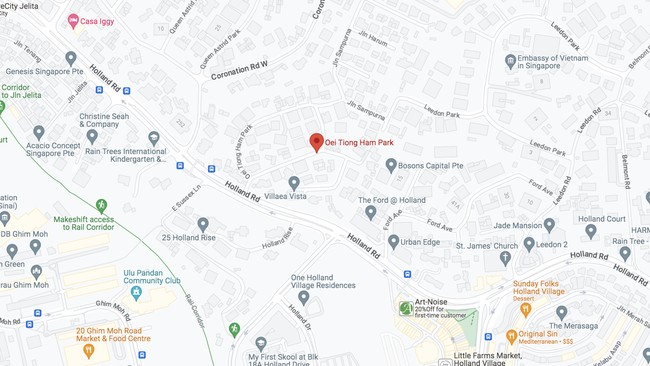
The same was true of the land and houses that had once covered a quarter of Singapore. They all disappeared from the record. Even so, Oei Tiong Ham’s legacy can still be seen in Singapore. The National University of Singapore has a building named after him, and the city has Oei Tiong Ham Park.
Source: jawawa.id (https://jawawa.id/newsitem/indonesian-tycoon-who-made-his-mark-in-singapore-with-streets-named-after-him-1793004751)
Originally published by CNBC Indonesia (https://www.cnbcindonesia.com/lifestyle/20261026134648-33-779476/konglomerat-ri-terkenal-di-singapura-namanya-diabadikan-di-jalan), translated from Indonesian