
Indonesian Territory Split in Two: Experts Reveal the Facts
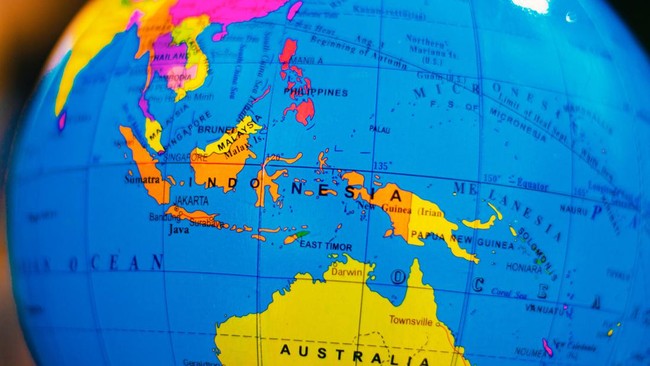
Indonesia holds a secret regional division that has existed for almost 160 years. This separation refers to the Wallace Line, a biological demarcation line stretching from Southeast Asia to Australia.
This imaginary line was first mapped by naturalist Alfred Wallace during his expedition in 1863. During his journey, he discovered highly contrasting species characteristics between the two regions.
However, the Wallace Line has long presented a mystery to scientists: why were Asian species able to cross and adapt to the Australian region, while Australian flora and fauna could not do the reverse?
This biological puzzle has finally been answered through a recent study. Researchers found that climate shifts caused by tectonic activity millions of years ago were the driving force behind this asymmetrical species distribution.
Massive tectonic activity occurring approximately 35 million years ago led to the birth of the Indonesian archipelago, beginning when the Australian landmass separated from Antarctica and moved to collide with the Asian plate.
To solve this mystery, a research team designed advanced computer models to simulate the climatic impacts of this ancient plate collision. The model accounted for dispersal capabilities, ecological preferences, and the evolutionary relationships of more than 20,000 species on both sides of the Wallace Line.
“When Australia moved away from Antarctica, it opened up deep-sea areas surrounding Antarctica that now host the Antarctic Circumpolar Current (ACC),” explained the study’s lead author and evolutionary biologist at the Australian National University, Alex Skeels, as cited by Live Science.
Notably, the Antarctic Circumpolar Current (ACC) is the largest ocean current on Earth and plays a vital role in regulating the global climate system.
The computer simulations also revealed that climate change did not impact all species equally. Southeast Asia and most of western Indonesia were blessed with a climate that tends to be warm and wet. Conversely, the Australian region possesses colder and drier climatic characteristics.
These differing climate patterns acted as a natural filter for the adaptive capabilities of living creatures. Asian species accustomed to a wet tropical climate proved more flexible in adapting when crossing into Indonesia and even advancing into Australian territory. In contrast, native Australian species, adapted to dry and cold weather, struggled to survive when attempting to cross the Wallace Line towards the west.