
Indonesian Technical Workers Begin Filling High-Tech Agricultural Sector in Japan
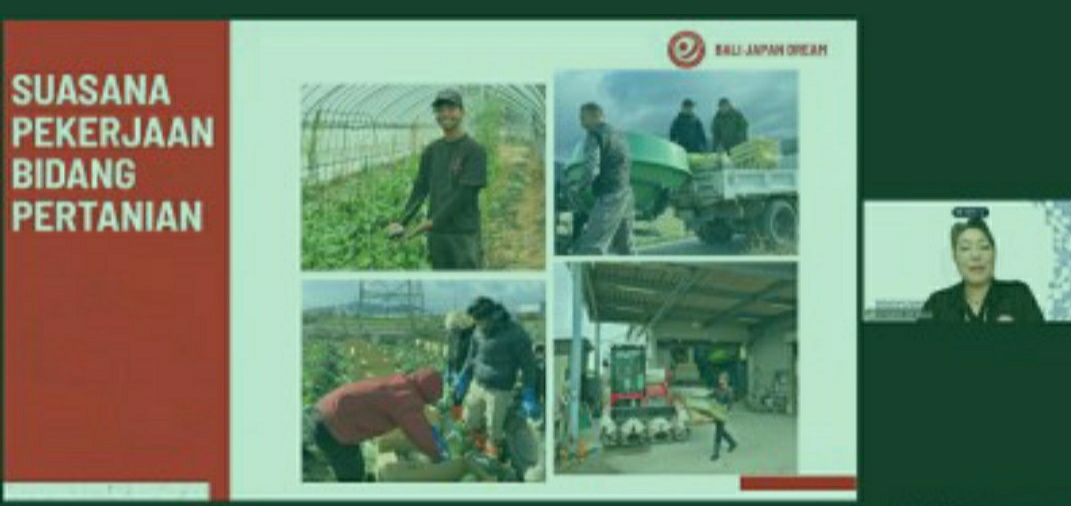
Indonesian technical workers are beginning to take on strategic roles in driving Japan’s high-tech agricultural sector. The presence of skilled human resources is no longer limited to filling physical labour positions, but has become an important part of the modernisation of precision technology-based agriculture being implemented in Japan. This was revealed by the Head of LKP Bali Japan Dream, Chikako Ishikawa, during a public online lecture organised by the Animal Husbandry Student Association, Faculty of Agriculture, Science, and Technology at Warmadewa University on Saturday (17/8). In her presentation, Chikako presented data from Japan’s Ministry of Health, Labour and Welfare (MHLW) as of the end of October 2025, which recorded that the number of foreign workers in Japan had reached 2,571,037 people, an increase of 11.7 percent compared to the previous year. These international workers are spread across 371,215 business establishments, indicating that Japan is increasingly dependent on global human resources, not only in large cities but also in regional areas and the agricultural sector. The demand for labour in Japan’s agricultural sector has experienced a very rapid surge. As of June 2025, the number of workers with Tokutei Ginou status in the agricultural sector had reached 35,454 people, an increase of approximately 5.7 times compared to December 2021, which recorded only 6,232 people. Indonesia stands out as the largest contributor of skilled workers in this sector. Data as of the end of June 2025 shows Indonesia ranked first by nationality with a total of 12,626 people. This figure accounts for 36 percent of all Tokutei Ginou workers in Japan’s agricultural sector, meaning that on average one in every three foreign workers in Japan’s agricultural sector comes from Indonesia. Career opportunities in this agricultural sector are no longer limited to short time frames. Chikako explained that the Tokutei Ginou 2 (SSW 2) scheme now opens the way for workers to build long-term careers, rather than simply working for five years. As of June 2025, a total of 519 people were recorded as holding Tokutei Ginou 2 status in Japan’s agricultural sector, with details of 371 people in crop cultivation and 148 people in livestock farming. Through the Tokutei Ginou 2 scheme, visas can be extended without limit on total period of stay as long as the required skills and experience criteria are met. This is a great opportunity for workers to pursue long-term careers in Japan. In addition to excelling in quantity and technical mastery, Chikako emphasised that the personal character of Indonesian workers has added value in the eyes of employers in Japan. Friendliness and a positive attitude are comparative advantages that make Indonesian human resources highly sought after. Indonesian workers are very well liked in Japan because they are known for smiling readily, being friendly, and never being surly. Even when facing difficult conditions or heavy work problems, they still display polite and warm personalities. This emotional maturity makes the work atmosphere comfortable and the process of adaptation with Japanese society very rapid. She explained that the professional job market in Japan currently provides two main visa pathways, namely Tokutei Ginou or Specified Skilled Worker for skilled workers in technical fields, and Gijinkoku (Engineer / Specialist in Humanities / International Services) which is specifically for university graduates to work according to their academic disciplines. Specifically for the Tokutei Ginou scheme in the agricultural and manufacturing sectors, prospective workers are required to meet dual qualifications, namely passing the Japanese language proficiency test at a minimum standard of JFT A2 as well as technical skills certification in the targeted sector. To ensure the readiness of human resources in adopting a high-tech work culture, worker preparation must go through four integrated stages. The process begins with physical and mental selection through psychometric tests and initial health checks (Pre-Medical Check Up), followed by intensive Japanese language and culture training for 4 to 6 months. After that, participants undergo the language competency test (JFT A2) and technical skills test to obtain official certification. The final stage is job matching through direct interviews with employing companies in Japan and visa processing for departure. The agricultural sector in Japan has widely implemented industrial automation, so workers no longer rely solely on physical strength but also on technological mastery. Companies there also provide standardised housing facilities for migrant workers. She added that the combination of modern technology mastery, recognition of mature educational quality, and positive personal character assets will be the main key for Indonesian university graduates to optimally capture these international career opportunities.