
Indonesian student in China: 'I feel safe and comfortable'
“During my years of studying in China, I feel safe, comfortable, and have gained valuable experiences. I hope to stay and work here,” said Maria, an Indonesian student wearing elegant traditional batik, appearing graceful and friendly as she conversed fluently in Mandarin with reporters.
As graduation approaches, Maria has clear career plans. She aims to work at a Chinese university as an Indonesian language teacher or return to Indonesia to continue in Mandarin education. “Whichever path I take, my connection with China and Mandarin will continue,” she said.
The 28-year-old from Kediri City, East Java, is a 2023 postgraduate student majoring in Chinese Language and Literature at Ningxia University.
To her, China is a country rich in history and culture, full of charm and uniqueness. After high school, Maria studied Chinese Language and Literature at Surabaya International Institute of Business and Technology (SIIBT). In 2018, through an international “2+2” cooperation program, she continued her studies in Chongqing, China.
“Learning Mandarin is not easy,” Maria said. She explained that Indonesian is a phonetic language with relatively simple pronunciation, while Mandarin is an ideographic language where meaning is conveyed through characters and tonal differences.
Additionally, cultural connotations and expression methods differ greatly. “Despite the difficulty, that’s what makes Mandarin interesting. It’s challenging yet intriguing,” she added.
To improve her Mandarin skills, she diligently studied pronunciation and Hanzi writing, read books, learned Mandarin songs, and watched Chinese dramas and films to enhance listening and speaking abilities.
In her free time, she enjoys interacting directly with Chinese locals, learning communication styles and understanding their thought processes. “Such experiences greatly help in understanding cultural differences and quickly improving Mandarin skills,” she noted.
After completing her undergraduate degree, Maria taught Mandarin at a trilingual school in Bali and a national plus school in Surabaya, instructing students from diverse ethnic backgrounds, including Chinese Indonesians and local Indonesians.
“In Indonesia, there are many ethnic Chinese. Interest in learning Mandarin is high. Now, families from various ethnic groups want their children to study Mandarin. This presents a great opportunity for us to teach Mandarin,” she explained.
Her three years of teaching experience deepened her understanding of cultural, linguistic, and cognitive differences between Indonesia and China. She felt the need to further deepen her language and cultural knowledge, prompting her return to China for postgraduate studies.
In September 2023, Maria was accepted into Ningxia University for a postgraduate programme in Chinese Language and Literature. The opportunity to study in China again after three years left her eager. She spends most of her free time in the library.
“In Indonesia, I also liked going to the library to study. Not too many people, enough seating, and a relaxed atmosphere. But at Ningxia University, you have to arrive early to secure a seat. Seeing Chinese classmates study so diligently motivates me to work harder,” she said.
Like other international students, Maria actively participates in cultural activities while studying, learning calligraphy, paper-cutting, tai chi, and other traditional Chinese cultural practices.
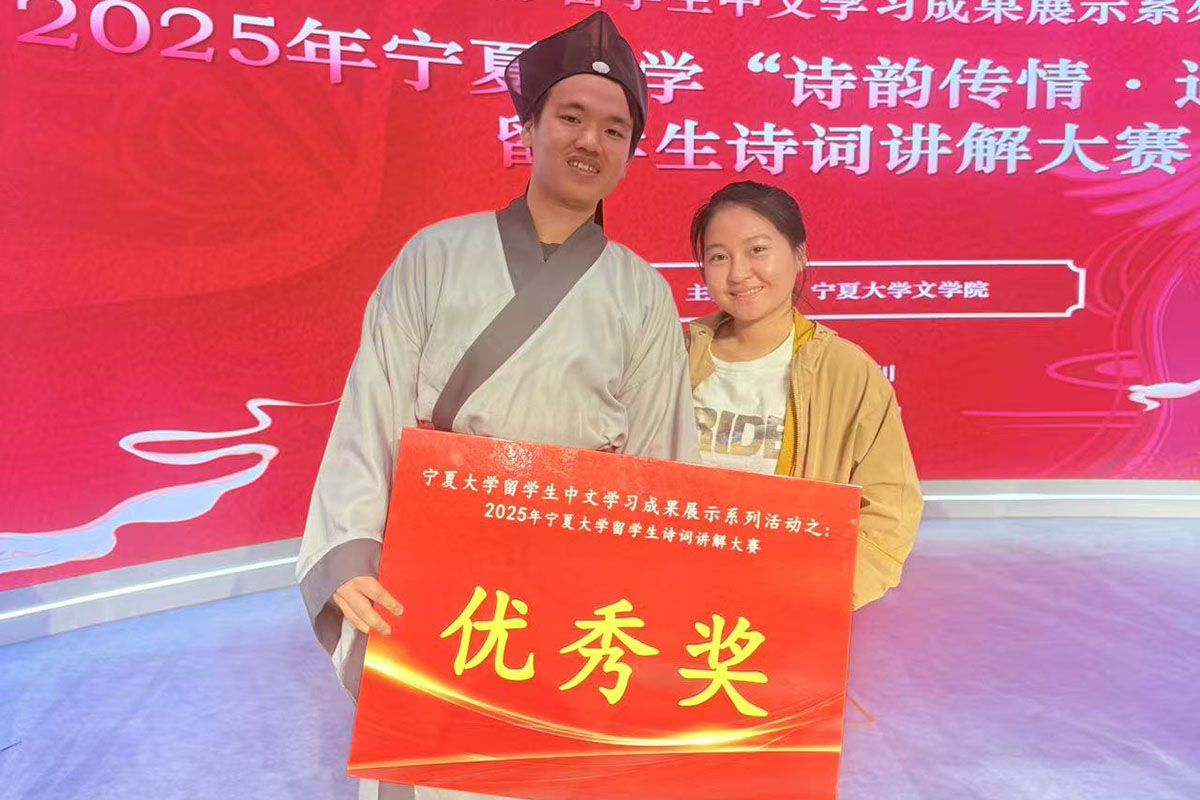
She has also gained a deeper understanding of China’s millennia-old cultural heritage. During campus art performances, she sang Mandarin songs like “Denghuo Li De Zhongguo” and “Nanniwan”, wore hanfu while reciting classical Chinese poetry, and admired the beauty of Mandarin literature and the patriotic spirit of Chinese people.
She also visited museums, schools, and prepared for international Mandarin teaching competitions. These experiences taught her the essence of “teaching and learning”, providing valuable lessons and honing her teaching skills.
Safety, warmth, and hospitality of Chinese society make international students feel at home. The open and inclusive campus environment fosters harmonious and supportive interactions between local and international students.
“China is very safe. I’m not worried walking alone at night. Even a laptop left in the library for days didn’t go missing. Professors and classmates are very kind, so I feel comfortable living here,” Maria said.
As a foreign student, she values China’s excellent social safety environment. During holidays, she enjoys cycling around Helan Mountains, exploring the city, or “travelling China by high-speed train” to experience cultural diversity.
Currently, while preparing her thesis defence, Maria is applying for teaching positions at schools. As relations and cultural exchanges between China and Indonesia grow stronger, she is optimistic about more cooperation opportunities in the field.