
Indonesian Student Finds Inspiration in China's Cultural Heritage Preservation
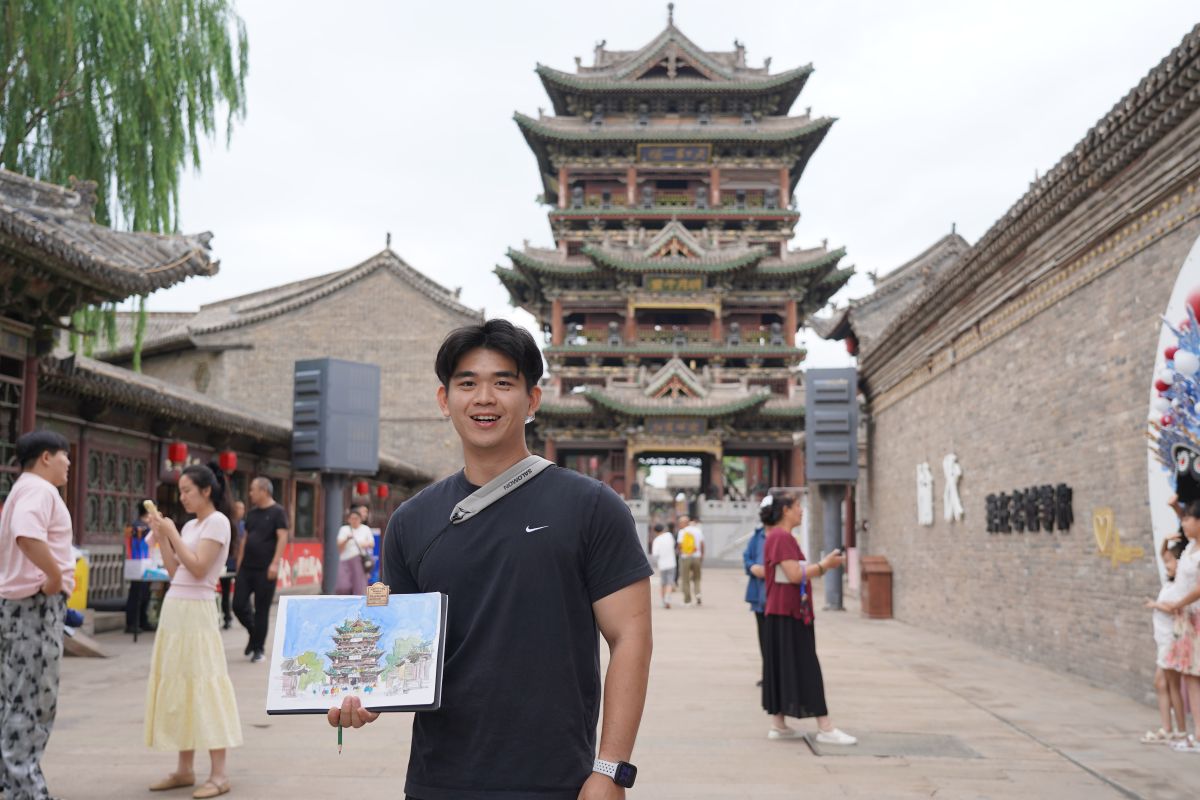
Taiyuan (ANTARA) — Rather than holding a camera, Veldesen Yaputra, an Indonesian architecture student and content creator, stood calmly in front of an ancient Chinese building. With a sketchbook in hand, he carefully drew the intricate wooden structure and the sweeping curves of the grand building’s roof.
The event brought together diplomats, heritage experts, foreign academics, and international media creators to discuss cultural heritage protection and mutual learning between civilisations.
“For me, drawing is not merely about capturing the appearance of a building,” he said. “More than that, drawing is an effort to build an emotional connection with it.”
Veldesen was one of the foreign guests attending the 2026 International Cultural Heritage Protection Week, themed “Unity for Prosperity, Heritage for Eternity”. The event opened on Wednesday (15 July) last week in the ancient city of Yuci in Jinzhong, Shanxi Province, northern China.
For Veldesen, the journey held both academic and personal value.
Born in 2001 in Pontianak, a multicultural city in West Kalimantan Province, he grew up amid a diversity of ethnic and cultural groups. His curiosity about his Chinese cultural roots prompted him to begin learning Mandarin from an early age.
In 2017, he set off for China to study Mandarin and gain a deeper understanding of the country’s culture. Captivated by China’s rich history and rapid development, Veldesen went on to study at Tsinghua University, where he studied environmental design before pursuing a master’s degree in architecture.
His studies led him to focus on traditional architecture, rural revitalisation, and cultural heritage preservation. In recent years, Shanxi has integrated digital technologies such as three-dimensional (3D) scanning, digital archiving, and immersive exhibitions into cultural heritage conservation. This approach has helped ancient cultural relics reach a wider audience whilst ensuring their preservation.
“China has taught me that heritage conservation is not simply about preserving old buildings,” he said. “It is also about nurturing the culture, history, and vitality of communities.”
During his visit to Shanxi, often dubbed “China’s treasure trove of ancient architecture”, Veldesen said he was deeply impressed by the province’s wealth of historic sites and the various efforts to protect them.
Shanxi is home to more than 500 major cultural heritage sites under state protection, the largest number among all provincial-level regions in China. The province also boasts three UNESCO World Heritage Sites: the Ancient City of Pingyao, the Yungang Grottoes, and Mount Wutai.
Veldesen believes China’s experience offers valuable lessons for many developing countries, including Indonesia.
“The greatest similarity between China and Indonesia is that their traditional architecture is closely connected to nature, culture, and local communities,” he said. “Buildings are not monuments standing in isolation. They evolve alongside the lives of their communities.”
According to Veldesen, the two countries hold significant potential for cooperation in the field of cultural heritage protection.
He hopes that more young architects, researchers, and students from both countries will have the opportunity to exchange ideas and learn from each other’s experiences. He also sees great potential for cooperation in digital technology, including 3D scanning, artificial intelligence (AI), and the digital documentation of cultural heritage.
Equally important, he said, is community participation.
“Protecting old buildings alone is not enough. Local communities must remain part of the process, so that cultural heritage continues to live and thrive among the people,” Veldesen said.
“When you carefully draw every detail, you begin to understand the wisdom of the ancient craftsmen and the stories behind the architecture,” he explained.
Looking ahead, Veldesen hopes to serve as a bridge between China and Indonesia, promoting exchanges in cultural heritage preservation, architecture, and cultural development.
“I believe cultural heritage can bring people closer together. Through closer cooperation and mutual learning, China and Indonesia can work hand in hand to protect the past whilst inspiring future generations,” Veldesen said.
Source: jawawa.id (https://jawawa.id/newsitem/indonesian-student-finds-inspiration-in-chinas-cultural-heritage-preservation-1784804244)
Originally published by Antara (Indonesian) (https://www.antaranews.com/berita/5662788/mahasiswa-indonesia-apresiasi-upaya-pelestarian-warisan-budaya-china), translated from Indonesian