
Indonesian stocks rebound 1.7% after three-day sell-off below 4,900
Indonesian Stocks Recover 1.7% After Three-Day Sell-Off Below 4,900
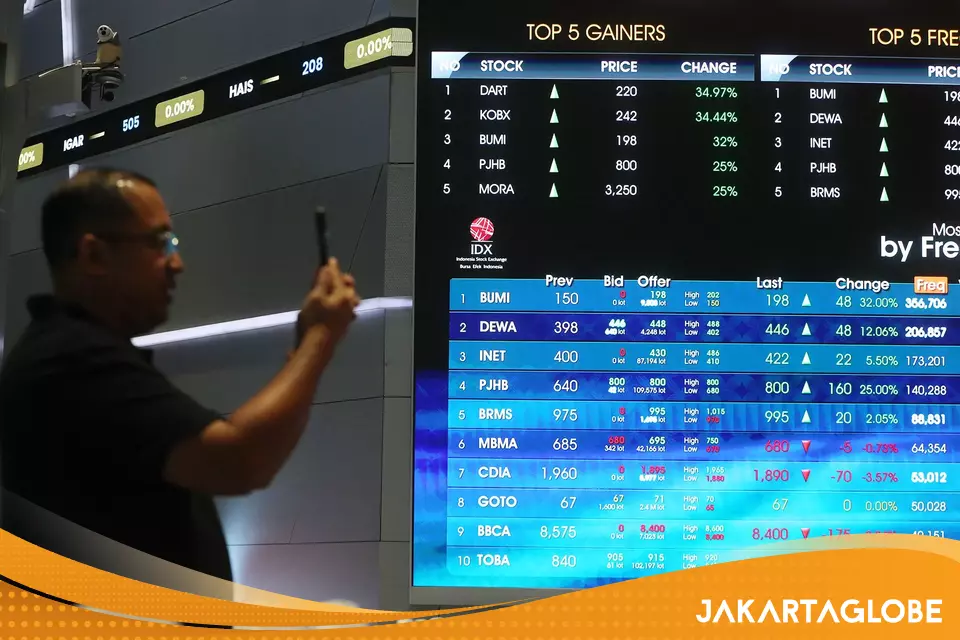
Jakarta. Indonesian stocks rebounded 1.7% on Tuesday, recovering above 5,000 after a three-day sell-off pushed the Jakarta Composite Index below 4,900 amid concerns over a potential MSCI downgrade of Indonesia to standalone market status and tighter trading rules introduced by the Indonesia Stock Exchange (IDX).
The index gained 88 points in early trading, according to IDX data, as investors assessed the exchange’s measures to improve market transparency and the prospect of share buybacks by several listed companies.
A total of 7.759 billion shares changed hands in early trading, with transaction value reaching Rp 3.9 trillion and trading frequency totaling 206,600 transactions. Advancing stocks numbered 318, while 344 declined and 301 remained unchanged.
The IDX lowered the asymmetric auto-rejection bawah (ARB), or lower trading limit, to 7% from 15%, a move aimed at moderating sharp price declines. Selling pressure persisted, although some stocks began recovering from their lower price limits after several issuers announced share buybacks.
Phintraco Sekuritas said the Jakarta Composite Index could face further pressure, with technical support at 4,800–4,900, particularly if selling continued in large-cap stocks. “Conversely, if large-cap stocks begin to rebound, the Jakarta Composite Index could strengthen above the 5,000 level today,” Phintraco Sekuritas wrote in its Tuesday research note.
The brokerage said the IDX’s measures to improve market transparency and integrity, including adjustments involving stocks with high shareholding concentration (HSC) and greater disclosure of shareholder affiliations, could help Indonesia meet MSCI’s standards. However, the measures do not guarantee a positive response from the index provider.
The policy is intended to make the Jakarta Composite Index better reflect underlying market conditions, although the adjustment could trigger short-term fluctuations because several HSC stocks carry substantial index weights.
“The adjustment process could increase market volatility, but it is expected to support the formation of an index that more accurately represents market conditions and stock liquidity,” Phintraco Sekuritas said.
Pluang Research said the IDX had responded quickly to MSCI’s potential downgrade of Indonesia, describing the decision to exclude HSC stocks accounting for around 18% of the Jakarta Composite Index’s weighting as a bold move.
“Removing HSC stocks, which account for around 18% of the Jakarta Composite Index’s weighting, is a bold decision. This means the index can no longer be driven by stocks whose ownership is concentrated in the hands of a few parties, allowing it to better reflect actual market conditions,” Pluang said in a report on Tuesday.
“The market remains volatile, and the Jakarta Composite Index fell again yesterday. Foreign investor confidence will not recover overnight. However, the policy direction is right, and we believe this is an important foundation for maintaining Indonesia’s market status in MSCI’s eyes,” it added.
Pluang explained that removing HSC stocks would automatically increase the relative weights of the remaining constituents, making major banking stocks more influential in determining the index’s direction.
In simple terms, if stocks accounting for 18% of the index’s weighting are removed, the relative weighting of the remaining stocks would increase by roughly one-fifth. This would make the Jakarta Composite Index increasingly sensitive to the performance of major banks and fund flows into the sector, requiring investors to pay closer attention to banking stocks when assessing the broader market.
Separately, Phintraco Sekuritas said Fitch Ratings’ assessment of Pos Indonesia’s default reflected company-specific internal problems rather than weakening government support for state-owned enterprises under Danantara.
The brokerage nevertheless warned that the development could raise perceptions of credit risk for some state-owned companies in the short term, prompting investors to scrutinize their debt repayment capacity and the consistency of government support.
Beyond Indonesia, global sentiment toward technology stocks began to improve, although the recovery remained uneven across markets, Kiwoom Sekuritas Indonesia said. Buying resumed after last week’s sharp correction, when advances by Chinese chipmakers and mounting debt pressures on cloud computing providers triggered a reassessment of valuations across the artificial intelligence sector.
“Investors are now increasingly selective and demanding evidence that heavy AI infrastructure spending can generate commensurate revenue and cash flow,” Kiwoom said.
Geopolitical tensions in the Middle East remained a key risk for energy markets after attacks on commercial vessels around the Arabian Peninsula and activity by Yemen’s Houthi group heightened concerns over shipping security, the brokerage added.
Brent crude prices held above $109 per barrel on Tuesday, maintaining recent gains as investors weighed escalating conflicts in the Middle East and Eastern Europe against signs of robust energy flows from the Persian Gulf.
Across regional markets, Japan’s Nikkei 225 fell 0.62% as of 10 a.m. Jakarta time. South Korea’s Kospi dropped 2.78%, Hong Kong’s Hang Seng declined 0.95%, and Shanghai’s SSE Composite slipped 0.02%.
Tags: Keywords:
Source: jawawa.id (https://jawawa.id/newsitem/indonesian-stocks-rebound-1-7-after-three-day-sell-off-below-4-900-1792497010)
Originally published by jakartaglobe.id (https://jakartaglobe.id/business/indonesian-stocks-recover-17-after-threeday-selloff-below-4900)