
Indonesian Stocks Look Cheap, with Some Trading Below Four Times Earnings: Are They Attractive?
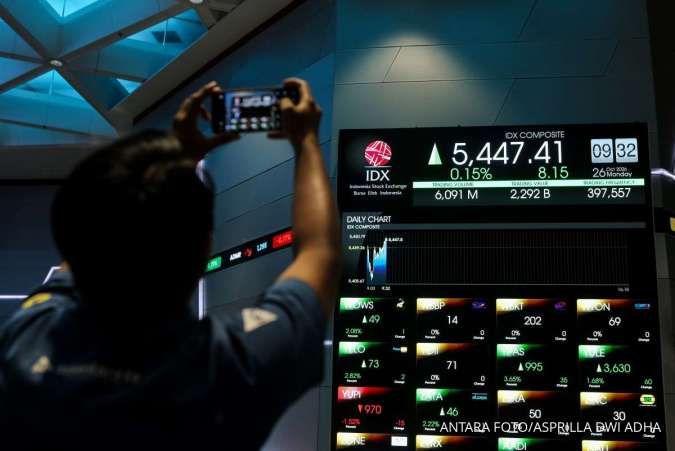
KONTAN.CO.ID – JAKARTA. The Jakarta Composite Index (JCI) fell in trading on Monday (26 October 2026), declining 1.22% to close at 5,373.04. It has now dropped 37.86% since the start of the year (year to date, or YtD).
Against this backdrop, Indonesian shares are now valued at relatively low levels. This is reflected in the JCI’s price-to-earnings (PE) ratio, which stands at around 11 times.
Several companies listed on the Indonesia Stock Exchange (IDX) have PE ratios well below the JCI’s average valuation. These include PTBA at about 7.95 times, TINS at 7.78 times, ANTM at 7.72 times, ITMG at 7.63 times, INDF at 6.19 times, BBNI at 6.15 times, CPIN at 6.08 times, BMRI at 5.67 times, JPFA at 4.04 times and BBTN at 3.18 times, among others.
This could create investment opportunities, particularly in companies with sound fundamentals whose share prices have also been hit by market sentiment.
However, a PE ratio below that of the JCI does not automatically mean a share is cheap. Investors need to consider each company’s business characteristics and earnings growth prospects.
For example, a share trading at six times earnings is not necessarily more attractive than one trading at 12 times if the former company faces a much greater risk of falling profits.
“We therefore see low valuations as a starting point for looking for investment opportunities, not as the main basis for a buying decision,” Rully told Kontan on Monday (26 October 2026).
Kiwoom Sekuritas Head of Research Liza Camelia Suryanata agreed, saying a low PE ratio should be used as an initial screening tool rather than treated immediately as a buy signal.
Liza said the key factor investors should consider is how long a company can sustain its earnings. A share with a PE below the JCI’s average of about 11 times is not necessarily cheap once differences in sector characteristics, growth prospects and business risks are taken into account.
“A simple example: a share with a PE of five times would have a PE of 10 times if earnings per share halved, even if its share price did not change. So what looks cheap today may actually be reflecting an anticipated fall in earnings tomorrow,” Liza said.
Factors behind low share valuations
Liza explained that low valuations can be driven by business factors as well as market conditions. Business-related causes include slowing growth, squeezed margins and high debt costs. On the market side, policy uncertainty can lead investors to demand a larger valuation discount.
She also cautioned that for cyclical businesses such as commodities, PE ratios can appear lowest when earnings are at the peak of a cycle and are difficult to repeat. Profits from asset sales or other non-recurring gains should also be excluded when assessing a company’s normal earnings capacity.
“For Indonesia at present, I think valuation discounts should also be considered alongside questions of confidence and capital-allocation risks, given that MSCI is still consulting on the possibility of changing the country’s status to Standalone,” Liza said.
Liza stressed that even high-quality shares can be sold when fund managers adjust their portfolios to match a benchmark. A falling share price, therefore, does not necessarily reflect a deterioration in the business. Investors need to distinguish between a discount caused by temporary selling pressure and one caused by a genuine worsening of a company’s prospects.
Rully also outlined several reasons why some shares have low PE ratios. First, the market may expect a company’s earnings growth to slow or even turn negative. This is particularly relevant to companies in commodities or industries that are highly dependent on the economic cycle.
Second, a low PE may reflect earnings that are currently elevated and may not be sustainable. When profits return to normal levels, a share’s PE can rise even if its price remains unchanged.
In addition, foreign investor selling pressure and uncertainty surrounding MSCI may be pushing some Indonesian shares below their historical average valuations, even when company fundamentals have not changed to a comparable extent.
Cheap shares or value traps?
Rully said earnings sustainability is the first factor to consider when distinguishing a cheap share from a value trap. Investors should not rely solely on trailing PE, based on earnings over the past 12 months, but should also examine earnings forecasts for the next one to two years.
Second, investors should assess the quality of earnings and operating cash flow. Companies reporting large profits but failing to generate adequate cash flow warrant closer scrutiny.
Third, valuations should be compared with the company’s historical average and those of similar listed companies, while accounting for differences in earnings growth, profitability and business risk.
Fourth, investors should look for catalysts that could improve performance or prompt a valuation reassessment, such as a recovery in demand, lower financing costs, wider margins or better corporate governance.
“Overall, we are starting to see more attractive investment opportunities after the market’s sharp correction. However, we continue to recommend a selective, gradual approach, prioritising companies with healthy fundamentals, sustainable earnings prospects and valuations that offer a margin of safety,” Rully said.
Source: jawawa.id (https://jawawa.id/newsitem/indonesian-stocks-look-cheap-with-some-trading-below-four-times-earnings-are-they-attractive-1793062226)
Originally published by investasi.kontan.co.id (https://investasi.kontan.co.id/news/valuasi-pasar-saham-sudah-murah-saham-ini-punya-pe-di-bawah-4-kali-menarikkah), translated from Indonesian