
Indonesian Shipyard Industry Struggles: Weakening Rupiah and High Bank Interest Rates
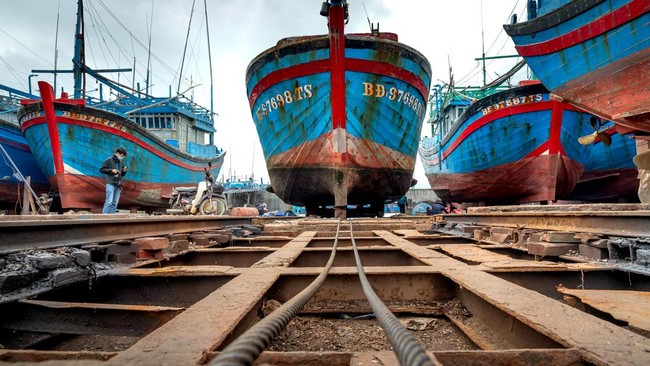
The national shipbuilding industry is facing cost pressures from two sides simultaneously. Ship financing remains expensive, while the weakening of foreign exchange rates is driving up the prices of various materials and components that must still be imported from abroad.
This condition is a critical issue because shipbuilding requires large amounts of capital from the very early stages. In addition to primary materials, several high-value components are still priced in foreign currencies, meaning exchange rate fluctuations directly impact production costs.
The Chairperson of the DPP IPERINDO (Indonesian Association of Shipbuilding and Offshore Companies), Anita Puji Utami, assessed that access to banking is not actually the primary issue. The challenge lies in the interest rate levels, which still follow general financing patterns and have not been specifically adjusted to suit the unique characteristics of the shipbuilding industry.
“Accessing it is not a problem, but if the banks continue to apply interest rate patterns that are the same as other industries, I think it will be difficult for the shipbuilding industry,” Anita told CNBC Indonesia on Tuesday (29/09/26).
Shipbuilding has a production cycle and investment return period that differs from many other business sectors. Therefore, the cost of funds is one of the components that determines whether a ship project can be executed competitively within the country.
Cost pressure also comes from the material side. Steel plates, consumables, paint, spare parts, as well as several engines and major ship components, are still affected by foreign exchange movements.
In addition to material prices, components such as main engines and auxiliary engines are also vital parts of the production cost structure. Dependence on imported materials means that exchange rate changes do not only affect one part of the ship but can ripple through the entire project value.
“Like in other countries, if it could be in the single digits—perhaps around 4%—it could greatly assist the shipbuilding industry and shipping companies in building in Indonesia,” she said.
The rising exchange rate also forces national shipyards to face price pressures when competing with shipyards in other countries. This situation becomes even more difficult when imported components still represent a large portion of shipbuilding.
Production cost calculations are ultimately influenced not only by the price of steel and domestic production needs. Main engines, auxiliary engines, and certain components that are not yet available competitively from domestic suppliers also determine the final price of the ship.
“Furthermore, with the recent rise in foreign exchange rates, this has triggered an increase in raw materials. Starting from the price of plates, consumables, then paint, and spare parts. Additionally, several imported materials such as main engines, primary engines, auxiliary engines, and various types of ship components that are still imported and use foreign currency make ship prices in Indonesia higher compared to other countries,” said Anita.
The magnitude of this pressure is beginning to reflect in the rising costs borne by the industry. This condition has the potential to reduce the competitiveness of shipyards in securing new orders, especially when potential ship users have the option to purchase or build ships from abroad.
“Currently, the most recent increase could be up to 15%,” she added.
Notably, the Rupiah exchange rate came under increasing pressure against the US Dollar during trading on Tuesday (29/09/2026). The US Dollar has now breached the psychological level of Rp18,000.
According to Refinitiv data, at 09:55 WIB, the Rupiah depreciated by 0.19% to the position of Rp18,000/US.TheRupiah′sweaknesswidenedcomparedtothismorning′sopeningposition.TheRupiahbegantradingwithaslightdeclineof0.03.
This pressure continued from Monday (28/09/2026), when the Rupiah closed weaker by 0.48% at the position of Rp17,965/US$.