
Indonesian Shipping Bosses Alarmed by Rising Dollar Exchange Rate
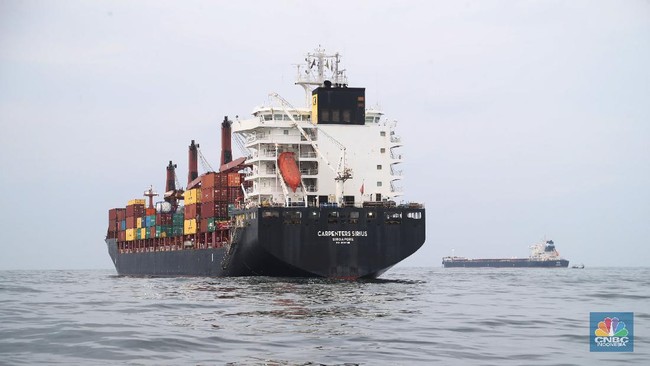
The national shipping industry is facing several challenges at the start of the year, ranging from global geopolitical uncertainty to pressure on the Rupiah exchange rate. These conditions are directly affecting the operational costs of domestic shipping companies.
Carmelita Hartoto, Vice Chairperson Coordinator for Infrastructure and Regional Development of the Indonesian Chamber of Commerce and Industry (Kadin Indonesia), stated that every global upheaval presents both challenges and opportunities for businesses. “In the shipping industry, we always say that whenever there is political or situational complexity, there is an opportunity there. However, this is contingent on the currency fluctuation not continuing to rise,” Hartoto told CNBC Indonesia on Tuesday.
Amidst these dynamics, shipping operators are striving to maintain operational continuity to ensure the distribution of goods and services remains normal. In addition to the Rupiah exchange rate, fuel prices are a critical factor determining the survival of the national shipping industry. “We hope prices do not rise further. The primary concern for us is oil prices. If fuel prices continue to climb, ultimately, shipping operations will cease. Therefore, we must continue to look for opportunities and hope for the best,” she said.
The weakening Rupiah is also exerting additional pressure on the financing of shipping companies. Several components still rely on transactions conducted in US Dollars, including the purchase of spare parts, insurance premiums, and credit obligations to foreign financial institutions. “The impact is primarily on the purchase of spare parts and other supplies, as we still pay in US Dollars. Furthermore, our insurance must also be paid in US Dollars. Some of our loans are not only from domestic sources but also from overseas, which are repaid in US Dollars. This is what will burden us,” said Hartoto, who also serves as the Chairperson of the Indonesian National Shipowners Association (INSA).
The shipping industry is directly linked to national economic activity as it plays a vital role in the inter-regional distribution of goods. Consequently, any change in operational costs has the potential to affect the broader supply chain. “I believe as long as public purchasing power remains high, shipping remains the most cost-effective mode of transport. It is our hope that operations continue. If transport ceases, it will not only affect shipping but the entire national economy will come to a halt,” she concluded.