
Indonesian Rubber Farmers Cry Out to Parliament: A Struggle for Survival
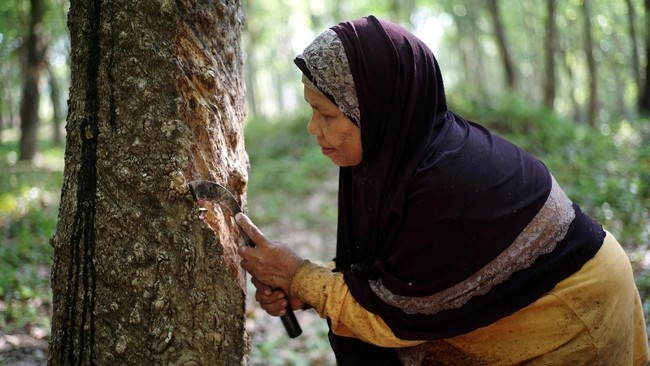
Jakarta, CNBC Indonesia - Rubber farmers are complaining about the lack of government support for the rubber commodity amidst the conversion of rubber plantations to oil palm. Farmers believe that palm oil receives significantly more attention, while smallholder rubber plantations continue to face issues such as ageing trees, low productivity, and a lack of assistance for production facilities.
These grievances were presented by the Chairman of the South Sumatra Regional Leadership Council of the Indonesian Rubber Farmers Association (Apkarindo), Supartlag, during a Public Hearing with Commission IV of the Indonesian House of Representatives (DPR) on Tuesday (6/10/2026).
“Why is the biological child treated like a stepchild? Because for palm oil, replanting can receive Rp60 million per hectare. For rubber? Forget about being given seeds, forget about fertiliser assistance; they are barely even noticed by the government, from the regency level to the central level,” said Supartijo.
According to him, the condition of smallholder rubber plantations is under increasing pressure. Most existing rubber trees are old plants, planted between the 1980s and 2000s.
“Of the total area, only about 300,000 to 400,000 hectares still have high productivity. The rest are old, weak, and lack vitality; they have never been properly fertilised because prices are so low that farmers cannot afford to support their families,” he said.
He noted that the current rise in rubber prices does not automatically benefit farmers because many trees are aged. Furthermore, some plantations have experienced overtapping, leading to low yields.
“Now that prices have risen, the rubber is old, the tapping is excessive (overtapping), and the results are very low. Consequently, many mutations are occurring; our farmers are switching from rubber to oil palm,” he revealed.
He stated that oil palm is the preferred choice for farmers as it is seen to provide faster returns. Rubber wood is felled and sold immediately, and the land is then replanted with oil palm.
“The wood is sold for quick cash, and then oil palm is planted, because oil palm is the ‘golden child’. Meanwhile, rubber has become the ‘stepchild’,” he emphasised.
Rubber Processing Factories Also Under Pressure
This issue affects not only the farmers but also the rubber processing industry. According to Apkarindo data, Indonesia’s rubber production fell from approximately 3.68 million tonnes in 2017 to around 2.1 million tonnes in 2025. This condition has also caused the utilisation of the rubber processing industry to fall below 50%.
Data on the position of crumb rubber processing units as of 30 September 2026 also shows a decline; of the 157 recorded units, 60 have ceased operations, while 97 remain active.
Supartijo stated that this situation is also occurring in South Sumatra. He noted that the number of rubber factories in the province has shrunk, and the factories that remain are not operating at full capacity.
“There is a factory in South Sumatra that went from 30 units down to 19, and even those have idle capacity because there is no raw material,” said Supartijo.
He also mentioned that the profession of rubber tappers is increasingly being abandoned because the income is no longer attractive.
“Labourer rubber tappers no longer want to work because they cannot earn Rp100,000 a day; they only get Rp50,000 to Rp60,000 a day,” he said.
Farmers Request Government Support
Supartijo hopes the government will provide support for the replanting of smallholder rubber plantations, including assistance during the planting period.
“We hope that the honourable members of the DPR and the government will provide fair and wise support. If food crops receive harvesting tools and paddy field moulding tools, for rubber, even partial assistance during the planting period would be enough,” he said.
Similar complaints were voiced by Apkarindo representatives from various regions. They requested replanting, as well as affordable seed and fertiliser assistance, to address the issue of ageing rubber trees.
Furthermore, Supartijo stated that smallholder plantations account for about 93% of Indonesia’s total rubber plantations, with approximately 2.3 million families depending on the commodity.
Apkarindo also proposed the formation of a Rubber Plantation Fund Management Agency (BPDP Karet) to support replanting, rehabilitation, research, human resource development, and the downstream rubber industry. He suggested that funding schemes could be sourced from, among others, export levies or rubber cess.
Supartijo warned that the national rubber industry will face even harder times if not addressed immediately.
“If left for another 10 years, ‘rubber’ will only be a name. Everything will close. Every day, rubber is felled, the wood is sold, and it is replaced by oil palm,” he concluded.
Source: jawawa.id (https://jawawa.id/newsitem/indonesian-rubber-farmers-cry-out-to-parliament-a-struggle-for-survival-1791283982)
Originally published by CNBC Indonesia (https://www.cnbcindonesia.com/news/20261006161055-4-773833/petani-karet-ri-menjerit-ke-dpr-cerita-tak-pernah-makan-enak-ada-apa), translated from Indonesian