
Indonesian Residents Can Produce Diesel Fuel Themselves from Plastic Bags, Here's How
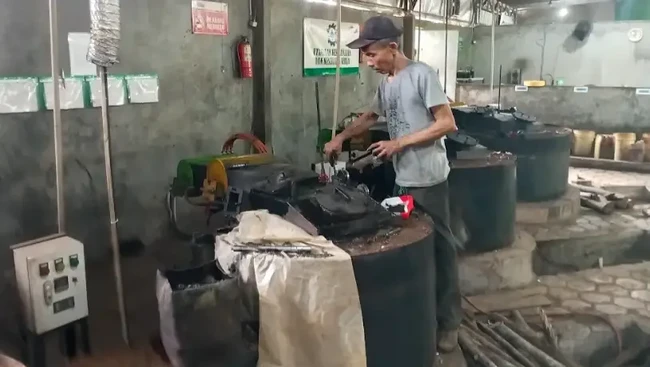
Jakarta, CNBC Indonesia - Plastic waste such as shopping bags is considered worthless once used, but it can actually be processed into fuel oil (BBM). The result is said to be close to Dexlite diesel fuel with economic value.
Chairman of the Faspol 5.0 Production Division at the Banjarnegara Waste Bank (BSB), Endi Rudianto, shared his experience managing plastic waste at BSB during the Media Lounge Discussion (MELODI) event by the National Research and Innovation Agency (BRIN), held online, quoted on Saturday (9/5/2026).
Endi explained that the idea stemmed from concern over the accumulation of plastic waste in the surrounding environment. He and his team then tried processing the waste into simple fuel for wick stoves.
Unfortunately, the government at that time began aggressively promoting the use of LPG gas stoves. As a result, wick stoves were gradually abandoned by residents.
Not giving up there, BSB community founder Budi Trisno Aji succeeded in 2019 in finding a catalyst or additive substance capable of purifying the plastic waste processing into high-quality diesel fuel. Endi calls it fast pyrolysis 5.0 technology or Faspol 5.0. The resulting fuel is named Petasol.
“Plastic waste as the main raw material comes from shopping bags that have no economic value. It is then burned to produce liquid and gas. The liquid or fuel oil is then treated with the catalyst we created, resulting in Petasol,” said Endi.
According to him, BSB currently has a waste processing machine with a capacity of 200 kilograms of plastic waste raw material, which can produce 170 to 180 litres of Petasol.
“We cannot confirm that 1 kilogram of raw material produces 1 litre of Petasol. As an illustration, clean dry waste can yield 95 percent. However, for average dry and wet waste, it yields 70 to 80%,” he stated.
So far, the Petasol produced by BSB has been used for agricultural machines and residents’ motor vehicles in the area.
In addition to creating Faspol 5.0, they have made simple waste incinerator machines for use by waste banks in other locations. Endi mentioned that at least 50 places across Indonesia are already using the waste incinerator machines and the Faspol 5.0 technology they produce.
“Whenever we send machines and Faspol 5.0 technology, we follow up with training for the operators to ensure the machines produce products according to the established SOP,” Endi explained.
To ensure its quality, Petasol has undergone various tests in laboratories at BRIN, Lemigas, and Diponegoro University. The results show that this fuel meets standards equivalent to B0 diesel.
BRIN Senior Researcher Tri Martini revealed that from an economic perspective, Petasol production is quite promising. Production costs are around Rp6,160 per litre with a recommended selling price of Rp9,700, thus generating a large profit margin.
“From our break-even point analysis, investment for a machine capacity of 50-100 litres is estimated to be recouped in 1.5 years. Additionally, the benefit-cost ratio is above one with a revenue-cost ratio above two, meaning this activity is profitable and viable for development,” Tri stated.
According to Tri, the development of this technology is also seen as having the potential to drive energy independence in rural areas, especially for farmers and fishermen. If widely adopted, this innovation will also help reduce dependence on conventional BBM while addressing Indonesia’s plastic waste issue.