
Indonesian Red Cross Establishes Learning Tents and Supports Field Hospitals Post-Earthquake in NTT
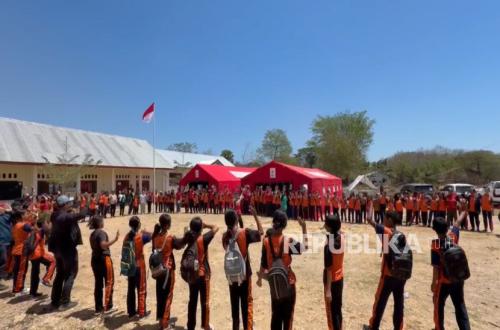
The Indonesian Red Cross (PMI) has constructed learning tents as temporary educational spaces to help restore educational activities for communities affected by the earthquake. This initiative includes SMP Negeri 8 Komodo in West Manggarai Regency, East Nusa Tenggara, where several parts of the school buildings suffered cracks following the tremors.
In addition to supporting the education sector, PMI is strengthening healthcare services by providing tents and supporting facilities to sustain the operations of field hospitals and community health centres (Puskesmas) impacted by the earthquake. This support is part of PMI’s response to the earthquake’s impact, which caused not only structural damage but also disrupted essential community activities, including teaching and healthcare services.
Previously, approximately 140 students of SMP Negeri 8 Komodo, divided into six study groups, had resumed face-to-face learning. However, for the time being, classes are not being held in classrooms. Instead, students are attending lessons in an open area using the learning tents provided by PMI.
The Head of SMP Negeri 8 Komodo, Aloysia Moto, stated that the decision was made considering both the condition of the school buildings and the psychological state of the students following the earthquake. “During the emergency response period, we prioritise the children’s psychology, especially their sense of fear,” said Aloysia.
She noted that repeated tremors have left some students anxious about returning to activities inside school buildings. The cracked condition of the buildings is also a significant concern. “Especially since we have a second floor. When there are vibrations, children might panic and run immediately. This is very worrying,” she added.
Consequently, open-air learning has become a temporary alternative. Beyond safety considerations, learning in tents is expected to help students gradually rebuild their sense of security after the disaster. Aloysia explained that before resuming face-to-face learning, the school had attempted online learning, but the method faced various obstacles and was not optimal.
“Post-earthquake, learning was ineffective. Students had been learning online, but it was not effective due to many disruptions. Some parents do not have smartphones, there is a lack of data credit, and various other constraints,” said Aloysia. The limited availability of communication devices and internet access made it difficult for some students to follow distance learning, necessitating an alternative to ensure the educational process could continue in person.
With approximately 140 students across six groups, the presence of learning tents is vital to ensure educational activities continue while school buildings cannot be used optimally. “We want the children to understand that learning can still take place, even if we are temporarily not inside a classroom,” said Aloysia. She also expressed her appreciation to PMI for responding to the school’s needs in this post-earthquake situation.
Meanwhile, the Head of the Infrastructure Bureau at the PMI National Headquarters, Ilham Huznul, stated that PMI’s support in handling the earthquake’s impact is tailored to the needs and requests of the community on the ground. This aligns with the directives of PMI General Chairman Jusuf Kalla, ensuring that disaster management is rapid, precise, and directly addresses the primary needs of the citizens.
In managing the earthquake’s impact, PMI is not only targeting the education sector but also ensuring that healthcare services can continue. “Our support is adjusted to the current needs and requests of the community. One of these is the provision of learning tents to support educational activities. In the health sector, we are also preparing temporary facilities according to the needs of field services,” said Ilma.
To support healthcare, PMI has constructed 13 units of large tents (6 x 12 metres) to support the operations of the field hospital in Ruteng. This Ministry of Health field hospital was established after the previous hospital facilities became inoperable due to earthquake damage. In addition to the tents, PMI is providing 10 portable toilet units to support sanitation and the comfort of both healthcare workers and the public receiving services at the field hospital.
Beyond the field hospital, PMI is also providing support for services at the community health centre (Puskesmas) level by constructing 3 units of tents to support health facilities. This support is intended to ensure that community healthcare services can continue despite the impact of the earthquake on health facilities. “This support is provided so that community healthcare can continue even if health facilities are affected by the earthquake and cannot be used normally. In accordance with the instructions of PMI General Chairman Mr Jusuf Kalla, PMI’s aid operations must prioritise the principles of being fast and precisely targeted,” said Ilham.
According to Ilham, providing tents and supporting facilities serves as a temporary solution while permanent facilities are unavailable. “The tents and supporting facilities we have built are expected to help healthcare workers provide services to the community in a more decent and comfortable manner,” he concluded.
Source: jawawa.id (https://jawawa.id/newsitem/indonesian-red-cross-establishes-learning-tents-and-supports-field-hospitals-post-earthquake-in-ntt-1788512360)
Originally published by Republika (https://news.republika.co.id/berita/tktylw430/pmi-bangun-tenda-belajar-dan-dukung-rumah-sakit-lapangan-pascagempa-di-ntt), translated from Indonesian