
Indonesian Quarantine Agency to Overhaul 22 Regulations, Partners with Apindo
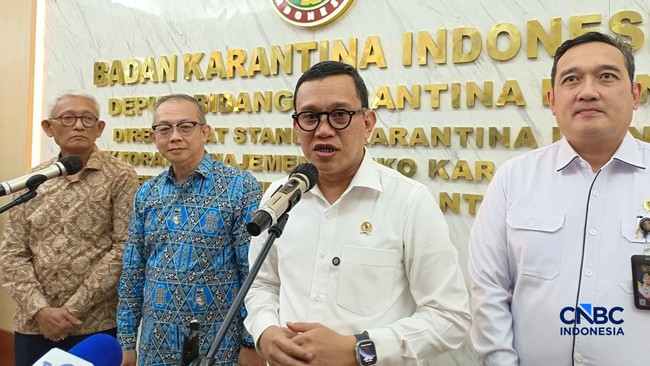
The Indonesian Quarantine Agency (Barantin) plans to cut various regulations deemed to hinder export activities. The move will be carried out through the deregulation of 22 head of agency regulations, while accelerating quarantine services and simplifying inspection processes to enhance exporter competitiveness.
Head of Barantin Abdul Kadir Karding stated that the deregulation plan is a follow-up to various inputs submitted by business actors. One prominent complaint is the persistent difference in document interpretation and service treatment in several regions.
“There were many inputs, first, (businesses) asked us to improve, shorten, and make services more efficient. So the service is fast. For example, what? It is still sometimes found in regions, between Belawan and Jakarta, that they interpret documents differently,” Karding said during a press conference at his office in Jakarta on Wednesday (1/7/2026).
He said Barantin is currently also preparing the deregulation of 22 internal rules to create a more efficient export-import ecosystem.
“Secondly, they hope for deregulation, and indeed we are working on 22 head of agency regulations that we will deregulate for improvements. The actual goal is that we want to build a good export-import and trade ecosystem,” he stated.
In addition to deregulation, Barantin will also strengthen coordination with other ministries and institutions so that service processes can be integrated through a single submission and single inspection system. According to Karding, this step is important to cut the administrative burden borne by exporters so far.
He assessed that efforts to simplify services are increasingly urgent amid the surge in global logistics costs due to geopolitical conflicts.
“When this war occurs between America, Iran, and its allies, what happens is that the costs for production, logistics, and shipping of goods rise. They rise by up to 103-109 percent. Not to mention production. Now, if this is added with the burden of checking this and that, too many, it increasingly burdens our exporters,” he explained.
According to him, if exports are hampered, the impact will spread to labour absorption, economic growth, and state foreign exchange earnings.
“So if our exports are not smooth, the labour absorption rate will fall, economic growth will decline, and thirdly our foreign exchange will also fall,” Karding said.
Karding added that Barantin and the Indonesian Employers’ Association (Apindo) also agreed to form a regular consultation forum every two to three months to evaluate various obstacles faced by business actors.
“Then secondly, we agreed to have a regular consultation forum, maybe every 2 or 3 months we meet, to find out what is lacking in quarantine, what is already good, what needs to be improved, so that this is healthy. So businesspeople, workers, and the government must be one movement, one heart, one soul,” he said.
Meanwhile, Apindo’s Head of Fisheries and Livestock Industry Hendra Sugandhi welcomed Barantin’s move to open a consultation space with the business world. According to him, this collaboration is necessary so that pressure from global economic conditions does not further burden exporters.
“This is what I think is important, because without collaboration between business actors and the government, amid a global economic situation with so many external pressures. We from the business sector hope, and it has been conveyed by Mr Kabarantin, to get relaxation facilities, so that this external pressure can be reduced,” Hendra said on the same occasion.