
Indonesian Mining Industry Prepares for the Era of AI and Electrification
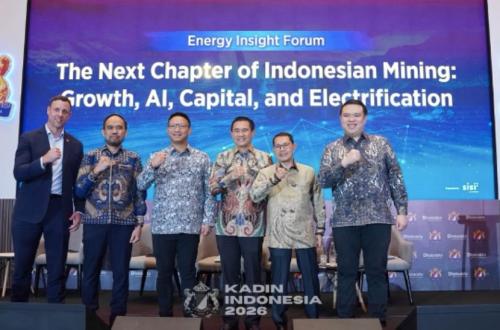
Geopolitical pressures and the volatility of fuel and commodity prices are making mining companies increasingly selective regarding their capital expenditure (capex). This situation is driving the industry to seek new sources of efficiency through the implementation of artificial intelligence (AI), electrification, and technologies capable of enhancing productivity.
These insights were highlighted during the Energy Insights Forum, titled ‘The Next Chapter of Indonesian Mining: Growth, AI, Capital, and Electrification’, held in Jakarta on Wednesday (9/9/2026).
Aryo Djojohadikusumo, Vice Chairman of Kadin Indonesia for Energy and Mineral Resources, stated that global geopolitical dynamics can affect budgets, financial projections, and the business resilience of mining companies, including through changes in fuel prices and availability.
“Many mining companies within the Kadin ecosystem are surviving because they have anticipated the future. What were previously merely pilot projects have now become operational necessities,” said Aryly.
He noted that innovation is a key factor in strengthening mining business resilience against long-term uncertainty. “From what I have observed from mining companies in Indonesia, there is no better way to build long-term resilience and strength than through innovation,” he added.
Dany Amrul Ichdan, Deputy President Director of MIND ID, stated that the implementation of technology in the mining industry must be accompanied by clear execution plans. This is particularly true for technologies such as AI and electrification, which require significant investment and operational adjustments.
“Indonesia can no longer rely solely on resource advantages. We must shift from resource advantage to intelligence advantage. AI is one of the ways to increase economies of scale, productivity, and strengthen industrial competitiveness,” said Dany.
According to Dany, the use of AI should be directed towards operational needs rather than simply following technological trends. MIND ID has begun developing AI applications to improve workplace safety, monitor equipment conditions, and optimise production processes.
Mapping by McKinsey & Company during the forum also indicated a shift in the industry’s growth drivers. Growth is no longer solely dependent on increasing production volumes but is shifting towards value creation through critical minerals, technology, and operational efficiency.
In the session ‘From Volume to Value: Winning the Next Decade of Metals & Mining’, McKinsey & Company Partner Yanto and Associate Partner Narendra Adoe discussed the changing growth drivers in the global mineral industry, including the rising demand for critical minerals.
Yanto explained that fundamental minerals such as coal, copper, and iron ore still play vital roles. However, critical minerals required for new technologies have the potential to become the next major growth source.
“Indonesia possesses immense potential. For the minerals that are already our strength, operational excellence is the key to maintaining fundamental competitiveness. At the same time, we need to invest in competitive downstreaming technologies so that Indonesia can capture greater value from the surge in demand for critical minerals, whether for energy transition, AI, data centres, or other future technological needs,” he said.
Narendra Adoe noted that while Indonesia has a strong mineral resource base and robust upstream and midstream industries, significant value-add opportunities remain throughout the industrial chain.
“This presents an opportunity for Indonesia to expand its role along the value chain, including in critical minerals, where downstream processing capacity is currently dominated by other nations,” he remarked.
In addition to AI, electrification was a key topic discussed. The transition from internal combustion engine (ICE) vehicles to hybrid and electric vehicles is seen as having the potential to reduce fuel consumption while increasing energy efficiency.
However, implementing electrification requires investment in heavy equipment, charging infrastructure, energy storage, and power grids. These challenges are more complex for mines operating in areas with limited electricity access.
Developing renewable energy and microgrids could be an option to support electricity needs in mining operational areas. With this approach, electrification involves not just replacing vehicles, but also ensuring the readiness of the energy systems that support mining activities.
Furthermore, the ‘AI-led Innovation in Mining and Metals’ session featured McKinsey & Company Associate Partner Vivek Jha and Google Cloud Indonesia CTO Sai Prasad Kolluri. The session discussed the application of AI for productivity, efficiency, and decision-making within the mining industry.