
Indonesian Manufacturing Hit by Internal and External Pressures, Industry Ministry Sees Positive Signals
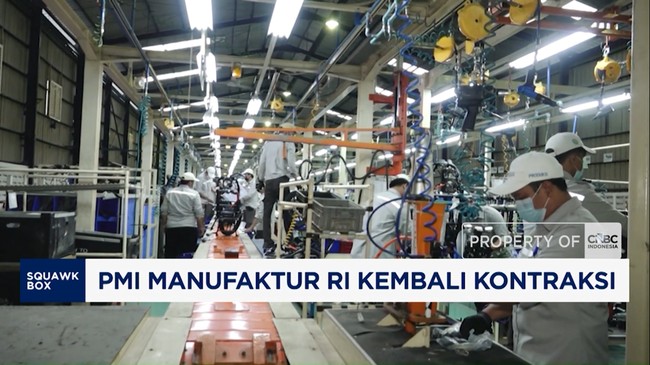
Jakarta - Indonesia’s manufacturing sector contracted in June 2026, with the Purchasing Managers’ Index (PMI) falling to 46.9 from 50.0 in May, according to S&P Global. A reading below 50.0 indicates a contraction in the sector. The decline was triggered by a drop in new orders from both domestic and export markets, which impacted production activity, raw material purchasing, and employment. The data showed a solid deterioration in factory operating conditions, marking one of the steepest declines in a year. S&P Global Market Intelligence Economist Usamah Bhatti noted that the health of Indonesian manufacturing deteriorated twice in the last three months, closing the first half of 2026 on a weak note.
Responding to the conditions, Ministry of Industry (Kemenperin) Spokesperson Febri Hendri Antoni Arief stated that the data highlights challenges the sector must address. He added that the industry is also facing a surge in production costs due to rising raw material prices and a weakening exchange rate, resulting in the second-highest input price inflation since the PMI survey began in 2011. “We must view this condition as a challenge to be answered through strengthening policies to increase the competitiveness of the national industry,” Febri said in a statement on Wednesday (1/7/2026). He explained that the pressure on the PMI in June was largely influenced by weakening demand and rising production costs, and the government’s current focus is ensuring various strategic policies run effectively to ease the burden on industry and revive manufacturing activity.
On the other hand, Febri detailed that national manufacturing performance still shows strong resilience amidst increasing global and domestic challenges. Despite facing production and demand-side challenges during June 2026, industrial activity remained in an expansion phase, reflected by the Industrial Confidence Index (IKI) achievement of 52.90. He acknowledged that this figure slowed by 0.66 points compared to the previous month, but the data shows that business optimism remains intact amid various economic dynamics. “The national manufacturing industry in June faced stronger challenges than the previous month. Challenges not only came from the production side but also began to emerge from the demand side,” he said.
Furthermore, he added that in June 2026, some industries and industrial estates also faced disruptions in the form of power outages that hampered the production process, especially for industries whose operations are fully dependent on electricity supply. “The power outages that occurred in a number of industries and industrial estates caused some companies to halt their production processes during the disruption. This condition certainly affected industrial operational efficiency,” Febri said. “Nevertheless, the industrial sector continues to show strong resilience so that national manufacturing activity still remains in an expansion phase in June 2026.”
Therefore, Febri stated that the government’s move to lower industrial gas prices and maintain the implementation of the Certain Natural Gas Price (HGBT) is a policy that can have a real impact on industrial efficiency in the country. The policy will reduce energy costs for industrial sectors that use natural gas as raw material or a primary energy source. The government decided to lower the price of liquefied natural gas (LNG) for the industrial sector to US$13 per MMBTU from around US$20-23 per MMBTU. Minister of Energy and Mineral Resources Bahlil Lahadalia said this step is to maintain the competitiveness of the national industry while preventing layoffs. “This policy (HGBT) has been felt by business actors and is proven to increase production efficiency and maintain the competitiveness of Indonesian manufactured products. Therefore, the implementation of HGBT needs to be continuously strengthened so that its benefits are optimally absorbed by all recipient industries,” Febri said. He added that the reduction in industrial gas prices from regasified LNG is a breath of fresh air for the industry and is one of the solutions to return the Manufacturing PMI to an expansionary path in the coming months.
Looking ahead, Febri noted that global challenges are becoming increasingly complex, making the need to protect domestic industry more crucial. This protection is not only to maintain business continuity but also serves as a vital instrument to safeguard employment in Indonesia, ensuring job absorption is maintained and the risk of layoffs is minimised. “In a situation where competitor countries are still moving expansively, the Government will not stand idly by. Through cross-ministerial and institutional involvement and collaboration, the Government will continuously strive to create a conducive business climate,” he asserted. He detailed that the Ministry of Industry is accelerating various other strategic programmes, including increasing the use of domestic products, facilitating manufacturing investment, securing the domestic market from unfair trade practices, and expanding export access to non-traditional markets. These policies are directed at maintaining industrial utilisation while increasing the competitiveness of national manufacturing amid global economic dynamics. Febri added that behind the PMI decline in June, the S&P Global survey showed that the level of business optimism regarding business prospects for the next 12 months actually increased compared to the previous month. “This optimism is underpinned by expectations of easing price pressures and improving market demand,” Febri said.