
Indonesian Lecturer Introduces Keris to Chinese Students in Beijing
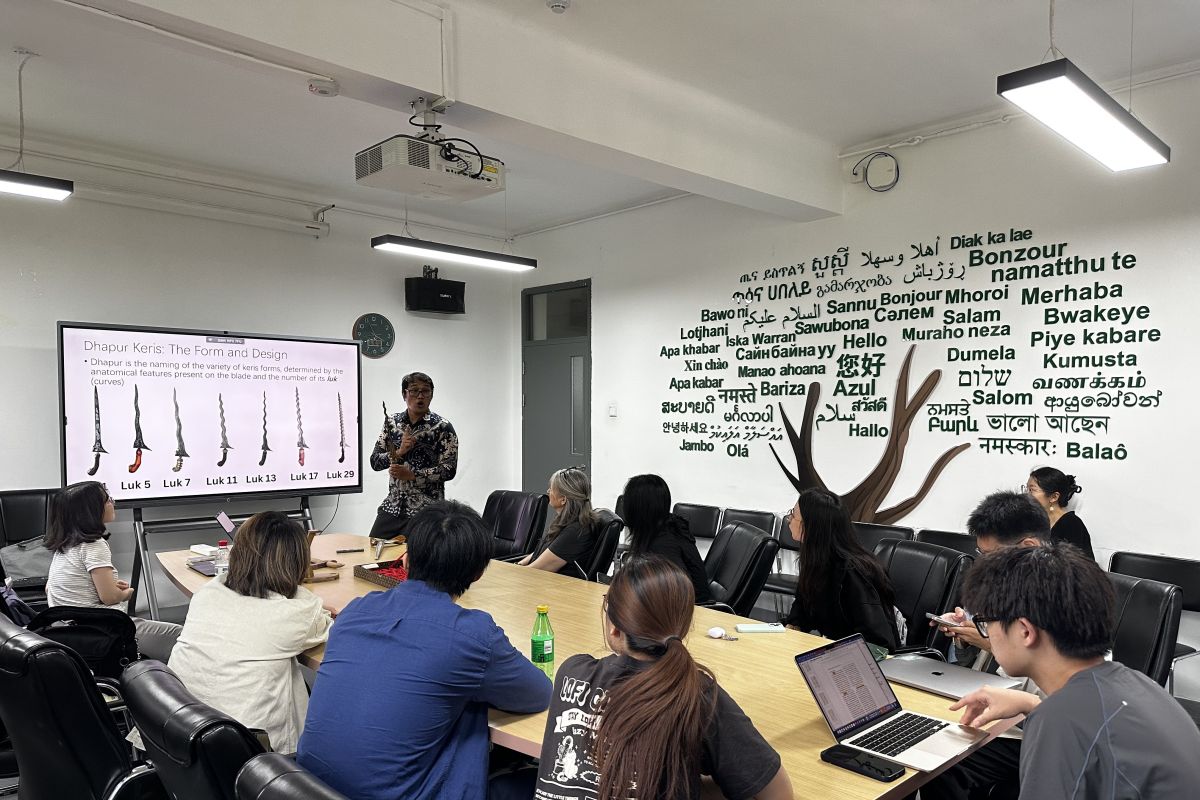
Beijing (ANTARA) - Indonesian language lecturer at Beijing Foreign Studies University (BFSU) Hendy Yuniarto introduced the keris as an Indonesian intangible cultural heritage item to Chinese students through a cultural lecture on campus. “Although the keris is a tangible object, UNESCO included it in the list of intangible cultural heritage. Why? Because the keris is not just an object, but also a skill passed down from one generation to the next,” Hendy said during the lecture attended by 15 participants on Wednesday (10/6). During the 1.5-hour discussion, Hendy displayed two keris blades, one of which was in the Majapahit style, dominated by gold colour and featuring dragon-shaped carvings along the blade. In addition to listening to the presentation, participants had the opportunity to see and touch the keris directly. “The ‘tangguh’ or distinctive style of a keris from a particular period or place holds high economic value and is highly sought after by keris enthusiasts. Majapahit-style keris are generally highly valued due to the fame of the Majapahit kingdom,” Hendy said. He further explained that the keris appears in several reliefs carved on the walls of Borobudur and Prambanan temples, indicating that the keris has been known to the Indonesian people, particularly in Java, for around 1,500 years. Several ancient Javanese manuscripts, such as Kakawin Arjunawiwaha and Kakawin Sumanasantaka, also mention the keris being used as a weapon. Not only does it appear in Nusantara historical records, but the keris is also mentioned in several records by foreign explorers, including from China. According to Hendy, the keris appears in a manuscript titled ‘Yingya Shenglan’ written by Ma Huan in the 15th century, which records Admiral Cheng Ho’s sea voyages stopping at various continents, including several regions in the Nusantara. The manuscript refers to the keris as ‘bu la tou’ or a dagger worn by Javanese people during the Majapahit Kingdom era. It also mentions that males from the age of three up to the elderly would tuck a keris made of steel with intricate decorations into their belts. “The hilt is said to be made of gold, rhinoceros horn, or ivory, carved to resemble a human or supernatural being with very beautiful carvings that demonstrate high skill,” Hendy said. The keris has also entered popular culture through films and games targeting the international market. “The sword used by Raya in Disney’s film ‘Raya’ was inspired by the keris. Additionally, the keris is used as one of the weapons wielded by the main character in the game Diablo 2,” said Hendy, who has been teaching Indonesian in China for 10 years. In his concluding presentation, he explained the functions of the keris in Javanese society, ranging from an heirloom, a weapon, a cultural identity, a symbol of authority and power, a marker of social status, to a medium containing spiritual and philosophical values. During the discussion session, a Chinese student who had previously conducted field research in Luwu, South Sulawesi, expressed admiration for the richness of keris varieties across different regions in Indonesia and noted that female keris makers (mpu) are now emerging on Madura Island.