
Indonesian Iron and Steel Exports Projected at US$28 Billion Amid Global Regulatory Challenges
The national iron and steel industry projects export values to approach US$2cap28 billion in 2025, with primary destinations including China, Taiwan, India, Vietnam, and Italy.
Regarding commodity prices, the supply price of Hot-Rolled Coil (HRC) from Indonesian producers has strengthened to approximately US$525 to US$534 per tonne, Cost, Insurance, and Freight (CFR) Vietnam, for the second half of 2026.
Despite relatively high trade values, the sector faces several external and internal challenges. The European Union’s Carbon Border Adjustment Mechanism (CBAM) presents a tariff barrier related to carbon emission certification for conventional steel products. Additionally, the domestic industry is under pressure from low-cost imports, a dependence on imported raw materials, and weakening demand in certain regions due to global geopolitical tensions.
To mitigate the impact of these global barriers, the government and industry players are focusing strategies on downstreaming, expanding into non-traditional markets, and improving production cost efficiency through the Specific Natural Gas Price (HGBT) scheme. These steps aim to shift the export structure from raw or semi-finished materials towards higher-value-added finished steel products.
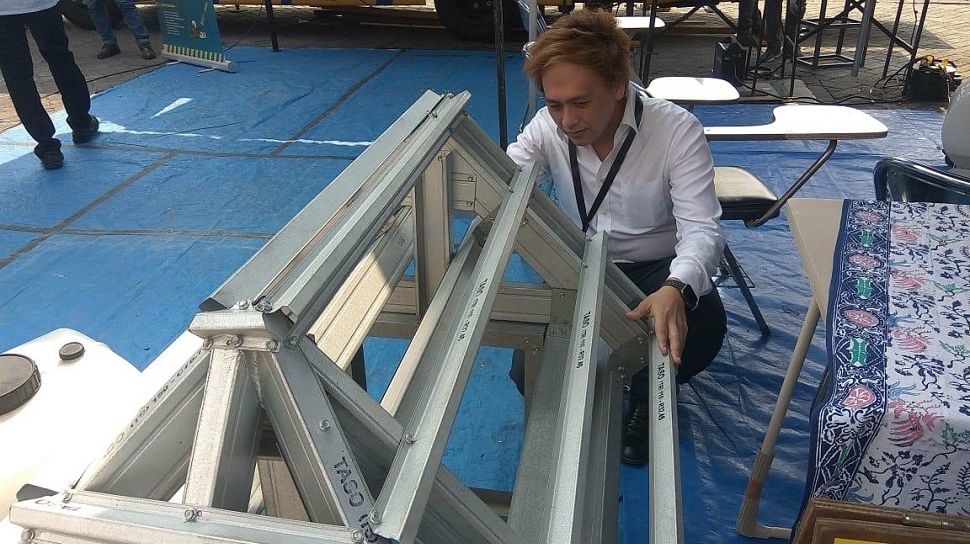
An implementation of this downstreaming strategy is evidenced by PT Auri Steel Metalindo, a domestic investment company located in the Kendal Industrial Park (KIK), Central Java. On Friday, 2 October 2026, the company realised its first export of 60,000 lightweight steel bars to the Australian market. This initial shipment has an estimated annual export potential of 6,000 tonnes, equivalent to a value of Rp132 billion.
Established on 28 September 2016, the company initially operated with a production capacity of approximately 5 tonnes per day for lightweight steel and galvalume roofing, before increasing to 120 tonnes per day by the end of 2022. Alongside this production growth, the company’s investment value has grown from Rp180 billion to Rp1 trillion. This expansion has also led to increased local employment, rising from 7 employees in 2016 to 480 people currently, with a target of 1,500 employees by 2028.
The development of this domestic investment in the Kendal Special Economic Zone (SEZ) has been supported by various ministries and agencies, including the Ministry of Industry, the Ministry of Investment/BKPM, the SEZ Administrator, the Directorate General of Customs and Excise, and the Directorate General of Taxes.
The Director of PT Auri Steel Metalindo, Auripallas Pramana, stated that successfully penetrating overseas markets indicates that the domestic manufacturing industry can meet international technical qualifications. He noted that this achievement proves domestic investment companies in Indonesia can grow and bring local products to the global stage.
The Executive Director of the Kendal Industrial Park, Juliani Kusumaningrum, noted that the shipment of finished steel products provides a positive signal for the structural change of national manufacturing exports, which have long been dominated by primary raw materials. She highlighted that PT Auri Steel Metalindo is the first domestic investment company to successfully export finished steel products abroad, demonstrating global competitiveness and international quality standards.
Responding to these developments, the Directorate General of Metal, Machinery, Transportation Equipment, and Electronics (ILMATE) of the Ministry of Industry reaffirmed the government’s commitment to overseeing downstreaming policies, strengthening the metal industry ecosystem, and expanding market access to increase foreign exchange reserves and the multiplier effect on the national economy.