
Indonesian Horror Films Go International, 'Kuyang' Becomes New Secret Weapon
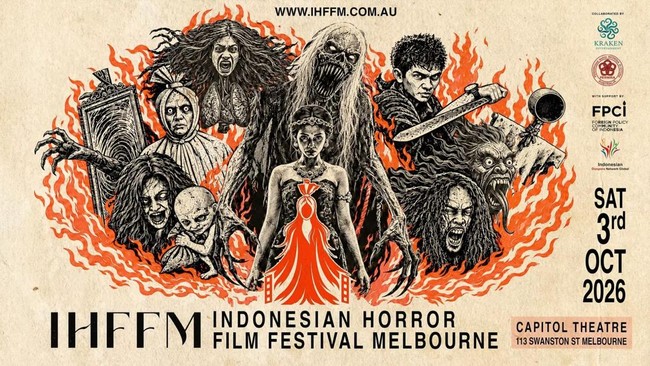
Indonesian horror films may be a staple for domestic audiences, but tales of the ‘Kuyang’ and Nusantara’s mystical rituals are increasingly piquing international interest. The issue is not a lack of demand; industry players note that many overseas audiences and distributors are interested in Indonesian horror but struggle to access these films.
This gap is a primary reason why the Indonesian Horror Film Festival Melbourne (IHFFM) 2026 will be held in Australia on 3 October. Intan Kieflie, a curator for IHFFM and an Australian film industry professional, stated that interest in Indonesian horror has repeatedly surfaced while she was presenting projects to various international film markets.
“I worked as an Indonesian film producer for 15 years before moving to Melbourne. We then opened a company in Australia focusing on Australian films, but with Indonesian backdrops,” Intan said during an IHFFM 2026 press conference in Jakarta on Thursday.
According to Intan, her experience in the industry shows that many global market players are already aware of Indonesian horror. However, one question persists: “There are so many in the market asking, ‘You are Indonesian, why is no one bringing Indonesian horror films to the market?’ even though there is significant interest.”
Intan noted that this situation presents a massive opportunity for Indonesian cinema. International audiences are not merely looking for the same type of horror they are accustomed to, but for stories that offer something different. Indonesia’s strength lies in its local stories, mythologies, and diverse supernatural elements.
For IHFFM, five films with distinct characters have been selected to be introduced to Australian audiences: Malam 3 Yasinan, Kuyang, Sukma, Ritual Gaib, and The Raid. The selection was not based solely on domestic popularity; rather, the curation aims to showcase the various facets of Indonesian storytelling to international viewers.
‘Kuyang’, for instance, was chosen for its strong representation of Kalimantan culture, while ‘Sukma’ was selected for its story and production quality, which are more accessible to international audiences without losing its Indonesian essence.
“Not all box office films are meant to be sold in the same way. All films can be, we just need to find the right audience,” said Intan. She emphasised that the main challenge is not determining whether a film is good or bad, but finding the appropriate market for each work.
She cited the project ‘Ritual Gaib’ as an example, which was created with strong Indonesian cultural elements from the outset. The film follows a family facing ancestral rituals. These deeply Indonesian elements, including ‘ruqyah’ and various religious aspects, did not hinder its international acceptance. Intan noted that the project was presented at several international markets, including the American Film Market, the Middle East, and the Cannes Film Market, eventually securing distribution opportunities in 38 countries.
This experience has driven the IHFFM organisers to bring Indonesian films directly to consumers rather than waiting for foreign distributors to pick them up. The strategy is simple: by creating demand among Australian audiences, they hope to encourage local distributors to seek out more Indonesian works. “We are not forcing distributors to buy our films, but we are creating the demand so that they want to buy them,” Intan added.
From ‘Kuyang’ to mystical horror, Intan noted that Indonesian horror possesses a unique advantage for some Australian viewers. Indonesian horror relies heavily on mythology, supernatural creatures, and cultural or religious elements, which differs from Western horror that often focuses more on thrillers, suspense, or violence. “That is precisely why there is so much interest; they are bored with their own horror and want something different.”
She added that Asian horror already has a dedicated fanbase in Australia, and Indonesian stories have the potential to offer a unique experience through their vast, largely unknown local mythologies and traditions.
Founder of the Foreign Policy Community of Indonesia (FPCI) and the Indonesian Diaspora Network Global, Dino Patti Diliat, views the IHFFM as an example of how the diaspora can help bring the Indonesian creative industry abroad. He believes the diaspora can act as both a bridge and an independent promoter of Indonesian culture.
He appreciated the initiative of the Indonesian diaspora in Australia to organise the festival to promote the creative economy, specifically Indonesian film and horror. “I believe this is something worthy of appreciation, as the diaspora independently has the initiative to promote Indonesia’s creative economy, particularly our films and horror genre,” said Dino.
The IHFFM 2026 will be held in Melbourne on 3 October 2026. The festival targets not only the approximately 20,000 to 25,000 Indonesians living in Melbourne but also the Australian horror-loving community. The festival is designed to be more than just a screening event; organisers have planned a red carpet in Melbourne’s city centre and will feature several Indonesian film industry figures, including Baim Wong, Yayan Ruhian, Wulan Guritno, Hamish Daud, and Shalom Razade.
Source: jawawa.id (https://jawawa.id/newsitem/indonesian-horror-films-go-international-kuyang-becomes-new-secret-weapon-1789665335)
Originally published by CNBC Indonesia (https://www.cnbcindonesia.com/lifestyle/20260917161446-33-768769/film-horor-indonesia-go-international-kuyang-jadi-senjata-baru), translated from Indonesian