
Indonesian Government Saves Rp170 Trillion Through Budget Cuts Last Year, Suahasil Calls It Largest in History
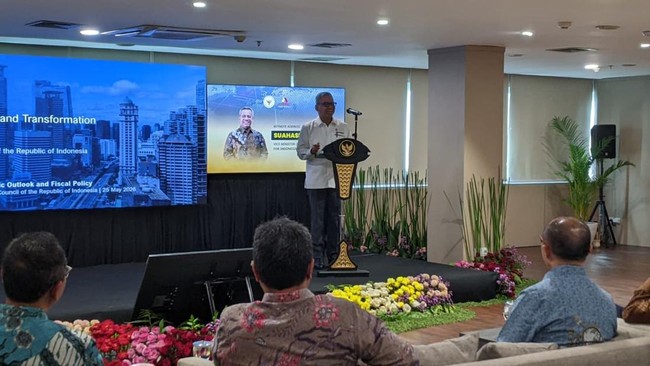
Deputy Finance Minister Suahasil Nazara revealed that last year’s government spending cuts totalled Rp170 trillion, supporting priority programs and social protection for citizens. This represents the largest budget reduction in Indonesia’s history.
Suahasil made the remarks during a presentation at the ASEAN Regional Economic Outlook and Fiscal Policy seminar at the DEN office on Monday, 25 May 2026.
Suahasil explained that the government adopted an adaptive budgeting approach, with one of the boldest measures being cuts to inefficient spending lines.
‘Nearly 9% of the entire budget had to be cut,’ Suahasil said.
Bureaucrats initially reacted, claiming this would halt government operations. However, Suahasil said this did not occur, as the budget became more flexible and adaptable, allowing resources to be reallocated to higher priorities.
‘As seen in the left-hand spending graph’s bottom section, we successfully saved nearly Rp170 trillion (2025 national budget), making it one of the largest budget cuts in Indonesia’s history—second only to the Covid-19 period,’ he added.
His presentation showed that the 2025 national budget target was Rp3,621.3 trillion, with actual spending at Rp3,451 trillion—resulting in savings of Rp169.9 trillion.
Suahasil added that this saving contributed to Indonesia’s 5.11% economic growth in 2025 despite tax revenue falling short of targets. National income recorded a deficit of Rp248 trillion, with actual revenue at Rp2,756.3 trillion.
This year, Suahasil confirmed the government will maintain an adaptive budget framework while keeping the deficit below 3% of GDP.
Similarly, in 2027, President Prabowo Subianto announced in his recent parliamentary address on the Macroeconomic Framework and Fiscal Policy Outline (KEMPPKF) that the budget deficit would be reduced to 1.8%-2.4% of GDP, below this year’s planned 2.68%.
‘We must operationalise these directives, but we are confident we can achieve them,’ Suahasil said.