
Indonesian Envoy at Renmin University Calls for Shared Resilience with China Facing Global Transformation
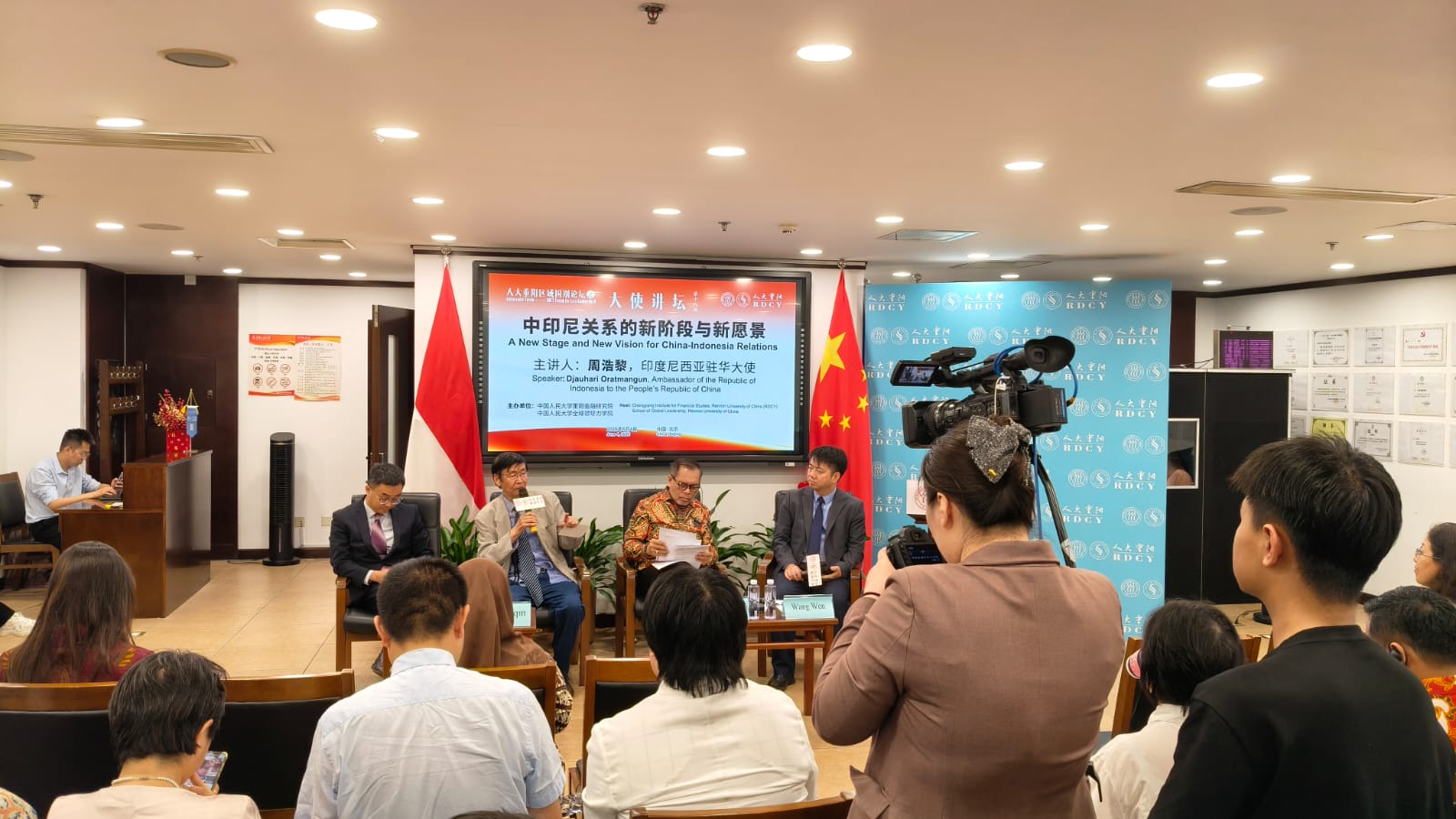
Indonesia’s Ambassador to China, Djauhari Oratmangun, has emphasised the importance of Indonesia and China building shared resilience in facing various global transformations, ranging from artificial intelligence (AI) and energy transition to climate change and geopolitical uncertainty. The message was delivered at the Ambassador Forum, RDCY Forum for Area Studies No. 18, themed “A New Stage and New Vision for China-Indonesia Relations”, organised by the Chongyang Institute for Financial Studies and the School of Global Leadership at Renmin University of China on Thursday (4/6). The ambassador’s presence was welcomed by Vice President of Renmin University of China, Prof. Zheng Xinye, as well as Dean of RDCY and Dean of the School of Global Leadership, Prof. Wang Wen. The forum also featured a number of Chinese experts, including Liu Zhiqin and Luo Yongkun. The public lecture and interactive Q&A session were attended by around 100 participants consisting of academics, students, researchers, business actors, and representatives of various institutions in China, including the Head of the Bank Indonesia Representative Office in Beijing. In his presentation, Ambassador Djauhari said that Indonesia and China have increasingly important roles in shaping the future of the region and the world. “China is the world’s second-largest economy, while Indonesia is the largest economy in ASEAN. Together, the two countries represent more than 20 percent of the world’s population and contribute nearly 20 percent to the global economy,” he said. Ambassador Djauhari also highlighted the strong development of economic relations between the two countries. China has been Indonesia’s largest trading partner for more than a decade and consistently ranks among the top three investors in Indonesia. In 2025, bilateral trade value reached approximately USD 167 billion, while Chinese investment in Indonesia reached around USD 7.5 billion. According to Djauhari, the next phase of Indonesia-China relations needs to focus on four key areas: AI for Development, energy resilience and transition, food security, and human resource development through education, research, student exchanges, and vocational training. During a Q&A session, a participant inquired about the greatest legacy Ambassador Djauhari wished to leave after nearly eight years of service in China. “If there is one contribution I am proud of, it would perhaps be helping to strengthen the habit of dialogue between the leaders of both countries. Because I believe, no matter how strong the challenges we will face in the future, as long as dialogue remains a habit, Indonesia-China relations will remain rational in difference, constructive in challenge, and optimistic towards the future,” the ambassador stated. Concluding his presentation, Djauhari asserted that the main goal of Indonesia-China cooperation is not merely economic growth or technological advancement, but improving people’s welfare. “Technology has value when it can improve human life. Development has meaning when it can expand opportunities. And cooperation will be successful when it can serve humanity,” the ambassador concluded.