
Indonesian Embassy in Seoul Encourages 50,000 Muslim Diaspora to Become Drivers of Sharia Economy
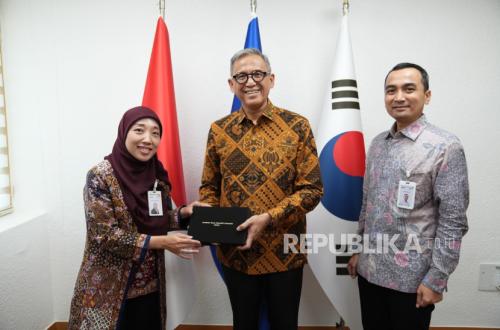
The Embassy of the Republic of Indonesia (KBRI) in Seoul is encouraging the Indonesian diaspora in South Korea to become drivers of sharia economic and financial development. Of the approximately 80,000 Indonesian diaspora members in South Korea, around 40,000 to 50,000 are Muslim.
Indonesian Ambassador to South Korea Cecep Herawan said this number represents significant potential for strengthening the sharia economic ecosystem, particularly through expanding literacy and access to sharia financial services.
“This diaspora population is a potential that exists in Korea. They are not only users of sharia financial services, but can also become agents for the development of the sharia economy and finance,” Cecep said during a meeting at the Indonesian Embassy in Seoul on Friday (28/8/2026).
The meeting involved Bank Syariah Indonesia (BSI), the National Committee for Sharia Economy and Finance (KNEKS), the Imam Foundation, and the Indonesian Preachers Corps.
The meeting discussed the development of Indonesia’s sharia banking industry, the progress of BSI, as well as the opportunities and challenges of developing the sharia economy and finance for the Indonesian diaspora in South Korea.
Cecep said the Indonesian Embassy in Seoul is ready to support KNEKS and BSI in expanding sharia financial literacy while encouraging the availability of sharia financial services that are more easily accessible to the diaspora.
According to him, the Indonesian diaspora not only has potential as consumers of sharia financial services. They can also serve as a bridge between Indonesia’s sharia financial industry and the Muslim community in South Korea.
The embassy also sees opportunities for sharia economic development through the halal sector, which continues to grow in South Korea.
The large flow of foreign tourists is seen as opening a market for various halal services, ranging from food and Muslim-friendly tourism to products and services that support the needs of Muslim travellers.
Data from South Korea’s Ministry of Culture, Sports and Tourism shows the number of foreign tourists visiting South Korea in 2025 is estimated to exceed 18.7 million people.
Cecep believes this market could be an opportunity for Indonesia to take part in developing the halal ecosystem in South Korea.
“Korea can be developed as one of the hubs for halal ecosystem development,” he said.
Meanwhile, BSI sees the Indonesian diaspora in South Korea as a potential market for developing cross-border sharia financial services.
Yosita Nur Wirdayanti, Business Strategy Head of BSI’s Islamic Ecosystem Group, said BSI wants to build long-term relationships with the diaspora through various financial services.
“We want to become a financial partner for the Indonesian diaspora in Korea through remittances, savings, gold investment, hajj savings, and ZISWAF,” Yosita said.