
Indonesian Embassy in Beijing backs education as a channel for China–Indonesia technology transfer
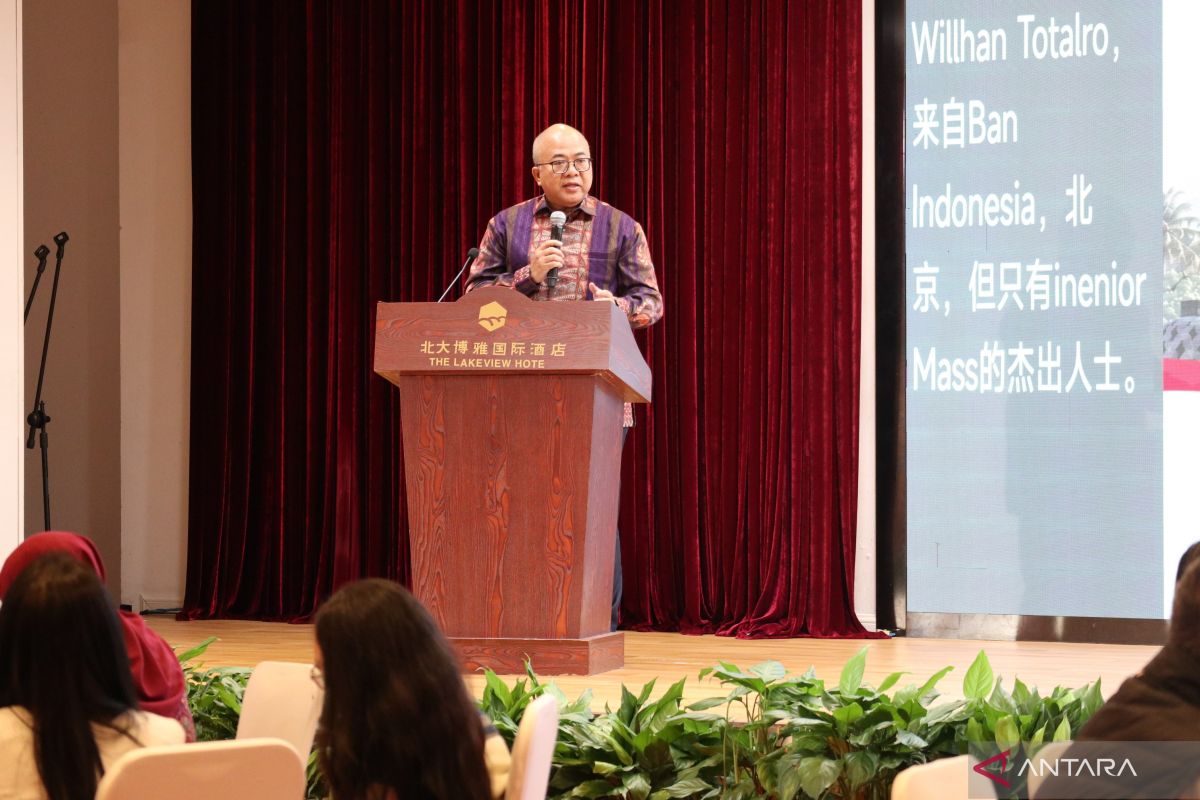
Beijing (ANTARA) – The Indonesian Embassy in Beijing supports using education as a bridge for technology transfer from China to Indonesia.
“Indonesia is pursuing an ambitious development agenda under President Prabowo Subianto, focusing on food and energy security, industrial downstreaming, digital transformation, human-resource development and inclusive economic growth,” Deputy Head of the Indonesian Mission in Beijing Parulian Silalahi said in Beijing on Friday.
Parulian made the remarks at the opening of the Peking University Indonesia Forum (PKUIF), held in Beijing through a collaboration between Peking University’s Institute of Area Studies, the Institute of Indonesia-Malaysia Studies and the university’s Institute of Social Science Survey.
“We hope this partnership will further promote technology transfer, innovation, the creation of quality jobs and sustainable development. Together, we can build more resilient regional industrial networks and supply chains, moving beyond simple commodity trade towards deeper value-chain integration and joint technology development,” Parulian said.
Student exchanges, university partnerships, language programmes and cultural activities, he said, could continue to foster mutual trust between the peoples of the two countries.
“Every partnership has its challenges. Addressing regulatory differences between Indonesia and China, supply-chain adjustments and market expectations requires patience and open dialogue. But gatherings such as this forum are the right place for us to speak openly, get to know one another, listen to each other and turn challenges into practical solutions,” Parulian said.
International Economic Association (IEA) Secretary-General Lili Yan Ing, also speaking at the event, stressed the importance of Indonesia’s integration into supply chains. To date, she said, Chinese investment has brought Chinese brands with it but has not been genuinely integrated into local markets.
“I want to emphasise the importance of China improving market access for Indonesian products in agriculture, seafood, furniture and other small and medium-sized enterprises,” Lili said.
She said it was crucial for China to improve the quality of its investment in ASEAN, including Indonesia, and proposed increasing bilateral foreign direct investment (FDI).
“In particular, I want to emphasise investment in infrastructure, technological advancement, digital infrastructure and green energy. When we discuss digital technology and AI, we are ultimately also talking about energy supplies,” she said.
China, Lili said, has strong capabilities in developing solar panels and hydropower, while ASEAN offers a market. Cooperation could produce mutually beneficial solutions if China invested not only capital but also technology and skills development for ASEAN markets.
Bilateral trade between Indonesia and China has more than tripled since 2015, reaching US$167 billion in 2025 and exceeding US$135 billion by August 2026.
China has also consistently ranked among the top three sources of foreign direct investment in Indonesia, with realised investment reaching US$7.5 billion last year.
Firman Witoelar, a researcher at the Australian National University’s Crawford School of Public Policy, said Indonesia had attracted substantial Chinese investment, most of it in processing industries, including batteries and electric vehicles. By contrast, export-oriented manufacturing investment has been flowing to Indonesia’s neighbouring countries.
“However, the next wave, including labour-intensive industries, electric vehicles and food processing, remains within reach. Whether Indonesia can seize those opportunities depends on whether it gets its policies right. This is an opportunity for both Chinese and Indonesian investors,” Firman said at the event.
He also noted that Danantara could become a major partner in long-term projects, but might also compete in business activities, sometimes in the same sectors.
Although fiscal headroom has narrowed because of various flagship government programmes, Firman said, banks are well-capitalised, public debt is low and inflation is under control, meaning there is no imminent crisis.
In his view, increased government investment in areas previously served by private companies would likely have a greater impact in crowding out private investment than the benefits expected from the increased investment.
“So, where does Indonesia stand today? Indonesia has strong financial foundations, a large domestic market and abundant natural resources. There is no reason to think it cannot recover from external shocks. But current concerns relate to the direction Indonesia is taking and the trajectory of its development,” Firman said.
The forum, titled “Indonesia in Transition: Development, Society and the Regional Order”, was attended by around 50 academics from universities in Indonesia, China, Australia and other countries. It was set to discuss four interconnected areas: politics, the economy, society and regional relations.
Source: jawawa.id (https://jawawa.id/newsitem/indonesian-embassy-in-beijing-backs-education-as-a-channel-for-china-indonesia-technology-transfer-1792169560)
Originally published by Antara (Indonesian) (https://www.antaranews.com/berita/5792493/kbri-beijing-dukung-pendidikan-jadi-media-transfer-teknologi-china-ri), translated from Indonesian