
Indonesian Economy Successfully Navigated Crises from 1998 to Covid, Here is the Secret!
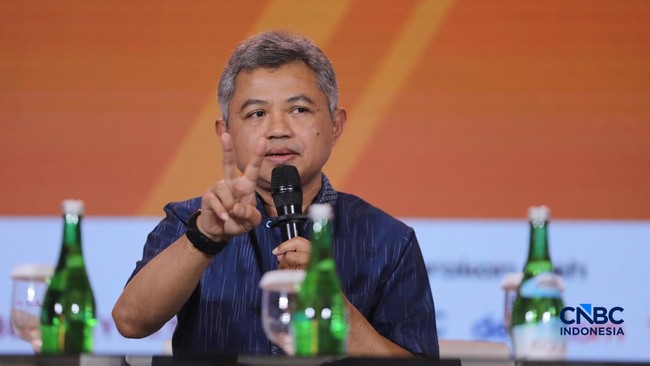
Dody Zulverdi, a member of the Board of Commissioners of the Indonesia Deposit Insurance Corporation (LPS) for Guarantee and Banking Resolution, has revealed the reasons why the Indonesian economy has been able to withstand various crises over the last three decades.
According to Dody, one of the key pillars of Indonesia’s economic resilience is the strength of the banking sector. This is because banks play a vital role in maintaining economic activity, ranging from collecting public funds to providing financing and facilitating payment systems.
“Banks have three major and important functions. First, as a place for all of us to store part of our wealth. We collect money from our income and save it in the bank. This is the most important part,” Dody stated during the Lampung Financial Festival 2026.
The second function, Dody continued, is as a source of financing. He noted that the banking sector remains the most significant source of financing for the Indonesian economy.
“Second, banks are a source of financing. To this day, the most important source of financing in Indonesia still comes from the banking sector. These two functions are interconnected,” he said.
The third function is as a facilitator of the payment system. Dody assessed that economic activity would be difficult to sustain without a banking system that supports payment transactions.
“Third, banks function as facilitators of the payment system. It would be difficult to perform transfers without banks. QRIS is also increasingly used due to the support of the banking sector. Therefore, that is the primary function of banks,” Dody explained.
He noted that a well-functioning payment system allows the public and businesses to carry out daily economic activities, including production, trade, and consumption.
“We can produce, trade, and consume because we can perform payments to one another. That is why banks must be strictly maintained,” he emphasised.
Banks Must Be Trusted
Dody emphasised the importance of maintaining trust in the banking industry. If banks lose public confidence, the impact could spread to financing and overall economic activity.
“If banks cannot be trusted, our entrepreneurs will not be able to obtain financing and the economy could collapse, as happened in 1998. This is why we must safeguard the banking sector,” he said.
He noted that Indonesia has faced various economic pressures over the last three decades, ranging from the 1997-1998 Asian financial crisis and the Covid-19 pandemic to the Russia-Ukraine war and conflicts in the Middle East.
However, these various shocks have not led to an Indonesian economic collapse similar to the 1998 crisis.
“Over the last three decades, we have experienced the 1997-1998 global financial crisis, the Covid-19 pandemic, the war in Russia, and the conflict in the Middle East. So, why could our economy survive and not collapse? Because our banks are strong,” Dody revealed.
Therefore, according to Dody, maintaining banking stability is crucial for preserving national economic resilience. This also forms part of the LPS mandate to maintain public trust in the banking system.
“That is why banking is so important, and that falls within the role of the LPS,” he concluded.
Source: jawawa.id (https://jawawa.id/newsitem/indonesian-economy-successfully-navigated-crises-from-1998-to-covid-here-is-the-secret-1788670473)
Originally published by CNBC Indonesia (https://www.cnbcindonesia.com/market/20260906105915-17-765438/ekonomi-ri-sukses-lewati-krisis-98-hingga-covid-ini-rahasianya), translated from Indonesian