
Indonesian Doctor Develops AI to Help Detect Early Heart Failure
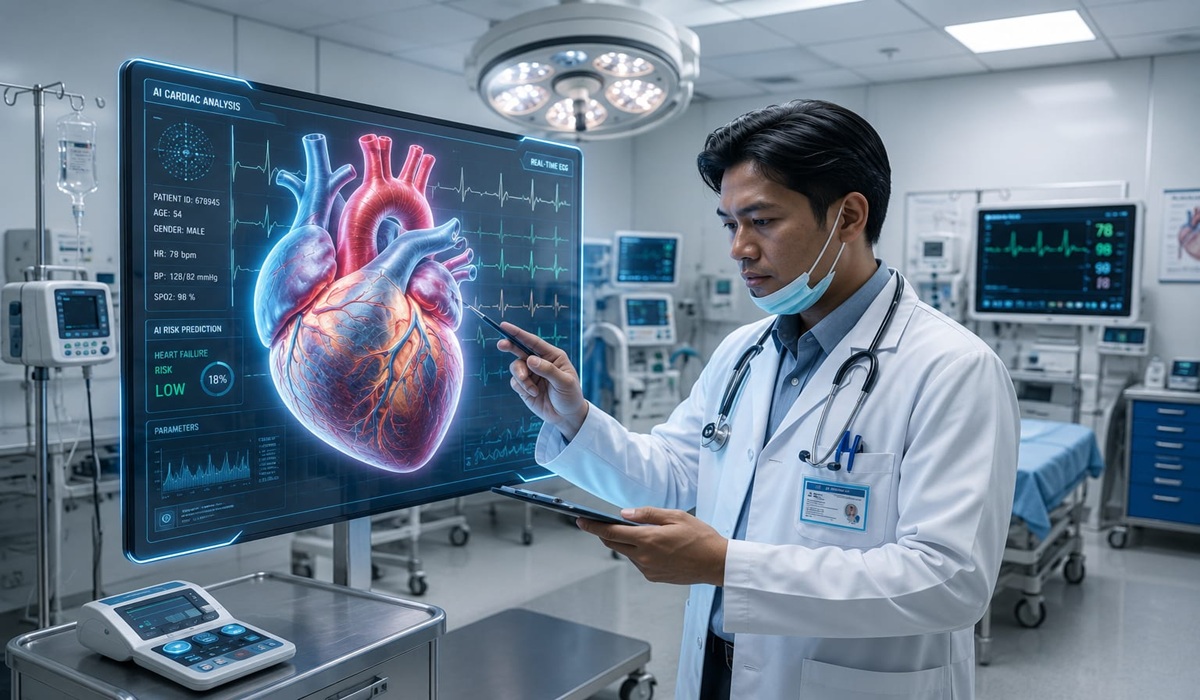
A cardiologist has developed artificial intelligence (AI) technology with the potential to help detect the risk of deterioration in heart failure patients at an early stage. The technology, named Novel Auscultation Device of Artificial Intelligence for Heart Failure (NAVI-HF), is expected to serve as a tool to assist medical staff in deciding how to manage patients before they are discharged from hospital.
NAVI-HF was developed by Dr dr. Rony M. Santoso, Sp.JP, Subsp. K.I.(K), FIHA, a cardiologist and vascular specialist at Primaya Hospital Tangerang.
The development of the technology formed part of his doctoral research at the Faculty of Medicine, Universitas Indonesia (FKUI). Unlike a conventional stethoscope, which relies on a doctor’s listening skills, NAVI-HF uses an AI algorithm to analyse patients’ lung sounds.
The technology is designed to detect signs of fluid accumulation, or pulmonary congestion, a condition that is often difficult to identify through ordinary physical examination.
Pulmonary congestion is one of the main reasons heart failure patients require repeat treatment after being discharged from hospital.
The condition frequently produces no clear symptoms, so there is a risk that it is detected too late. With the help of AI, medical staff are expected to identify high-risk patients more quickly.
The way NAVI-HF works is relatively simple. The device records the sound of a patient’s chest from five examination points for approximately one minute.
The recording is then processed using an AI algorithm capable of recognising certain sound patterns as indicators of pulmonary congestion. The analysis results provide doctors with additional information to determine the patient’s condition. In a study involving 246 patients with acute heart failure, NAVI-HF showed promising results.
Compared with lung ultrasound examination, the technology achieved an accuracy of around 86 per cent, sensitivity of 91 per cent, and specificity of 82 per cent. A six-month follow-up study showed that patients with a positive NAVI-HF result had roughly 1.6 times higher risk of heart failure readmission than patients with a negative result.
Nevertheless, the developer stressed that NAVI-HF is not designed to replace the role of doctors in making a diagnosis. The technology functions as an aid to speed up the identification of high-risk patients. Going forward, NAVI-HF has the potential to support telemedicine services and home-based patient monitoring, thereby improving the quality of heart failure care in Indonesia.