
Indonesian Consumers Grow Pessimistic About Job Prospects, Call for Internship and Cash-for-Work Programmes
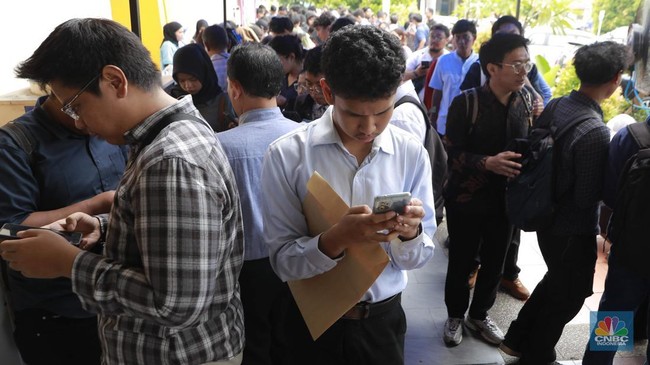
Jakarta, CNBC Indonesia - Indonesians are increasingly pessimistic about finding employment, according to a component of the Bank Indonesia (BI) Consumer Confidence Index (IKK). The Job Availability Index (IKLK) fell to 105 in the latest data, down from 108.8 the previous month. This decline was accompanied by a drop in the Current Income Index (IPSI), which fell to 123.2 from 128.1. The overall Consumer Confidence Index (IKK) for May 2026 consequently slipped to 120.9 from 123, driven by a decrease in the Current Economic Conditions Index to 112.2 from 116.9, while the Consumer Expectations Index remained relatively stable at 129.7 from 129.6.
Deni Friawan, a senior researcher at the Centre for Strategic and International Studies (CSIS) economics department, explained that the government could address this issue with short-term assistance, such as cash-for-work programmes. “So it helps open up employment for labour-intensive work, for example, cash-for-work,” Deni told CNBC Indonesia on Thursday (18/6/2026). He also noted that programmes like the internship hub or national internship, which was launched last year for fresh graduates and paid at the regional minimum wage (UMR) by the government, are needed again by the public. “I think that’s also good. So they are given an internship, but paid by the government. That’s two benefits. They gain experience, and they also get money to help with purchasing power,” he explained. “So it addresses the demand side and also adds production capacity on the supply side. That’s what I think if you don’t want to just help from the demand side,” he stressed.
A similar view was expressed by M Rizal Taufikurahman, Head of the Macroeconomics and Finance Centre at the Institute for Development of Economics and Finance (Indef). However, he emphasised that to solve this perennial problem, the government must structurally improve Indonesia’s economic conditions. “The government must strengthen investment and the real sector through regulatory certainty, accelerating productive projects, and supporting industry and MSMEs so they can create new jobs,” he stated. He stressed that with this strategy, the foundation of Indonesia’s economic growth will become stronger and more resilient to various global and domestic pressures. “The government’s main focus must shift to job creation, accelerating investment, strengthening the industrial sector and MSMEs, and increasing productivity. Ultimately, healthy consumption is consumption supported by rising public incomes, not by continuous government assistance,” Rizal said.
For context, the government previously confirmed that the national internship programme will continue. Coordinating Minister for Economic Affairs Airlangga Hartarto stated that the programme will be rolled out again starting this month. “The middle class, one of the internship programmes we are pushing again in June,” Airlangga asserted. Besides gaining direct work experience, internship hub participants also have the opportunity to receive mentor guidance, competency development, periodic evaluation reports, and an allowance equivalent to the Provincial Minimum Wage (UMP). The Ministry of Manpower (Kemnaker) is currently proposing the implementation of the fourth wave of the National Internship programme to President Prabowo Subianto. The programme is targeted to accommodate up to 150,000 participants. Kemnaker Secretary General Cris Kustandi said the financing discussion process is still ongoing at the State Secretariat. If it proceeds according to plan, the registration process could begin in July 2026. “For this year, we have proposed it to the President and it is currently being processed at the State Secretariat for financing. The target is 150,000 participants and hopefully it can proceed, at least starting the process in July,” Cris said, as reported by detik on Wednesday (10/6/2026).