
Indonesian Consulate General in Shanghai and Knowledge Diplomacy for Indonesia
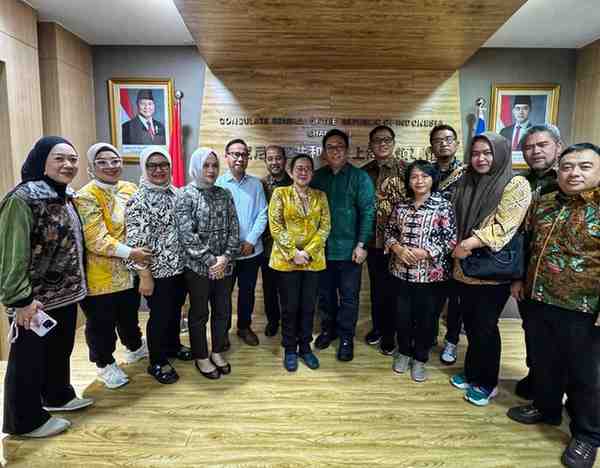
The visit by a delegation from the Institut Pemerintahan Dalam Negeri (IPDN) to the Konsulat Jenderal Republik Indonesia (KJRI) Shanghai offers important lessons on how Indonesia’s diplomacy now operates far beyond ceremonial and protocol functions. Amid China’s rapid transformation, particularly in Shanghai as one of the world’s economic and technology hubs, Indonesia’s overseas representations bear increasingly strategic roles: safeguarding national interests through economic diplomacy, trade, investment, education, and research and technology cooperation.
The IPDN Strategic Studies Delegation, led by Vice Rector Prof. Hyronimus Rowa and Postgraduate Director Prof. Muhadam Labolo, was directly received by the Consul General of the Republic of Indonesia in Shanghai, Berlianto Situngkir. The meeting was not merely an institutional visit agenda but became a vital space for dialogue on how Indonesia must read global changes more strategically.
In the midst of increasingly tight global economic competition, KJRI Shanghai actually plays a far more complex function than just consular services. It has become a nexus of Indonesia’s national interests in one of Asia’s most dynamic regions. From this representative office, trade diplomacy, investment, education, culture, and industrial networks are implemented in concrete and measurable ways.
For IPDN students, this experience should be understood as part of broader civic education. Future government apparatus must not only understand public administration and domestic governance but also possess a global perspective on how a country builds influence and competitiveness through diplomacy.
The world today moves in a competition determined by the quality of human resources, mastery of technology, innovation capabilities, and the capacity to build international networks. Successful countries are not only those with vast resources but also those able to connect diplomacy, industry, academia, and research in one direction of national development.
In the forum with KJRI Shanghai, there were several strategic agendas worth noting.
First, the importance of promoting quality investment for Indonesia. Investment is no longer sufficiently measured by the size of the capital entering but by how far it brings technology transfer, job creation, enhancement of national industrial capacity, and strengthening of the domestic production chain. In this context, Indonesia’s economic diplomacy must become more selective and based on long-term interests.
Second, strengthening trade, education, and culture as interconnected instruments of foreign relations. Modern diplomacy no longer stands on one sector alone. Cultural products, academic cooperation, and human exchanges now form important parts in building a country’s influence.
Third, developing the creative economy and digital economy as future sectors that need to be prioritised in Indonesia’s diplomacy. Shanghai demonstrates how technology, innovation, and creativity can become a new growth engine for a country. Indonesia has great potential in this sector but requires human resources and an ecosystem capable of competing globally.
Fourth, utilising trade hubs like Yiwu as access for Indonesian MSME products and home industries. So far, many Indonesian MSME actors have faced limitations in accessing international markets. However, global trade networks like Yiwu can serve as an important gateway for local Indonesian products to enter the world market.
Fifth, strengthening the existence of Indonesian companies in China as proof that Indonesia truly has the capacity to compete in the global market. The presence of various national companies in Shanghai shows that Indonesia’s economic diplomacy is beginning to move from mere promotion to strengthening the position of national businesses abroad.
In the banking and finance sector, for example, Bank Mandiri has a full branch office in Shanghai that serves trade transactions and corporate financing between Indonesia and China. Bank Negara Indonesia (BNI) is also present through a representative office to support project funding, remittance services, and business activities of Indonesians in the region. The presence of this banking sector is important because it becomes strategic infrastructure for Indonesia’s economic expansion in the Chinese market.
In the consumer goods sector, Mayora Group through Mayora Shanghai has successfully expanded the penetration of Indonesian products in the Chinese market. Products like Kopiko have even developed into one of the globally recognised brands there. Indofood is also strengthening the distribution of Indomie and various other food products in the Shanghai and East China regions. Meanwhile, Kapal Api is beginning to expand its packaged coffee distribution network and market penetration in the urban lifestyle in Shanghai’s trading centres.
The presence of these companies shows that Indonesia is not only present as a raw material supplier but is beginning to enter the global value chain through consumer products with strong brand identities.
In the investment and property sector, Royal Golden Eagle (RGE) Group owned by Sukanto Tanoto is even conducting strategic expansion through the acquisition of premium property assets like Wanda Reign on the Bund in Shanghai. This step shows that Indonesian companies are beginning to appear as global players capable of international-scale investments.
Meanwhile, in the fisheries sector, PT Perikanan Indonesia (Perindo) is expanding export cooperation for marine products with local partners like Shanghai Seafirst Co., Ltd. This collaboration opens greater opportunities for national fishery products to enter China’s vast market.
Beyond these companies,