
Indonesian Composite Index Rises on Strong Domestic Foreign Exchange Reserves Data
The position of foreign exchange reserves can offset external debt payments and interventions as efforts by Bank Indonesia to maintain the stability of the Rupiah exchange rate.
Jakarta (ANTARA) — The Indonesia Stock Exchange’s Composite Index (IHSG) moved higher on Tuesday morning, supported by strong domestic foreign exchange reserves data for August 2026.
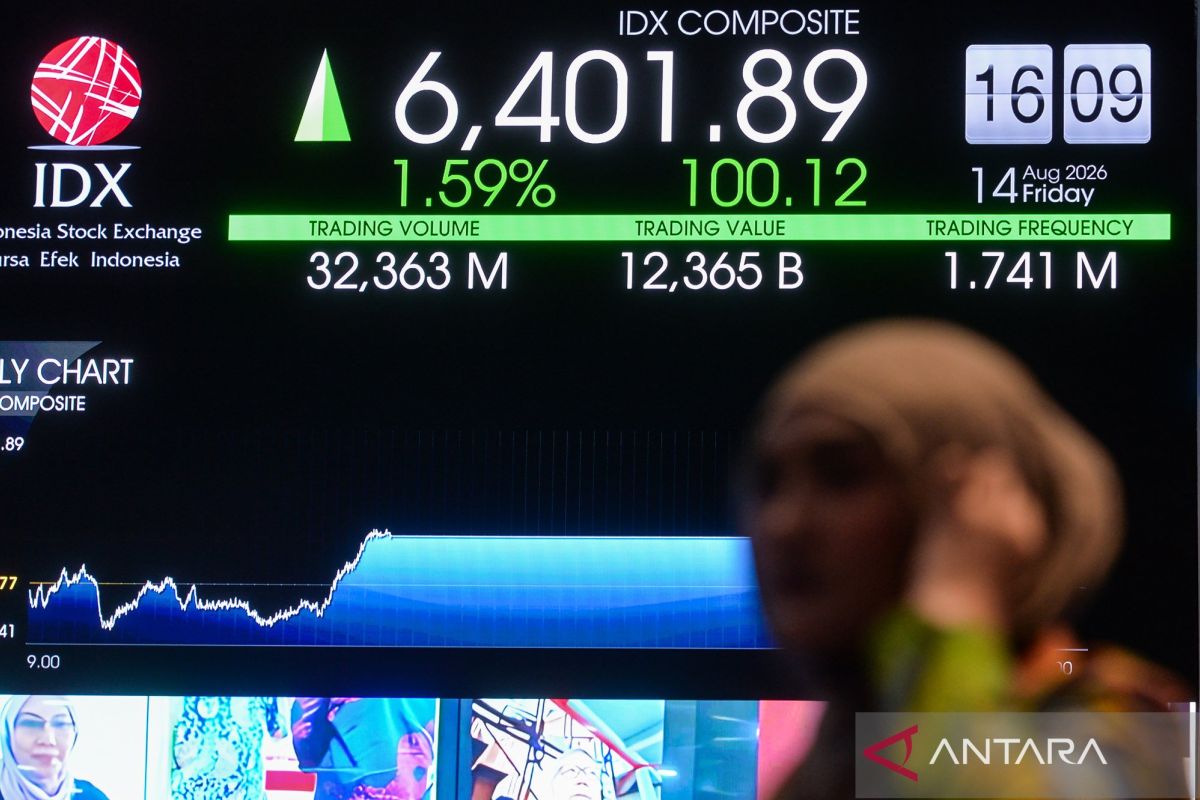
The IHSG opened up 19.84 points, or 0.30 per cent, at 6,639.51. Meanwhile, the group of 45 leading stocks, or the LQ45 Index, rose 1.31 points, or 0.20 per cent, to 657.73.
“The position of foreign exchange reserves can offset external debt payments and interventions as efforts by Bank Indonesia (BI) to maintain the stability of the Rupiah exchange rate,” said Ratna Lim, Head of Research at Phintraco Sekuritas, in her note in Jakarta on Tuesday.
Domestically, Indonesia’s foreign exchange reserves recorded an increase to US$146.5 billion in August 2026, up from US$145.3 billion in July 2026 — the highest level since March 2026 — driven by higher tax and services receipts, as well as the withdrawal of government external debt.
The reserves position covers 5.4 months of imports, or 5.3 months of imports plus payments of the government’s external debt, and is above the international standard of three months of imports.
On the other hand, additional budget requests from ministries and agencies (K/L) for 2027 reached almost Rp1,000 trillion, but the government cannot meet all of these requests due to limited fiscal space.
The value of these requests exceeds the additional ministry and agency spending budget that has been agreed upon at Rp9.1 trillion. The government needs to improve budget efficiency so that the budget deficit does not exceed what has already been set.
From the Asian region, investors will be watching China’s trade data on Tuesday (8/9), which is expected to grow 25 per cent year on year (yoy) in August 2026, up from 23.9 per cent (yoy) in July 2026.
Import growth is also expected to rise to 30 per cent (yoy) in August 2026 from 27.5 per cent (yoy) in July 2026, in line with continued strong demand for AI-related technology products.
In addition, investors will be watching China’s inflation data on Wednesday (9/9), which is expected to increase to 0.3 per cent month on month (mtm) in August 2026, from a previous 0.1 per cent (mtm) deflation in July 2026, bringing the annual figure to an expected 0.8 per cent (yoy) from 0.5 per cent (yoy) previously.
From Europe, investors are anticipating a 25 basis point increase in the European Central Bank’s (ECB) benchmark interest rate on Thursday (10/9), triggered by Eurozone inflation data rising to 3.3 per cent in August 2026, caused by a 14.3 per cent increase in the energy component.
Internationally, tensions between the United States and Iran are escalating, after the Speaker of Iran’s Parliament warned of potential attacks on US energy companies should Iranian assets be attacked.
The escalation followed the US attacking and disabling three Iranian oil tankers, while Iran signalled plans to establish a prohibited zone around the Strait of Hormuz. Reduced vessel traffic on this strategic route has increased the risk of disruption to global oil supplies.
Meanwhile, stronger US labour data is an important factor in determining the direction of The Fed’s policy in September 2026.
European stock markets moved mixed on Monday (7/9): the Euro Stoxx 50 gained 0.17 per cent, the UK’s FTSE 100 index fell 0.08 per cent, Germany’s DAX index weakened 0.15 per cent, and France’s CAC 40 index rose 0.33 per cent.
Meanwhile, Wall Street was closed on Monday (07/09) in observance of Labour Day.
Regional Asian stock markets this morning included the Nikkei index up 0.31 per cent at 66,605.00, the Shanghai index up 0.29 per cent at 3,944.19, the Kospi index up 1.69 per cent at 7,113.46, the Hang Seng index down 0.70 per cent at 25,236.00, and the Straits Times index down 0.59 per cent at 5,759.24.