
Indonesian Beaches Often Become 'Graves' for Whales, UGM Expert Reveals Danger Alarm
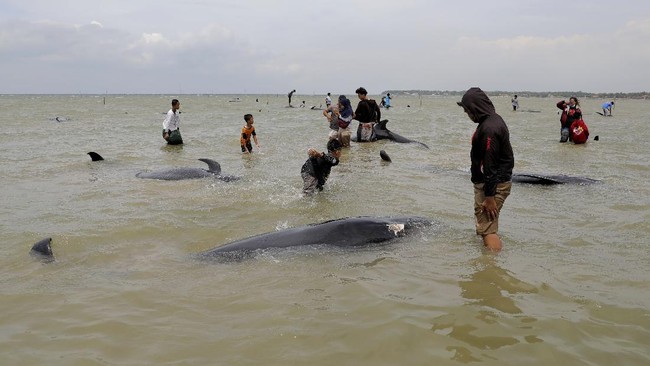
Jakarta, CNBC Indonesia - Dozens of pilot whales found stranded on the shores of Mbadokai Beach, Deranitan Village and Fuafuni Village, Southwest Rote, Rote Ndao, East Nusa Tenggara (NTT) on Monday (9/3/2026) shocked local residents.
According to the Universitas Gadjah Mada (UGM) website, out of a total of 55 pilot whales that stranded, 21—including 4 calves and 17 adults—were found dead. The remaining 34 were successfully herded back to the sea.
A lecturer from UGM’s Faculty of Biology, Akbar Reza, expressed his concern over the dozens of pilot whales that died after stranding. Pilot whales are animals with full conservation protection status.
Based on the International Union for Conservation of Nature (IUCN), there is no global population data available.
“If we look at the IUCN data, we don’t have global population data, so we don’t know whether their population is increasing, decreasing, stable, or what,” Akbar said, quoted on Friday (3/4/2026).
Akbar highlighted that this incident serves as an alarm for ecological disturbances in the surrounding waters, especially since it is not the first time it has occurred.
In 2024, 50 pilot whales stranded in Alor. Previously, in 2020, 11 pilot whales stranded in Sabu Raijua, or 52 pilot whales stranded in Madura.
“Indeed, this has happened several times, but just because it happens often doesn’t mean it’s natural,” he explained.
Akbar added that these incidents repeatedly occur in the NTT area, the Savu Sea, and around western Kupang, because this region is an annual migration route.
They migrate from the south in the early to mid-year. From Australia near the cold Antarctic, they seek warmer tropical waters.
In addition to pilot whales, collaborative research from BRIN and James Cook University, Australia, reveals that from the 1990s to 2021, more than 20 species of whales and dolphins have stranded in Indonesian waters.
“And other types that have also been recorded, for example, bottlenose dolphins. Then, three years ago, there were also three large blue whales that stranded dead. There were also dugongs, whale sharks—the large whales that often strand in Yogyakarta at the end and beginning of the year, which have also been recorded there,” he explained.
To determine the exact cause of why these marine animals strand, Akbar explained that further dissection or necropsy is needed. Similar to how humans conduct autopsies to determine the cause of death.
Akbar revealed that there are several factors that can damage whale organs. For example, overlap with activities that also emit sound waves, as well as organ damage caused by parasites or environmental pollution, such as plastics, fishing nets, or ship debris.
Meanwhile, the overlap with waves from activities like heavy shipping, seismic surveys, earthquakes, or oil and gas exploration using sonar.
“This condition is what causes these whales to strand,” he said.
Additionally, some locations in NTT have muddy and sandy substrates, which make the reflection of these waves weaker than if the substrate were hard, such as coral and rocks.
“Well, related to damage to the echolocation organ, this can certainly worsen, because if it’s damaged when the pilot whale or similar whale moves to shallow areas, it won’t know if it’s already shallow or still deep. It’s like the sensor is broken. It doesn’t know, and ends up stranding,” he explained.
Furthermore, pilot whales are animals that live in groups. The leader whale, which is an adult female, when facing difficulties like getting lost, will certainly affect the other group members.
Pilot whales are also sensitive to environmental changes, such as water pollution, heavy metals, even solar storms. To ascertain this precisely, a necropsy is required; otherwise, it remains speculation.
“Indeed, the biggest suspicions are due to noise pollution, water contamination—the water quality could be poor, or there is plastic, or fishing nets and other debris,” he said.