
Indonesian Barbershop Owners Face New Phenomenon as Conditions Shift Drastically
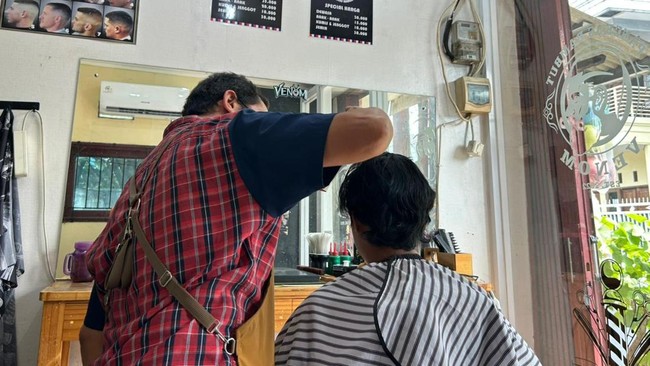
The barbershop or hair-cutting business is known as a timeless trade, as the service remains a necessity for the public. However, a new phenomenon has recently emerged in the industry, closely linked to Indonesia’s still-challenging economic conditions. Business owners acknowledge that whilst customers still come in daily, the numbers are unpredictable. They even admit that their shops are only busy during certain moments, such as ahead of the Eid al-Fitr holiday and the new school year.
Diana Ganefa, owner of Gamma Barbershop, said she started her business three years ago after seeing that opportunities in the hair-cutting business remained wide open. She also hopes that getting a haircut can become a routine need for people. “Opportunities in this business are still open; the hope is that getting a haircut becomes a routine need for the Indonesian people,” she said when contacted by CNBC Indonesia on Tuesday (7/7/2026). However, the number of customers at her barbershop in South Tangerang is currently still erratic. On a single day, the barbershop serves as few as around 2 people and as many as about 15 people. Diana assesses that her barbershop tends to be busy only at certain moments, such as weekends, ahead of Lebaran, and during the new school year.
Moving to the Mampang Prapatan area of South Jakarta, an employee and manager of a barbershop, Ibrahim, also acknowledged that customers come every day, but the numbers are inconsistent. His shop is usually busy on weekends or after working hours past 3 p.m. “Alhamdulillah, there are customers every day, people come to get a haircut. We have had 20, but it’s rare. On normal days, though, we get about 3 to 5 heads,” he said. Ibrahim explained that an adult haircut is priced at Rp35,000, a child’s cut at Rp25,000, and a beard trim at Rp10,000. He noted that the characteristics of the barbering business are clearly different from food businesses, which are a daily necessity. People’s habits for going to the barber vary, although some feel the need to cut their hair every few months. Moreover, rising prices of basic necessities have made many people more cautious with their spending, including on haircuts. Ibrahim hopes economic conditions will stabilise so that everyone can meet their needs, including getting a haircut. For now, he relies on customer loyalty and whoever needs a trim. “Just normal, that’s it. We are just ordinary people, we don’t ask for much. Just standard, normal prices,” he said.
Moving to the Tebet area of South Jakarta, an employee of Asgar (Asli Garut) barbershop, Deni, admitted that a downward trend in customers is more noticeable compared to last year. At certain operating hours, only one customer might come in. “When it’s busy, we can get nine to 15 people. But when it’s quiet, only three. Today alone, up to this hour, there’s only been one customer,” he said. This is despite the relatively cheap rates offered, with adult haircuts priced at Rp20,000, children’s cuts at Rp15,000, beard trims at Rp7,000, and hair colouring at Rp50,000. According to Deni, the growing number of competitors has spread the customer base, affecting the number of visitors to his shop. Additionally, some customers are now reluctant to queue and prefer to find an empty barbershop. Deni also believes that weakening purchasing power has influenced customer numbers at his workplace. “Compared to last year, it feels like a decline. The economic situation has an effect too,” he said. As a migrant from Garut, West Java, with school-age children, Deni hopes the economic situation in the country will improve soon so that people have a greater capacity to spend, including on haircuts.
The stories from Diana, Ibrahim, and Deni show that barbershop businesses can still survive because they offer a service that people need. However, the frequency of customer visits appears to be changing. Where haircuts were previously done more routinely, some people are now holding back on visits as a way to adjust their daily spending. This situation makes barbershop revenue increasingly dependent on seasonal moments. Consequently, these barbers hope for economic stability so that people no longer postpone their haircuts.